Caring for a Rescued Horse: Feeding, Health, and Handling
Casey Wilson
Bringing Home a Rescue Horse
Horses suffering from neglect or abuse can be found in many places, and auctions are a common destination for them. Auctions operate in every state, and depending on the location, they may be held weekly, monthly, or even daily. If you are looking for a horse, consider attending an auction—horses do not need to have perfect pedigrees or registration to make wonderful companions. By purchasing a horse at auction, you may be saving it from being sent to slaughter and ending up on someone’s dinner plate in Belgium.
Equine rescues across the United States are growing in number, but most operate with limited funds and resources to buy and care for horses in need. Because of this, many rescues cannot take in every horse that requires help. You can make a difference by going to an auction and bringing a horse—or several, if you have the space and means—home with you.
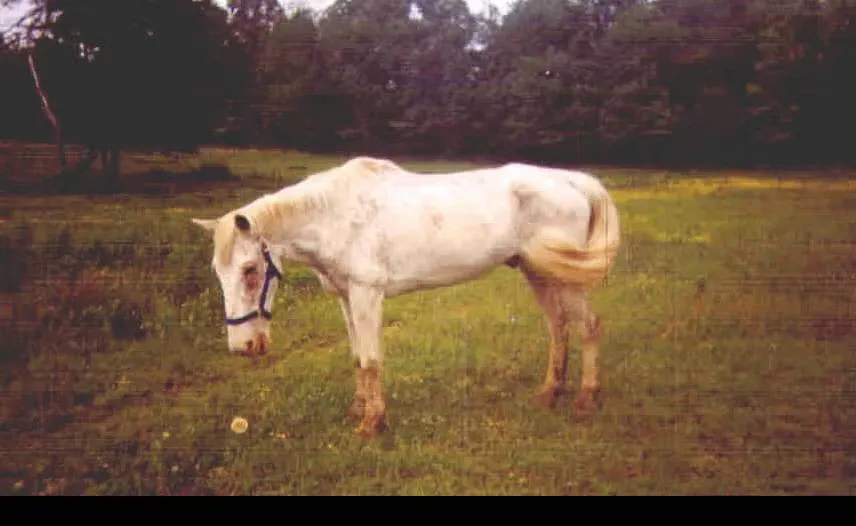
Shonac, pictured two weeks after rescue, still looks thin but has improved significantly and is recovering from a fungal skin condition.
Common problems in rescue horses include overgrown hooves, founder, and malnutrition.
How Rescue Horses Differ
Rescue horses often require different care than horses that have been properly managed. They may have gone without adequate nutrition and veterinary care for extended periods, which can disrupt their metabolic and digestive systems.
Coat and Hooves
They may carry diseases or internal parasites. In many cases, they have received no proper hoof care and are at risk for founder and other hoof issues. Their teeth almost always need floating or other dental work, especially in older horses. Skin problems are also frequent, with fungal infections being particularly common. Prompt evaluation by a qualified veterinarian is essential, along with special care to restore health without overwhelming their systems.
Feeding a Rescue Horse
The first instinct may be to “feed the horse up.”
That is the wrong approach!
It is actually the worst thing you can do. The key principle is that any dietary changes must be made gradually and in very small steps.
If the horse is kept in a stall or dry lot, provide free-choice access to fresh, clean grass hay (not alfalfa) and water at all times. These two staples can be offered without restriction.
However, when it comes to grain, feed only one very small handful of a complete pelleted feed three to five times per day. Giving more can lead to colic. A feed with 10–11% protein is sufficient.
After about a week, if the horse shows no signs of distress, increase the grain to 1/2 pound three times daily until you reach the amount your veterinarian recommends as a normal daily intake for that horse.
If the horse continues to tolerate the changes, the total daily ration can be increased by one pound every 10 days. For a senior rescue horse, use senior pellets rather than regular feed, as regular feed is too hard on their digestive systems.
Recovery from malnutrition takes time. Do not get discouraged. It may take up to a year for the horse to reach good health. Often, though, you will see a marked improvement within a week or two. After that, progress is slow. Remember that it took the horse a long time to reach its current condition.
Health and Quarantine
A newly rescued horse should always be quarantined. If the horse is carrying diseases or parasites, you do not want to expose any other horses you own. Quarantine generally lasts at least two weeks.
Strangles (Streptococcus equi) has an incubation period of 10 days before signs of infection appear. It is better for the rescued horse to be kept separate from other horses during its recovery to reduce stress from competing for food, establishing herd dominance, and similar pressures.
The horse should have a Coggins test, and you should wait for negative results. Results may take a few days to come back. At auctions, a veterinarian is supposed to be present to certify that horses are Coggins negative. Before taking a horse home, ask to see a negative Coggins certificate. It is always best to be cautious.
Keep the horse as clean, dry, and comfortable as possible. Make sure the first thing you do is call your veterinarian to examine the horse and identify any health concerns. Your veterinarian’s advice is the primary guidance you should follow.
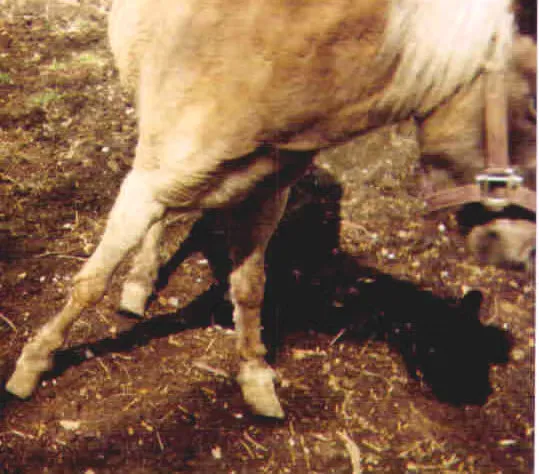
Photo #1 – “Sugar Candy,” a pony with severely overgrown hooves and founder. Her hooves were actually much worse than they appear here. About 6 more inches of hoof were buried in soft dirt that is not visible in the photo.
Hooves and Parasites
Another important step is to call your farrier immediately to evaluate the rescued horse’s hooves, especially if they are overgrown or appear foundered. Hoof care is critical to a horse’s well-being.
The photo above shows an example of what a rescue horse’s hooves might look like. This is Sugar Candy, a pony I rescued from a local auction. When she was led into the sale ring, people laughed and called her “Snowshoes.” Of course, she had to come home with me.
Her hooves were actually much worse than the photo suggests. About six more inches of hoof were buried in soft dirt that you cannot see in the image.
It took about a year of monthly farrier visits to get her hooves halfway normal. Her bones had grown into an abnormal position, and she was foundered, which was very painful and made walking difficult.
Opinions vary on deworming rescue horses. As a general guideline, feed pyrantel tartrate (daily wormer) for two to four weeks; then at four weeks, administer ivermectin according to the horse’s weight; then six to eight weeks later, deworm with fenbendazole, and continue with a regular deworming rotation. Do not give Quest/moxidectin while the horse is receiving daily pyrantel tartrate. Consult your veterinarian about your horse’s deworming needs.
Social Issues and My Experience
Rescue horses may have other problems. They may have been abused or left in a pasture or dry lot with no one paying attention to them. You may find that your rescue horse is head-shy, bites or kicks, or has other undesirable habits that require work.
The horse may not be accustomed to being around people. Remember that it took a long time for the horse to become this way, and it will take time and patience to earn its trust and teach it to respond to your requests. Horses need daily attention and care, day after day. Be patient, and you will be rewarded.
The photo at the beginning of this article shows Shonac about two weeks after I brought him home from a local horse auction. His legs are muddy from wading in the pond. He may not look like much to you, but to me he looked wonderful considering his condition when I found him.
His hipbones protruded at least a foot on either side, his head was covered with gouges and bleeding, and rain rot was all over his head and in his eyes—that is what the pink area around his eyes is. He was truly a mess. In this picture, he had filled out considerably and was up to 1/2 pound of senior pellets three times a day, plus all the grass and water he could eat.
He could not get enough grazing. He had been kept in a dry lot with no food or water. The vet estimated he was about 20 years old. He was so malnourished that he could barely stand or walk when I first brought him home.
Shonac was an Appaloosa who did the “Indian Shuffle.” Beneath his white coat, his skin was covered in black spots, like a Dalmatian. Everyone said, “he is so ugly!” but he was a very gentle horse, and anyone could handle him—little children could walk under his belly and pull his tail, and he did not mind at all. Shonac is an Indian name meaning something like “he who survives great hardship but achieves great fortune at the end.” I thought it suited him perfectly.
Shonac lived for 2 1/2 years after being rescued. His final days were spent on a 21-acre farm, eating good Kentucky grass alongside 14 other horses. Shonac was truly the start of rescue work for me. Sadly, he has crossed the Rainbow Bridge. I miss my friend.
Further Resources on Rescue Horse Care, Health, and Training
The American Association of Equine Practitioners (AAEP) has developed a resource guide titled “Care Guidelines for Equine Rescue and Retirement Facilities.” The guide is intended to help non-veterinary caregivers successfully provide care for a rescued horse or a horse in need of rehabilitation.
Topics covered include basic health management and nutrition, refeeding the starved horse, caring for the geriatric horse, and determining when euthanasia is necessary for humane reasons.
“Care Guidelines for Equine Rescue and Retirement Facilities” is available free of charge from the AAEP office. To request a copy, call 800-443-0177 or email [email protected].
This article is accurate and true to the best of the author’s knowledge. It is not meant to substitute for diagnosis, prognosis, treatment, prescription, or formal and individualized advice from a veterinary medical professional. Animals exhibiting signs and symptoms of distress should be seen by a veterinarian immediately.