How Selective Breeding Turned Rats into a Multitude of Varieties
Harper Kelly
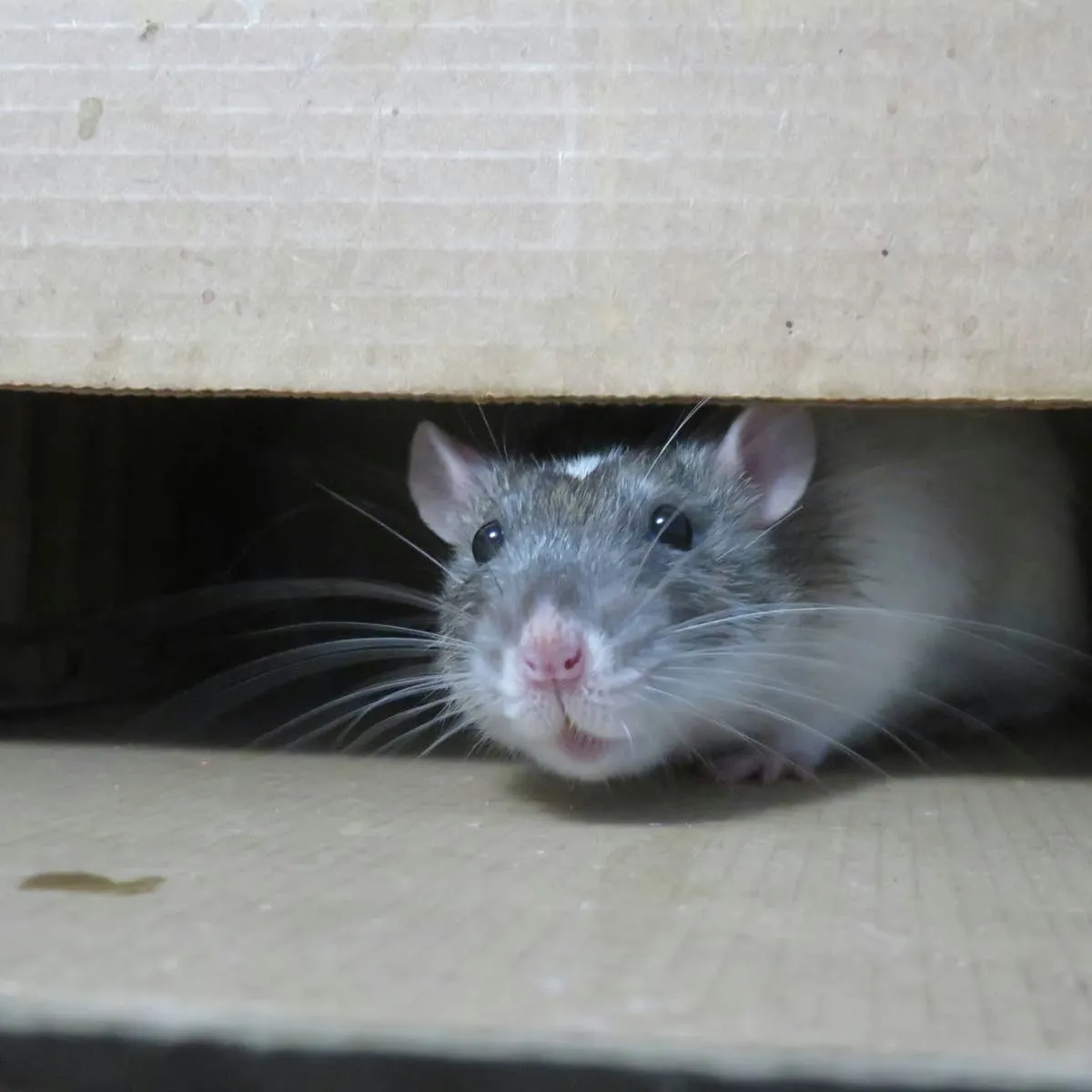
From Wild to Domestic: The Rise of Fancy Rats
Centuries of selective breeding have transformed the humble rat from a two-colored wild creature into a dazzling array of hundreds of coat colors, patterns, and physical types. This feat is all the more remarkable considering that the modern pet rat's domestication began only in the mid-1800s. In this article, we'll explore the fundamental genetics behind these unusual characteristics that are found solely in captivity, along with a touch of historical context.

Read on to learn about all the varieties of fancy rats, including those bred exclusively for laboratory settings.
riccardo ragione | Unsplash

Jack Black – 1851
Early Days: Mid-1800s England
While anecdotes of people keeping small rodents as pets stretch back centuries, the domestic rat as we know it today traces its roots to England in the mid-1800s. At that time, Queen Victoria's royal rat catcher, Jack Black, was employed to control vermin. Although paid to kill rats, he discovered that capturing them alive could be more profitable. These live rats were sold for rat-baiting, a popular blood sport where dogs were set upon rats in a pit and bets were placed on how many the dog could kill—similar to bear-baiting, bull-baiting, and dogfighting.
Fanciers and the First "Pretty" Rats
The rat fancy has always attracted eccentric individuals, and Jack Black was no exception. He understood the value of a public persona, reportedly wearing a belt of cast-iron rats around his waistcoat. He also proved to be an enterprising businessman, eventually breeding his own rats for the pits. Historical records indicate that he began selectively breeding the "pretty" rats to sell as pets to affluent women of the era. While the exact criteria for "pretty" remain unclear, we can reasonably assume these rats included albinos. Some accounts suggest that the first albinos were two captured by Black himself in a cemetery. Regardless, this initial step into selective breeding laid the foundation for rat domestication.
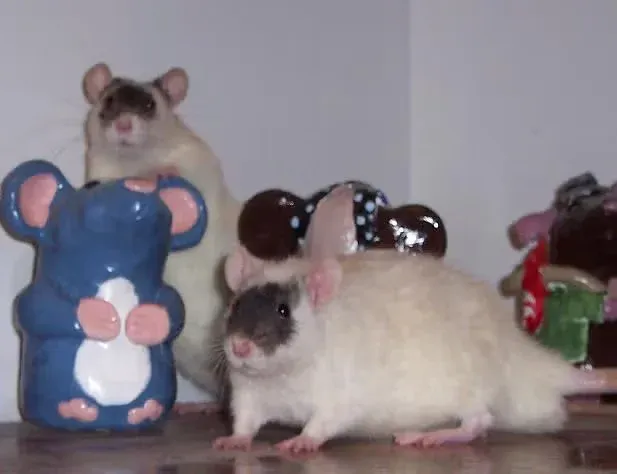
These two black rats display the over spotting gene, causing them to be masked.
Albinos, Blacks, and the Spread of White
Jack Black's breeding of albino rats is well-documented. Beatrix Potter, author of Peter Rabbit, is thought to have been one of his customers and even featured a white rat in at least one of her books.
Albino Rats
Albino rats, with their distinct appearance from the brown (agouti) wild rats, were the first to be selectively bred. Initially bred for their looks, they were later also selected for tameness, which eventually gave rise to the modern laboratory rat. Albinos were likely crossed back to agouti rats for many generations, and this outcrossing introduced further color mutations.
Black Rats, Over-Spotting, and White Rats
Black rats eventually appeared among agouti parents and were incorporated into breeding efforts, though the exact breeders remain unknown. Domestication truly took hold when white feet and spots began to appear in newer generations, caused by a masking gene often called the over-spotting gene. At first, these rats were called piebald and likely had only white bellies and chests. Through selective breeding, the white spread, producing a variety of markings, including entirely white rats with black eyes and no markings—distinct from albinos.
Further Color Changes
With albino, agouti, black, and white established, the foundation of domestic colors was set. These colors soon mutated further. When albinism and black combined in the same rat, it produced pointed rats, also known as Siamese. The albino gene altered the black pigmentation, resulting in dark brown fur on the nose, feet, ears, and tail, with lighter brown on the body. Agouti gave rise to colors like beige and black, and eventually dilution genes turned it into various shades of blue. As colors became more complex, fanciers crossbred them extensively, leading to a surge in variety. As late as the 1970s, rats were known only in agouti, albino, black, over-spotted, and beige. By the turn of the millennium, hundreds of colors existed, but color was only part of the picture.
Manxed Rats: The Tailless Variety
Manx rats are born without tails or with shorter tails than their parents, often having only stubs or no tail at all. They were first recorded in the 1920s when four individuals were born in an American laboratory. Breeding attempts to produce more revealed that the gene was problematic: tailless females couldn't give birth, and breeding a tailless male, even to a half-tailed female, didn't reliably produce more manx offspring. Offspring were produced so sporadically that researchers lost interest, and the manx didn't reappear until much later in the pet population. There's no evidence that these later manx rats descend from the laboratory ones, but the possibility can't be dismissed. The manx gene remains poorly understood and may even involve multiple genes. Though they still exist in the pet population and some breeders continue to work with them, they are, and likely will remain, rare. It's far easier to find what I call an "accidental manx": a rat whose tail was lost due to an overzealous mother or an accident later in life.
Featured Gallery
1 / 1
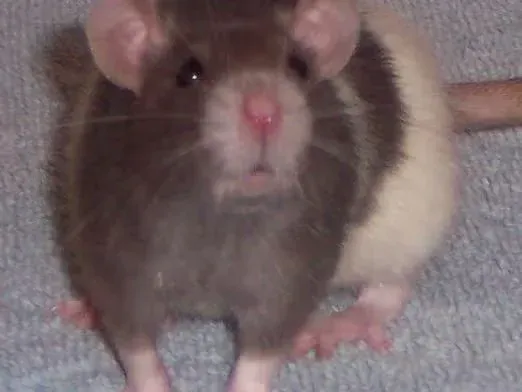
Standard coated blue hooded
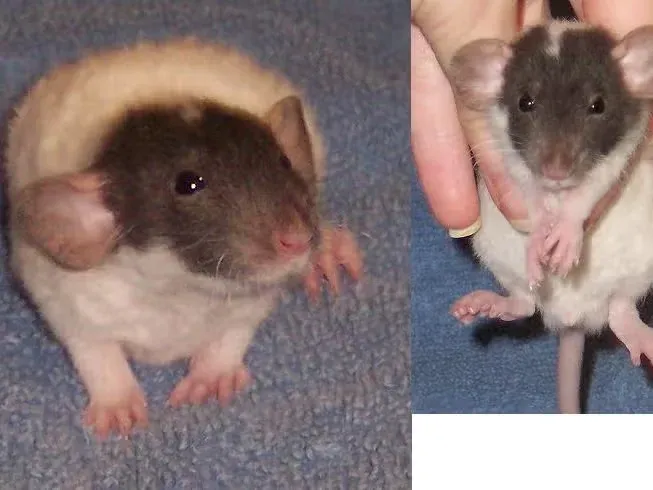
Rex dumbo baby
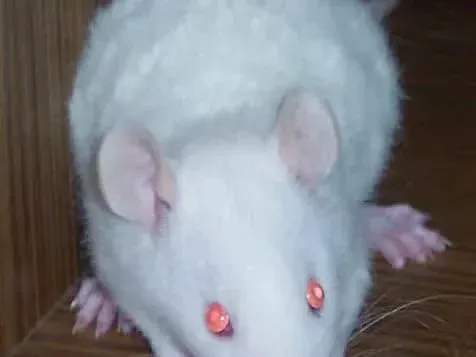
Pink-Eyed White (overspotted) Rex
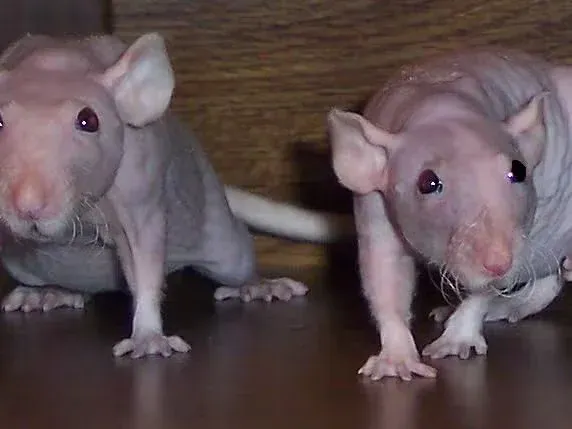
Furless Dumbos
Coat Genetics: Rex, Hairless, Satin, and Harley
Rex rats are born with curly fur. Unlike most genes, rex is dominant, meaning a rex bred to a standard rat can produce rexed offspring. This reduced the need for inbreeding, giving the variety a better chance to be bred for health rather than just looks. However, rex rats were still bred together for many generations.
Double Rexes
Occasionally, a rat is born that looks almost mangy—sparsely furred with curly whiskers, growing hair in patches and losing it, only to grow more elsewhere. These are called double rexes, the result of over-rexing. When double rexes were bred together for generations, they produced babies with even less hair, until some were born with no hair at all except for curly whiskers. This is likely the most common type of furless rat in the pet population, but not the only one. Unlike rexes, this hairless trait is mostly recessive. I say mostly because an over-rexed hairless bred to a standard does produce rexes, but not more hairless.
Nude Hairless Rats
Nude hairless rats originated in the laboratory. They are very fragile, with little or no immune system, and were specifically bred for experiments. These rats occasionally enter the pet population, but they rarely live past six months; they lack the defenses to fight off even minor infections. It's speculated that there are at least four genetically different strains of hairless in the pet population. This can cause confusion when two hairless rats bred together produce fully furred offspring, as all hairless genes are recessive.
Satin Rats
Satin rats appeared in the 1990s. They have smooth, slippery hair with flat hair shafts instead of round ones, creating a satin effect. Some breeders crossed them with rex to create velveteen rats. Satin, like rex, is a dominant gene and appears to have arisen spontaneously. I haven't heard anyone claim to have discovered it first, but it was likely a fancier; otherwise, the gene probably would have gone unnoticed.
Harley Rats
Harley rats have long hair like a teddy bear hamster. The first Harley (named Harley) was a Himalayan found by Odd Fellows Rattery at a pet shop in September 2002. Harley was brought home and used as a stud to determine if the gene was dominant or recessive. Unfortunately, it proved recessive, so an intense line-breeding program was necessary to produce more Harleys. The variety has gained popularity in its few years of existence.
Featured Gallery
1 / 1
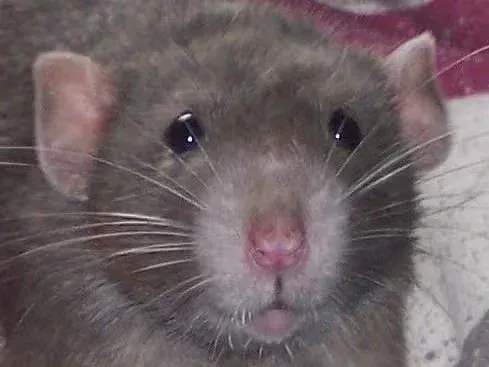
This is Krishna, my dearest American Blue Dumbo (the beginning of my own dumbo lines!). RIP.
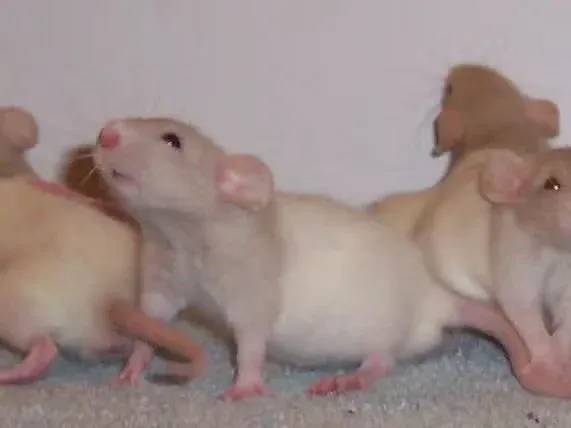
Beige hooded dumbo babies (one of the ones pictured is Krishna’s father, Tavi)
Dumbos Enter the Scene
Dumbo rats first appeared when a litter born in California in 1990 included a male dumbo. The breeder kept this rat and bred it to regular rats, but no more dumbos were produced. At that point, it was bred to its mother or sisters to create more dumbos, proving it is a recessive gene. Rat enthusiasts were thrilled by this new mutation, which had rounder ears set lower on the head and a skull resembling that of a Bull Terrier. They spread rapidly across the US, with breeders outcrossing and line-breeding to create a stable, genetically diverse animal. The phenomenon grew even larger when dumbos were exported and gained popularity worldwide.
What Causes the Dumbo-Like Appearance?
It wasn't until 2009 that dumbos were studied in a laboratory. Breeders had observed that dumbos sometimes had smaller lower jaws and that females didn't wiggle their ears when in heat like other rats. Someone compared this to a group of pharyngeal arch development disorders in humans, the most recognized being Treacher Collins Syndrome. A study of nine dumbo embryos in the laboratory confirmed they had a pharyngeal arch development disorder, causing them to develop differently from non-dumbo peers. Although this sounds alarming, there's no proof it causes adverse health effects beyond preventing some facial muscles from developing normally (making them unable to wiggle their ears and make certain facial expressions).
Laboratory Strains: Sprague-Dawley, Dwarfs, and Zucker
Laboratory rats have long been bred to be uniform, with genetic backgrounds so similar they are essentially the same animal for research purposes. This reduces confounding factors that could flaw studies. To achieve this, laboratories first bred albinos sister to brother for at least 300 generations, resulting in stock that is 99.9% genetically identical—natural cloning without high technology.
Sprague-Dawley
After the uniform rat process was established, researchers began breeding rats suited to specific studies. One notable example is the Sprague-Dawley, an albino strain bred to be the mother of all rats. Sprague-Dawleys were bred from highly productive females and males born to even more productive females, so that today they routinely give birth to 18-25 pups per litter, compared to the average of 6-10. These rats quickly gained favor outside the laboratory when feeder breeders acquired them. It's now standard for large rodent breeders (who usually breed food for reptiles) to have Sprague-Dawleys or Sprague-Dawley crosses.
Dwarfism in Rats
Sprague-Dawleys remain popular in labs for their quick turnaround. It was in these rats that the first spontaneous dwarf was born. These rats had a genetic defect causing them to make very little use of their own growth hormones, resulting in a stunted rat perfect for further studies. Dwarfism in rats is as complex as in humans. We have no reason to believe rats are any less capable of producing all the forms of dwarfism seen in humans (over 100). Pet breeders have been breeding naturally small rats and dwarves since they first left the laboratory, but just like the different strains of furless, two individual dwarves may not be compatible enough to produce more dwarfed offspring. Current studies suggest dwarf rats may be more susceptible to mammary tumors and other ailments related to their inefficient use of hormones. It remains to be seen whether these rats will be healthy enough in the long run to become popular in the pet market.
Zucker Rats
The Zucker rat is the opposite extreme: a strain of piebald rats bred in the laboratory to be super obese. These rats have very little control over their weight and can become enormously fat even when fed the same amount as a regular thin rat. They are used predominantly in diabetes research and are not specimens most enthusiasts would want in the pet trade because of their health issues. Zucker rats have been seen outside the laboratory and kept by enthusiasts, but no concentrated effort has been made to breed them for this market.
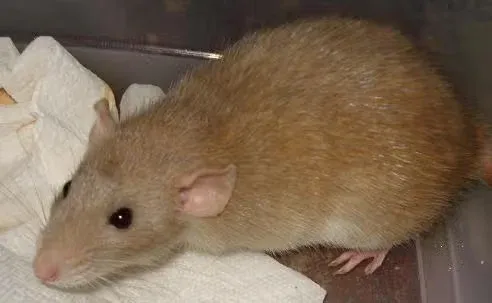
This is Honey, my mystery-colored rat. She’s at least a triple rescessive. The photo isn’t that great.
The Future of the Domestic Rat
Rats seem to be gaining popularity worldwide, and more breeders are focusing on these little creatures than ever before. New markings and colors appear frequently as breeders experiment with triple, quadruple, and sometimes quintuple recessive genes. Breeders are creating the rat types they want with the colors and markings they set out to cross, which requires a concentrated and immense effort. Burmese have appeared within the past five years, as have merled, and a few tricolored rats (none of which were healthy enough to be successfully bred). Just before I left the hobby, a color was created in my lines that I still haven't named. It's an exciting time to be a rat breeder, and I predict that rats will undergo a boom similar to that of small dogs during the Industrial Age in the next twenty years. I predict colors will continue to mutate, but body types may also begin to change. I wouldn't be surprised if rats become the next dogs in terms of genetic and aesthetic diversity. If breeders continue responsibly, we may even have rats that live longer and suffer from fewer diseases.
This article is accurate and true to the best of the author's knowledge. It is not meant to substitute for diagnosis, prognosis, treatment, prescription, or formal and individualized advice from a veterinary medical professional. Animals exhibiting signs and symptoms of distress should be seen by a veterinarian immediately.
© 2008 Theophanes Avery