Capybara Chronicles: Unpacking the World’s Biggest Rodent
Harper Kelly
World’s Largest Rodent
Capybaras hold the title for the biggest rodents on the planet. These sturdy South American creatures can reach weights of up to 145 pounds—and occasionally even heavier—while standing about two feet tall at the shoulder and stretching four and a half feet long. They are striking and fascinating animals. I explore their existence in the wild and their status as exotic pets.
Highly social and semiaquatic, capybaras live in groups and consume plants. Even though they frequently stroll slowly through grassy environments, they are capable of running swiftly when needed. They are also strong swimmers.
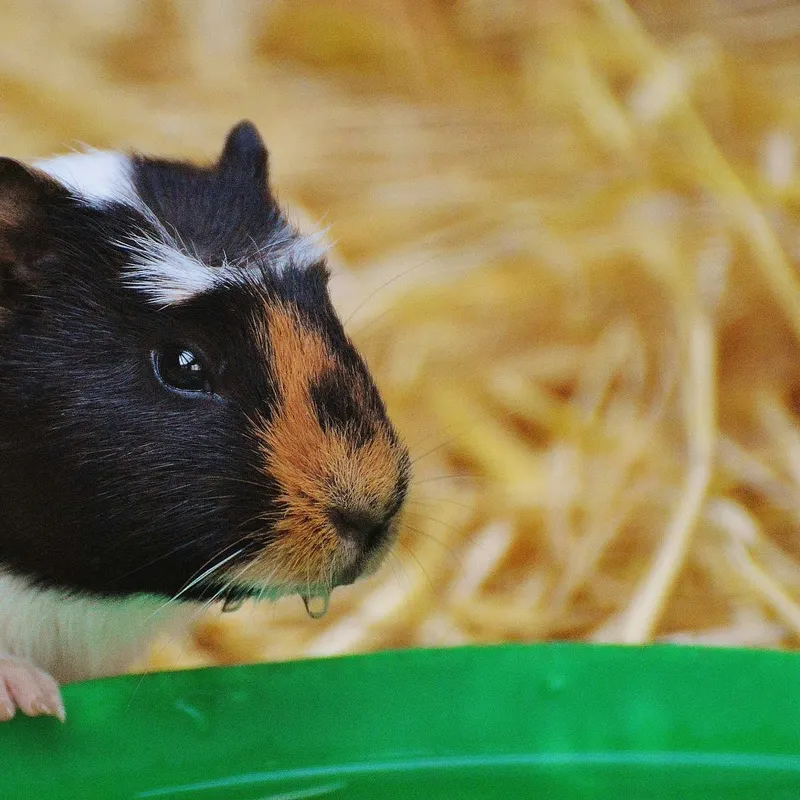
Scientists once classified these animals as a kind of pig. Their scientific name, Hydrochoerus hydrochaeris, translates to “water pig.” Today, researchers know capybaras are rodents and share a family connection with guinea pigs. They are found across much of South America and into parts of Central America, and they also reside in zoos and wildlife parks globally.
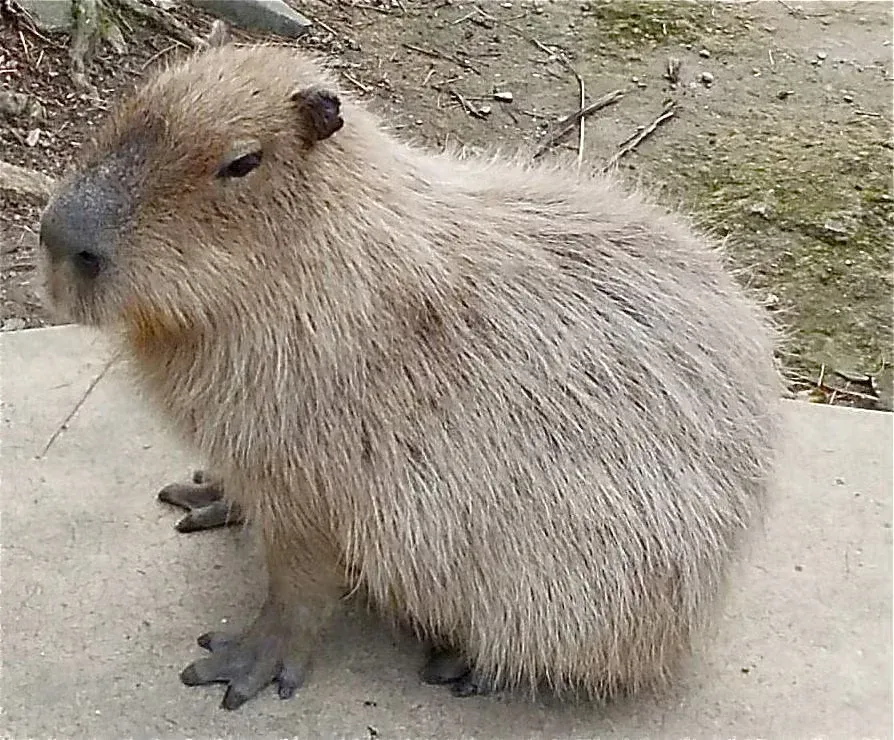
A capybara at Nagasaki Bio Park
STA3816, via Wikimedia Commons, CC BY-SA 3.0 License
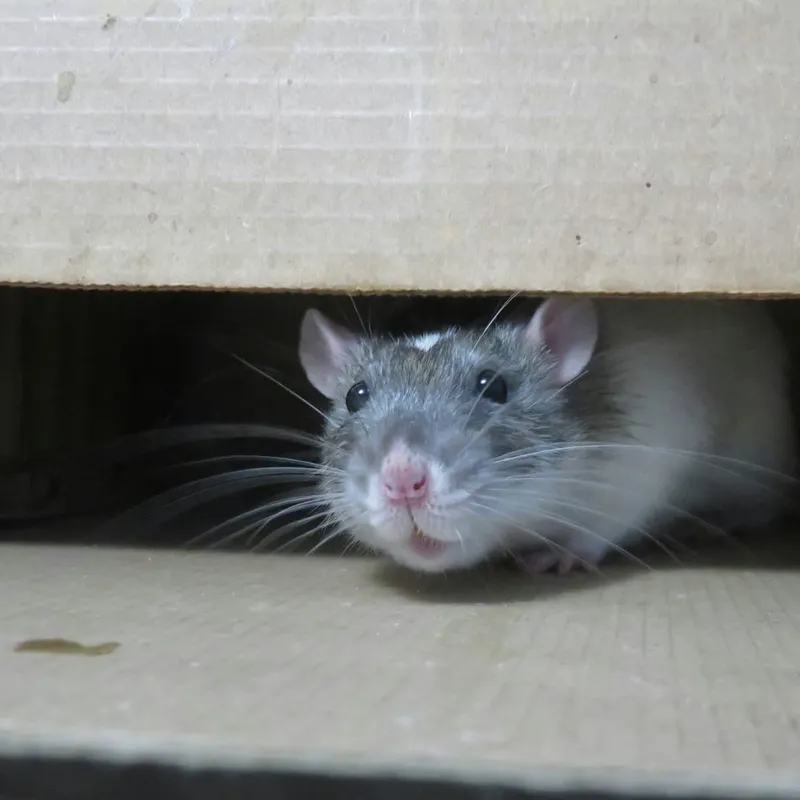
Capybaras belong to the mammal order known as the Rodentia. Other animals in this order include mice, rats, hamsters, guinea pigs, squirrels, and beavers.
Capybara Anatomy
A capybara’s frame is heavy-set, covered in long, coarse fur that can be reddish-brown, yellowish-brown, or grey. Its elongated head features a blunt snout and small ears. The eyes are also small and set high on the head.
This animal has short legs. The hind legs are longer than the front ones, and the feet are partially webbed. In soft ground like mud, the feet leave star-shaped prints. The front feet have four toes, while the back feet have only three. Capybaras can walk, run, and swim with ease, and they sit in a dog-like posture.
At first glance, a capybara seems tailless, but it actually possesses a tiny, vestigial, immobile stub at the rear of its body that is sometimes called a tail.
The name “capybara” comes from a word that means “master of the grasses” in the language of the Guarani people of South America.
Where They Live and What They Eat
Capybaras make their homes in forests and grassy regions close to marshes, swamps, lakes, ponds, and rivers. Their eyes, ears, and nostrils are positioned near the top of the head, allowing a capybara to stay submerged with only the upper part of its head above water. This lets it breathe and scan the surroundings while most of its body remains hidden. African hippos share this same adaptation.
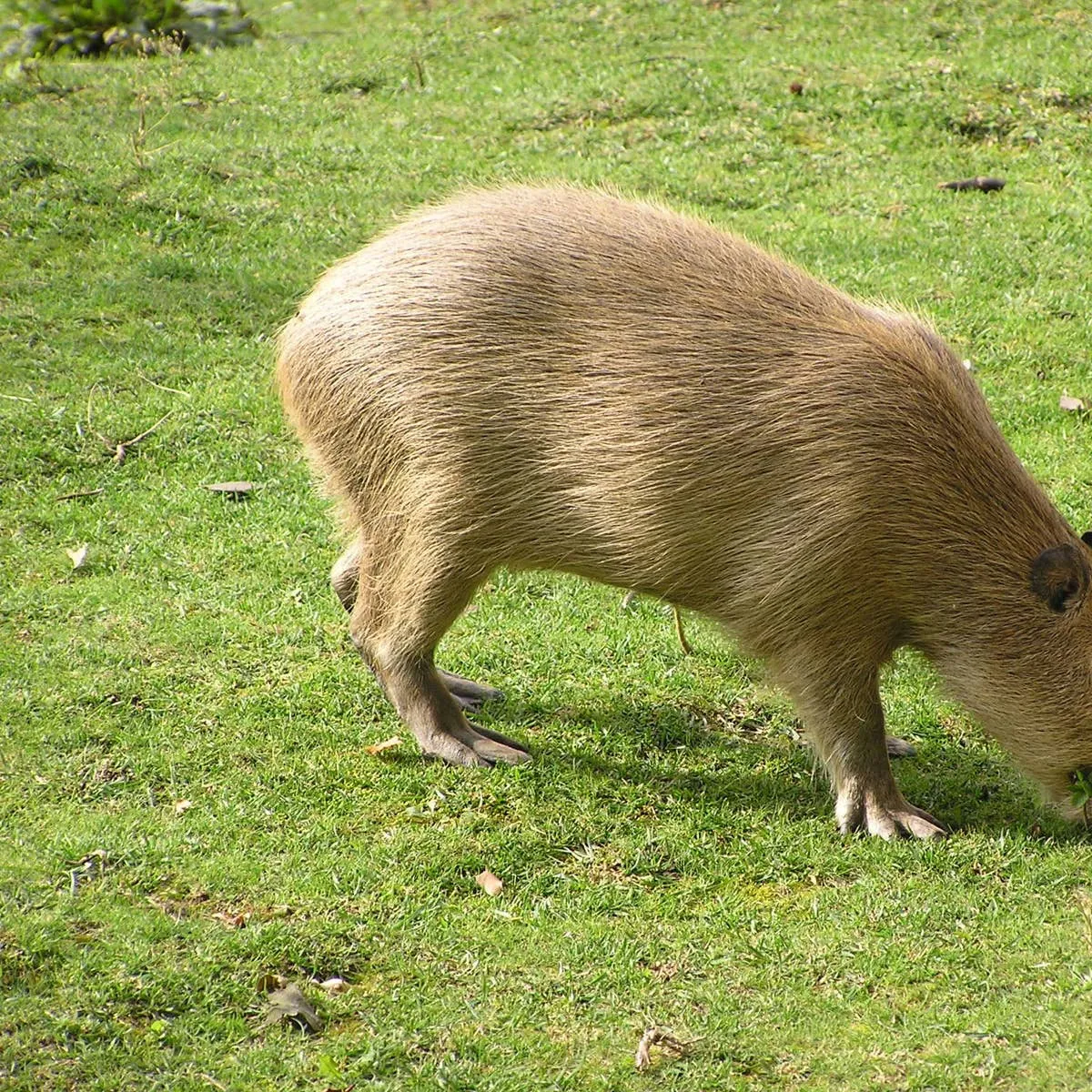
Capybaras can remain completely underwater for as long as five minutes. Water supplies both food and safety from threats. These herbivores feed on grasses and aquatic plants, but when grass dries up, they will also consume some fruits, grains, and reeds. As they chew, their jaws move side to side rather than up and down as ours do.
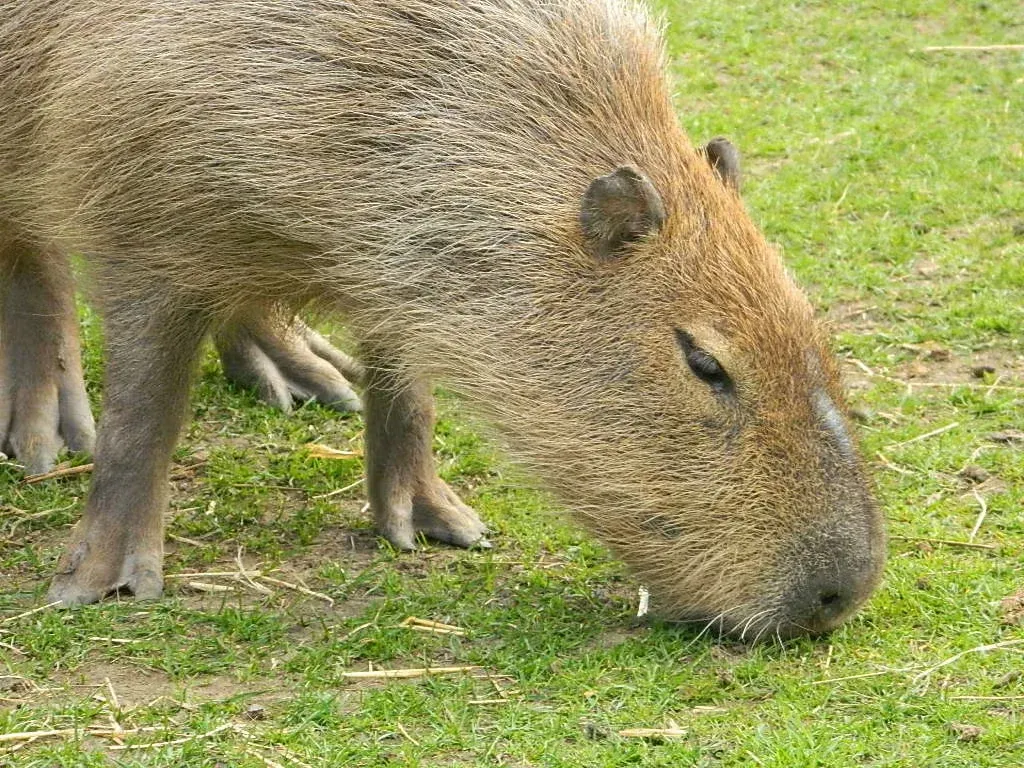
A capybara grazing at Shepreth Wildlife Park in the UK
FinlayCox143, via Wikimedia Commons, CC BY-SA 3.0 License
Social Structure
Capybaras typically live in groups of ten to thirty individuals, though solitary animals have been spotted. A dominant male leads the group, which is made up of females, young, and younger males.
The group usually grazes in the morning and evening, but sometimes feeds at night instead to avoid predators. During the hottest part of the day, the animals stay in water or mud.
Groups can grow to around a hundred animals when capybaras congregate at a water source during the dry season. A group’s home range covers about fifty acres and partially overlaps with the ranges of other groups.
How Capybaras Communicate Vocally
Capybaras are very vocal and produce a wide variety of sounds. They bark when danger approaches to alert their group and to frighten predators away. The bark sounds quite similar to a dog’s bark. The animals also communicate with each other using whistles, chirps, squeals, clicks, purrs, growls, and grunts. One capybara owner compared a sound made by her pet to that of a Geiger counter.
Communication is especially important between a mother and her babies. Both the mother and the youngsters vocalize to keep in contact within their group, especially when the group is moving. Babies may vocalize almost continuously.
A dominant male growls and chases other animals to maintain his position as the leader of his group. Observers say that serious fights between the rodents are rare, however.
Scent Communication
Capybaras communicate via their sense of smell in addition to making sounds. Males and females have a scent gland called a morillo on the upper part of their snouts. Males have larger morillos than females. The dominant male rubs his morillo over grass, releasing a sticky white fluid that is scented and marks the group’s territory. The animal’s anal glands also release a scented substance.
Other individuals besides the dominant male release scented secretions for communication. Males usually scent mark more frequently than females, however. In addition, they appear to mark with urine more often than females.
Reproduction
Capybaras often mate in the water. Two to eight babies are born after a gestation period of about 130 to 150 days. The babies start to eat grass when they are only a few days old and are weaned at about sixteen weeks of age. They congregate in a creche and may obtain milk from other nursing females in addition to their own mother. The group as a whole guards the babies from danger.
A female generally has one litter a year but may occasionally have two. In captivity, capybaras live up to twelve years. In the wild, their lives are usually much shorter due to predation.
In some places it’s legal to keep capybaras as pets, but in others it’s illegal. Anyone interested in getting a capybara as a pet should check their local rules carefully. They should also ensure that they have the means to keep the animal healthy and happy.
Exotic Pets
The term “exotic pet” is often used to describe an animal that is not fully domesticated and is kept as a pet. The term seems appropriate for capybaras. The animals are often (but not always) gentle and peaceful in captivity and will often (but not always) let humans pet them. Many seem to enjoy being stroked. As with any exotic animal purchased from a breeder, however, it’s important to remember that the animal isn’t a domesticated one. True domestication requires many years of selective breeding.
There are some wonderful photos and videos of pet capybaras on the Internet. The pets seem to enjoy swimming in backyard pools, going for walks with a harness and leash, and even lying on sofas. Owners say that the animals are intelligent and trainable, like Caplin Rous in the video above. The animals shouldn’t be thought of as giant guinea pigs, however. Taking care of an exotic pet and keeping it happy are major undertakings.
Things to Consider Before Getting a Capybara
A person needs to do some research and planning before bringing an exotic animal onto their property for both the animal’s sake and the sake of the humans involved in the situation. This requirement applies to capybaras as well as other animals. I give general guidelines below. A capybara breeder or expert should be consulted for details.
A Suitable Diet and Habitat
Before bringing any exotic animal home, a person should investigate the best diet for the animal. The diet must be as natural as possible and must enable the animal to stay healthy. The food must also be easy to obtain and affordable. Captive capybaras will require multiple plants in their diet in order to stay healthy. They may also require other foods and perhaps supplements to make up for the fact that they are not feeding in the wild. Though the video of Caplin Rous eating a popsicle is cute, depending on its ingredients, a popsicle may not be a suitable food for capybaras.
The animal’s habitat should be as natural as possible. Scenes of capybaras inside houses are interesting, but a house is not their usual home. It would be a good idea to ask a breeder lots of questions and to carefully observe the habitat of their animals. This should be done before the pet is brought onto the buyer’s property so that there is time to make any necessary changes.
Other points are important to consider, whether or not a pet is exotic. If the owner has to go to work, who will take care of the animal? Are other members of the family willing to give the animal attention? Can the animal live happily and safely without personal attention while the owner is at work? Is the pet safe for the other members of the family to interact with?
Social Needs and Exercise Requirements
In the wild, capybaras are social animals. Their day is spent interacting with other members of their species as well as grazing on plants. If they are the only member of their species in captivity, they will need a lot of human attention. This may not be sufficient for some individuals.
Even getting as small a number as two animals may be socially beneficial, though this is a question to ask a pet capybara expert. The gender of each animal in the couple may be important.
It’s important that pet capybaras have room to move and things to do. It’s also important that they have a place to swim, since they are semi-aquatic animals. If this place is a swimming pool meant for humans, the question of how to keep the water clean and safe for the animals will need to be investigated.
Obtaining Suitable Veterinary Care
An important consideration for a prospective capybara owner in veterinary care. Exotic animals generally require treatment from specialty veterinarians or from general ones with experience in treating their species. Finding a suitable vet within a reasonable distance from the home may be a challenge. It’s important to meet this challenge before a capybara is bought as a pet.
Even if a member of the family agrees to drive the pet a considerable distance to receive suitable veterinary attention, the question of what to do if the animal is experiencing an emergency health problem needs to be considered.
Many generations of selective breeding are necessary in order to domesticate a wild animal. Anyone thinking of owning an exotic pet needs to keep this in mind. Exotic pets are not domesticated and require special attention in order to keep them happy and to keep humans safe.
Temperament of Pet Capybaras
The capybaras shown in this article appear to be docile and even friendly. Some online videos show the rodents playing with other pets and apparently enjoying the company of humans. In some of the photos and videos that I’ve seen, the animals seem to be showing affection towards their owners.
Even a previously calm capybara may sometimes exhibit an aggressive behaviour, however. This is likely not so much a problem with the animal as with our lack of knowledge about its needs according to its gender and life stage. The consensus of pet owners seems to be that capybaras are not aggressive by nature but may be so if we act inappropriately towards them (according to their standards).
Even though the rodents are bred in captivity, they are still very much wild animals. Though they often seem to be friendly, it should be remembered that they are capable of biting hard.
Other Interesting Capybara Facts
- As in other rodents, the front teeth or incisors of a capybara never stop growing. The teeth are generally worn down by the tough grasses that the animal eats.
- Capybaras are coprophagous, which means that they eat their feces. This behaviour enables them to obtain extra nutrients and beneficial bacteria. (House training a pet capybara is a major topic of its own. Pet owners say that it can be done.)
- Like a cow, the rodents often regurgitate food to chew it again. They are only distantly related to cows, however.
- In some parts of South America, the animals are farmed for their meat or skin. This has the advantage of protecting the wild population from being hunted.
- In Venezuela, capybara meat is eaten during Lent. In previous centuries, the animals were classified as fish by the Vatican because they spent most of their time in water. Therefore they could be eaten during Lent when meat was forbidden.
- Unlike many other rodents, capybaras can’t hold food with their front feet.
- In some areas of the United States, the animals may be seen in the wild. The wild population is believed to have originated from escaped pets.
The capybara has a relative (Hydrochoerus isthmius), which is known as the lesser capybara. This animal lives in a small area in the northwestern part of South America.
Population Status of the Species in the Wild
Wild capybaras face many predators, including anacondas, caiman, eagles, and wild cats (puma, ocelot, and jaguar). They are also hunted by humans for their meat and skins. The skin is used to make leather, and the fat under the skin is used to make medicinal drugs.
Although the capybara groups in some areas are under pressure from hunting, at the moment the population as a whole isn’t endangered. The IUCN (International Union for Conservation of Nature) maintains a “Red List of Threatened Species.” In this list, animals are classified into one of nine categories based on their population status. The IUCN has placed capybaras in the Least Concern category of the Red List based on a 2016 assessment.
As is the case with all animals that share the earth with us, we mustn’t become complacent about the population status of capybaras. Although the idea of keeping one or more animals as a pet may be appealing for some people, the status of the wild population shouldn’t be forgotten.
References
- Capybara facts from the San Diego Zoo
- Information about Hydrochoerus hydrochaeris from the Reid Park Zoo
- Capybara information and facts about the escaped animals in the United States from the USGS (United States Geological Survey)
- The capybara entry on the IUCN Red List
This article is accurate and true to the best of the author’s knowledge. It is not meant to substitute for diagnosis, prognosis, treatment, prescription, or formal and individualized advice from a veterinary medical professional. Animals exhibiting signs and symptoms of distress should be seen by a veterinarian immediately.
© 2011 Linda Crampton