Swollen Abdomen in a Female Dog: Why You Shouldn't Delay Veterinary Care
Charlie Evans
Should You Wait for an Appointment if Your Dog's Abdomen Is Swollen?
"My dog's name is Cloie. She is about 4 years old; she just had her last litter about a year ago. When she was breastfeeding, one of her nipples got really big and swollen, but it went away after the puppies left it alone. Then, about a month ago, I noticed Cloie was getting a little bigger. I had just changed her dog food.
Then, she supposably went in heat again; it seemed like it lasted longer, and my male dog was following her around, but nothing like normal. Normally, he would have been going crazy, but there was none of that. Then, after her being in heat, I noticed her stomach getting bigger and harder. She is not in pain. She eats, drinks, and acts pretty normal, but not her usual Speedy Gonzalez-type activity.
My concern is a hernia or cancer. I just put them on pet insurance about two weeks ago, and we have a 30-day wait period. Do you think she can wait, or should I take her in now? Thank you so much for your time, and have a wonderful day."—Angelica
Possible Reasons for a Swollen Abdomen
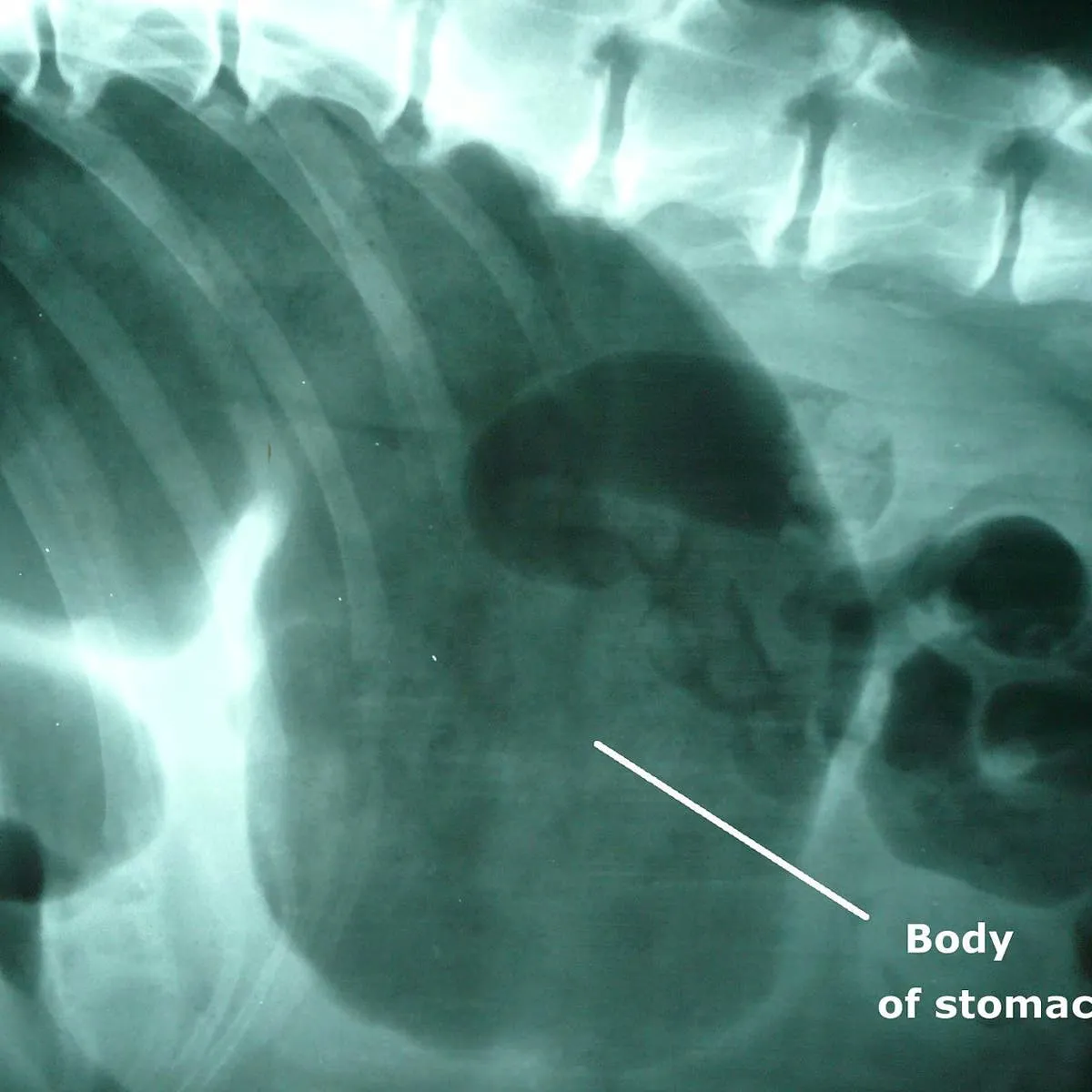
Waiting another 15 days for an examination is not advisable. A swollen belly in a dog should be treated as an emergency. Several conditions can cause this sign:
- Obesity: This is not serious or an emergency, but you likely would have recognized if weight gain was the only issue.
- Pregnancy or false pregnancy
- Heart disease: Fluid accumulation in the abdomen, as can occur with heartworm disease.
- Gastric dilatation and volvulus (GDV): Also known as torsion, twisted stomach, or bloat. Affected dogs experience severe pain and often do not survive.
- Urinary obstruction
- Pyometra
- Other infections (peritonitis, infected and swollen internal organs, etc.)
Pyometra: A Serious Condition
From your description, the condition that concerns me most is pyometra, a uterine infection in female dogs. There are two forms: open and closed.
With an open pyometra, pus can drain through the cervix, so the abdomen does not become as distended. Your dog's signs sound more consistent with a closed pyometra. In this form, the uterine lining thickens and becomes infected, and pus accumulates in the abdomen, leading to a swollen belly.
Because the pus cannot escape, it continues to build up in the uterus. If the uterus ruptures, pus spills into the abdominal cavity, and the dog dies. Dogs with this type of pyometra often show other signs, including:
- A swollen abdomen: This is not very noticeable in open pyometra, but a hard, swollen abdomen is one of the first things noticed in closed pyometra.
- Lethargy: You mention this when you say she does not run around like normal. In some studies, all owners of dogs with pyometra reported this sign. (1) It is a common indicator of pain in dogs. Most dogs are stoic and show few pain signals, so this is something to watch for.
- Drinking excessively
- Urinating excessively: The infection releases toxins into the bloodstream, and the kidneys work to eliminate them.
- Dehydration: This occurs if a dog cannot drink enough to replace the water lost through urine.
- Poor appetite
- Vomiting
- Fever
Not every dog shows all these signs. Even if your dog does not have all of them yet, she could still have pyometra. After the examination, your veterinarian will usually run blood tests to confirm the diagnosis.
This video gives a graphic view of how severe the internal damage can be.
Conclusion: Seek Veterinary Care Immediately
I cannot guarantee that your dog will die if you delay an exam and surgery, but the risk is real. Some dogs are left untreated for a long time before receiving care. Although their survival rate after surgery is much lower and they require longer hospitalization, (2) some do survive and return to normal life after treatment. However, if her uterus continues to fill with pus and ruptures, she will likely die.
I would not take that chance. Please take her in as soon as possible.
Sources
- Xavier RGC, Santana CH, de Castro YG, de Souza TGV, do Amarante VS, Santos RL, Silva ROS. Canine Pyometra: A Short Review of Current Advances. Animals (Basel). 2023 Oct 25;13(21):3310. i.nlm.nih.gov/pmc/articles/PMC10647846/
- Pailler S, Slater MR, Lesnikowski SM, Gayle JM, Duvieusart CBCA, Ledesma EJ, Lee ML, Stevens JD, DeClementi C. Findings and prognostic indicators of outcomes for bitches with pyometra treated surgically in a nonspecialized setting. J Am Vet Med Assoc. 2022 May 21;260(S2):S49-S56. i.nlm.nih.gov/35290206/
This article is not meant to substitute for diagnosis, prognosis, treatment, prescription, or formal and individualized advice from your veterinarian. Animals exhibiting signs and symptoms of distress should be seen by a veterinarian immediately.
© 2024 Mark dos Anjos, DVM