What Does It Take to Be a Therapeutic Riding Horse?
Charlie Mitchell
Understanding Therapeutic Riding Programs
I often receive calls from owners hoping to donate their horse to our therapeutic riding center. Occasionally, the horse seems like a great fit, and I'll send along a questionnaire and details about our program. But more often than not, the horse is not suitable for our program or any similar one, and the owner is left feeling confused and disappointed when I explain why we can't take it.
Even those with professional horse backgrounds tend to have a limited understanding of what makes a good therapy horse. In this article, I'll cover what therapeutic riding programs actually do, the qualities they look for in their horses, what they simply cannot accept, and how you can assess your own horse's potential for this kind of work.

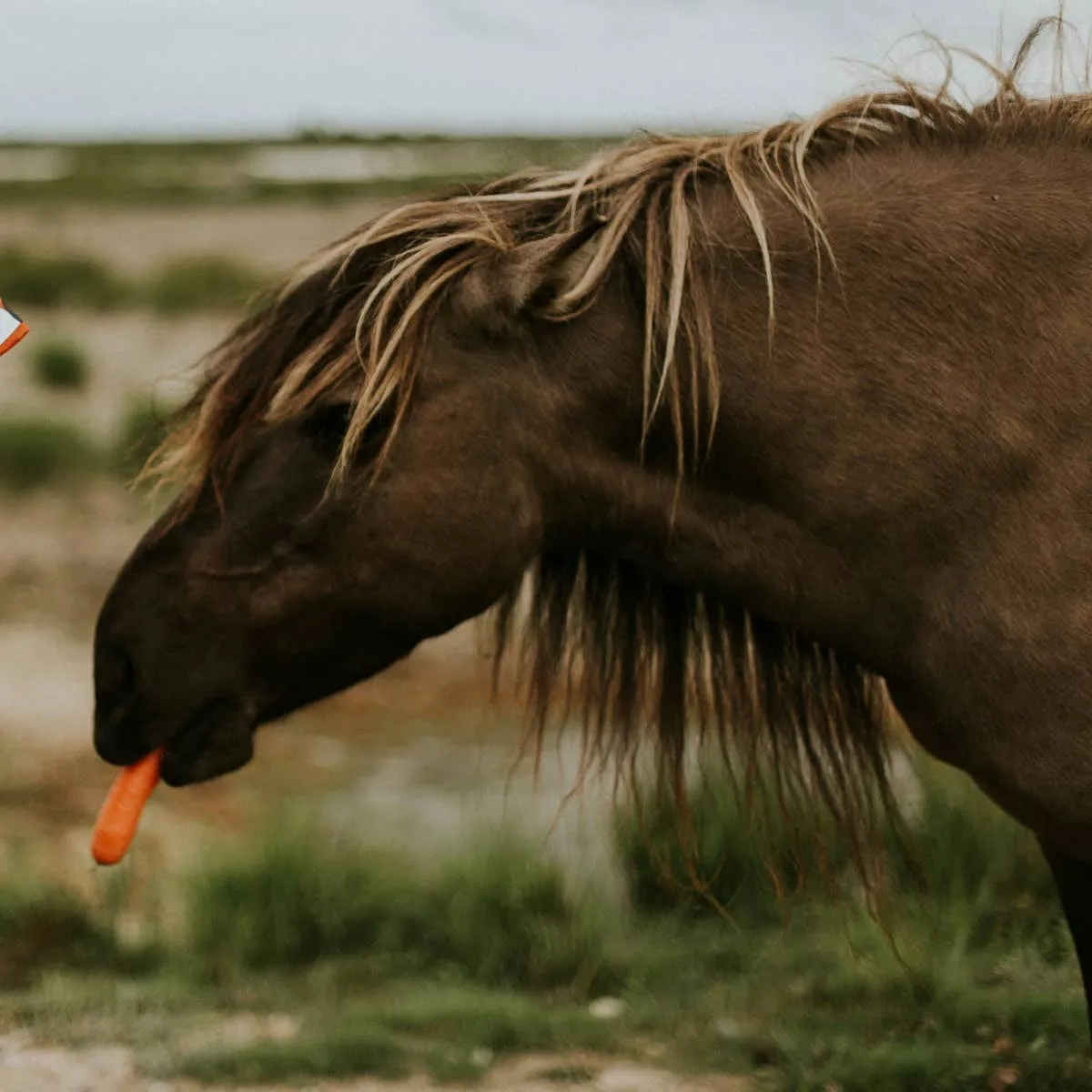
Horses use their noses to nuzzle.
Photo by Donald Giannatti on Unsplash
How Therapeutic Riding Programs Operate
Whether large or small, most therapeutic riding programs share certain traits that heavily influence their operations and activities.
Non-Profit Status
Even if they operate alongside a for-profit lesson business, most therapeutic riding programs are classified as 501(c)3 organizations. This typically means they have a defined mission, a set budget, and a small team.
- A program's mission statement outlines its purpose and is usually available on its website. Unless the mission includes rescue or rehabilitation, they are not a horse rescue or rehab facility. Their focus is on helping people with disabilities, and they require horses that can do that safely and effectively.
- With a fixed budget, programs cannot afford to keep a horse they can't use, or one that won't be as useful or versatile as the horses they already have. Even if a horse could be valuable, they must carefully consider whether it has long-term, costly health needs.
- Limited staff means limited energy, time, and resources to work with a horse that needs extensive training to be safe and effective. If the horse hasn't been ridden in a long time or has many stable or riding issues, the program likely lacks the manpower to bring it up to standard.
Strict Safety Protocols
Anyone around horses can get hurt because all horses can be dangerous. Therapeutic riding programs must be especially cautious, as their clients have a wide range of physical, mental, emotional, and developmental disabilities that can make them more prone to injury, and more severely affected by injuries, than able-bodied individuals. Programs must constantly evaluate the risks and benefits of every aspect of their operation, including the horses they use.
Clients with Unique Needs
Expanding on that, people with disabilities may produce sounds, movements, behaviors, and emotions that are completely new to a horse. While programs won't tolerate unsafe or violent behavior, it can still occur, and the horse must be tolerant until the client can be removed.
Teaching Goals
Therapeutic riding programs are essentially lesson programs designed for people with disabilities. Some clients may need a lot of support, require three or more helpers, and never go faster than a slow walk. Others may advance to compete in western, hunt seat, saddle seat, dressage, driving, or vaulting. Each program has specific horse needs that can change over time. Programs need horses with a wide range of skills and experiences to help each client learn as much as possible.
Volunteer Support
Since most programs have limited staff, they depend heavily on volunteers. Volunteers come with varying levels of horse experience and natural ability. While good programs carefully screen and train their volunteers, every program needs horses that will tolerate inexperienced handling and not take advantage of someone who is still learning.
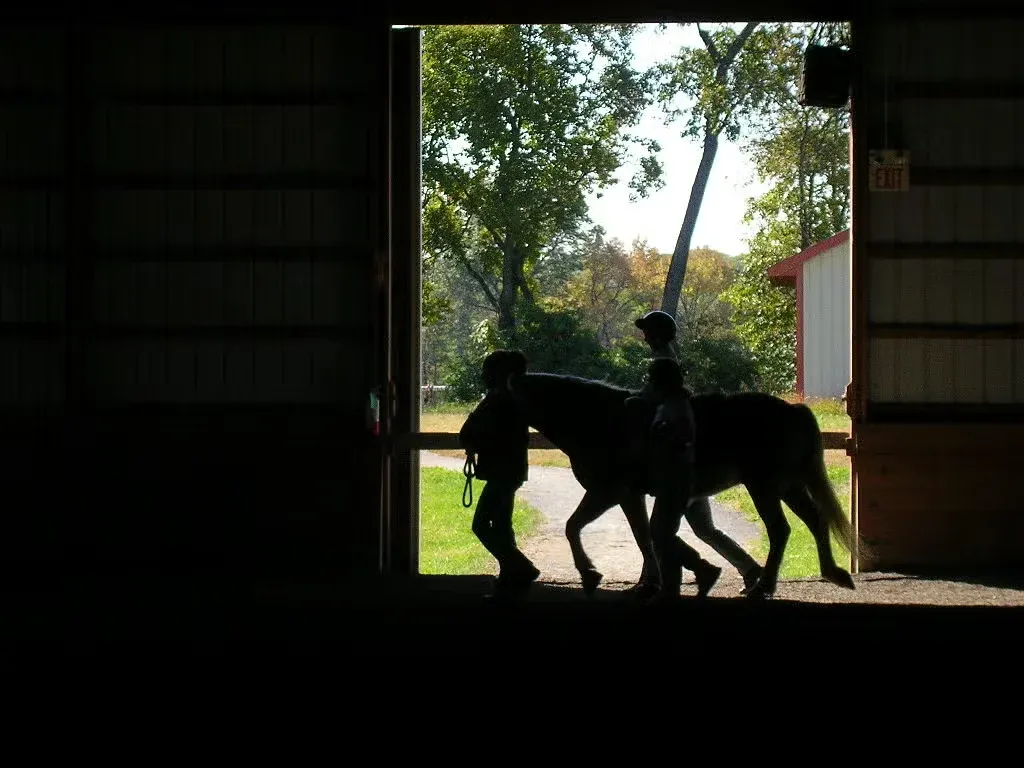
Horse and rider are led outside
Key Qualities of a Good Therapy Horse
In the information I send to owners of potential therapy horses, there's a questionnaire designed to gather all the details I need about a horse. Because most programs rely on donated horses, we know we can't be too selective. However, minimum requirements must be met for the horse to be safe and useful. Below are the qualities I look for, roughly in order of importance.
- Height vs. weight-carrying ability: The tallest horse isn't always the one who can carry the heaviest rider. I'd prefer a shorter, sturdier draft breed that can carry 200+ pounds over a tall, leggy Thoroughbred type that can't carry as much and makes riders harder to reach.
- Temperament: Horses that are naturally kind, calm, and people-oriented are more likely to give that "little extra something," whether it's standing rock-solid on three legs while a fallen rider is removed from under them, or turning the way they know the rider wants to go, even if the rider can't ask properly.
- Training and trainability: A therapy horse must have good manners on the ground and under saddle. It must also be able to learn new things and apply them to what it already knows. Unless the horse has been a therapy horse before, there will be plenty to learn.
- Soundness: Therapy horses must be sound at least at the walk and trot to benefit the rider. The horse should be comfortable working at least 2 hours a day under saddle.
- Conformation: A therapy horse's conformation (how its parts are put together) matters only as it relates to weight-carrying ability, soundness, and movement. Blemishes that don't affect these and aren't related to health should be overlooked. Some of the ugliest horses I've seen have been the nicest – maybe because they know looks aren't their strong suit?
- Health: Due to limited budgets, horses with chronic, expensive health issues aren't ideal unless the owner agrees to help with costs. Therapy horses should be at a healthy weight for their type, with strong hooves, a shiny coat (when clean!), clear eyes, fresh breath, and normal droppings indicating good overall health.
- Movement: Therapeutic riding works because of the horse's natural, rhythmic, repetitive 3-dimensional movement (this deserves its own article; I'll write it if there's interest). A horse's movement quality is influenced by soundness and conformation (which a program can't change) and by training, saddle fit, and athleticism (which a program can improve). The movement can be big, small, or average, but it must be clean and correct at the walk and trot, and at the canter if the horse will canter in lessons.
- Spookability: I made up this word, but it's useful and important. A program needs a horse that rarely spooks, not because it's never exposed to scary things, but because it's brave about most and smart about the rest. Horses will look at scary things and want to explore or flee. But therapy horses must trust their handlers, learn that new things won't hurt them, and never, never choose jumping or spinning away as a first response.
- Age: Age is just a number, and older isn't always better. Older horses are often calmer and more experienced, but they're also more likely to have health and soundness issues and fewer useful years left. Like all things, it's a balance.
By considering how a potential horse rates in all these areas, a program can decide if it's a good fit. Just as needs change over time, every program has unique requirements based on its situation.
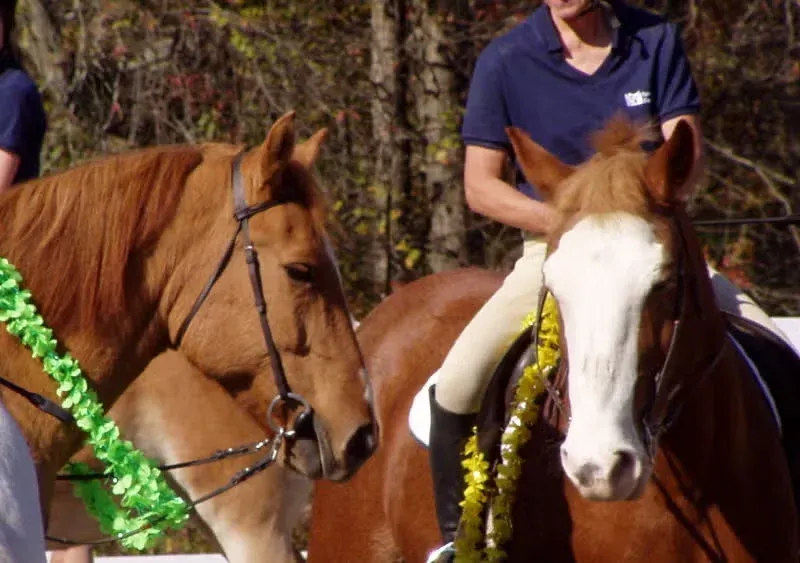
Therapy horses should be calm and content, even while getting lei-ed.
Reasons for Rejection
It's hard for me to say no, but I have to turn down most horse offers because they have one or more issues my program can't handle. Different programs have different resources, but common reasons for rejection include:
- Aggression toward people, such as biting, kicking, or overly dominant body language
- Aggression toward other horses that prevents integration into a herd or focus during lessons
- Acute lameness affecting movement or temperament
- Uneven movement from an old injury, like a dropped hip
- Chronic, serious conditions like navicular, severe laminitis, severe allergies, recurring colic, heaves, or EPM
- General condition and health problems from old age (usually over 25) that may give the horse less than 2 more years of rideability
- Stallions (intact males)
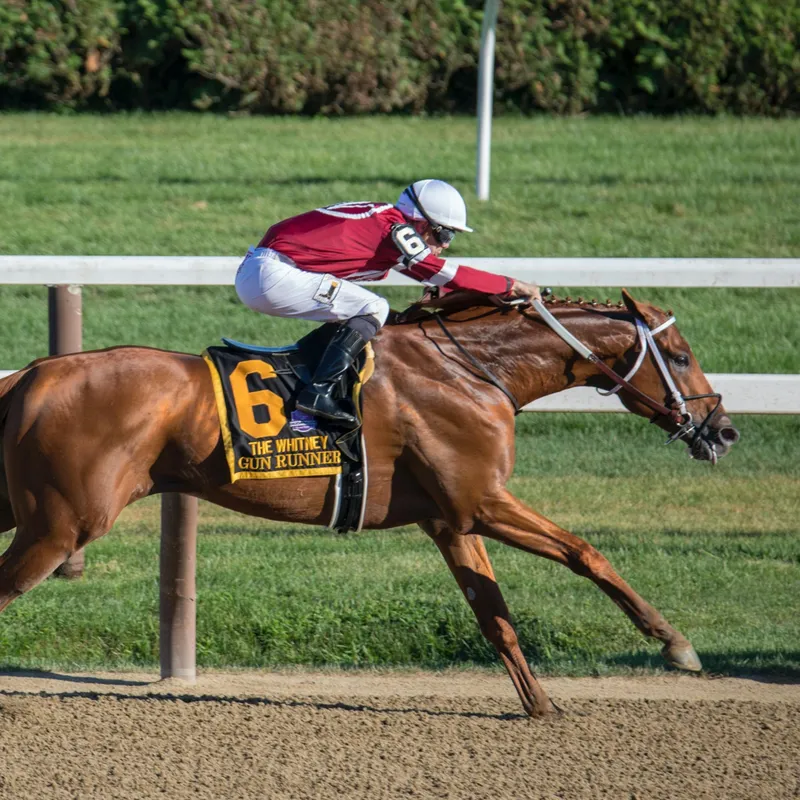
- Untrained horses, including racehorses straight off the track
- Sore or "cold" back
- Bucking, rearing, running, spinning, or any bad or dangerous habit under saddle
- Cribbing, pacing, rocking, or any bad or dangerous habit in the barn or pasture
- Hyper-sensitivity to new objects
- Unpredictable behavior in new places
- Dangerous loading or trailering habits (We rarely travel, but other programs might, and we sometimes ship horses in emergencies.)
- Inability to accept unusual riders (We put staff on new horses and "pretend" to be the types of riders the horses will carry.)
- Severe eyesight or hearing loss
- Dangerous behavior for the vet, dentist, or farrier
- Head-, ear-, or body-shyness
- Inability to focus on work when out of sight of other horses
- Inability to accept the program's schedule of work, turnout, and stall time
- Wrong size, height, or experience for the program's current needs
Test Your Horse!
If you're thinking about donating your horse to a therapeutic riding program, these "games" can help prepare it for a new career. Even if you and your horse stay together forever, these activities can strengthen your bond, give you unmounted "homework" for rainy days, and provide hours of entertainment for you (and your horse, as he laughs at your ridiculous new requests).
With all these games, start slowly and easily, and expect better results over time. If your horse gets tense, scared, mad, or bored, just change the subject for a while. The more he enjoys his work, the better he'll do it.
- Learn a new language: There are many great online resources about horse body language and how to use it (see links below). Therapy horses pay attention to their handlers' body language as part of the illusion that riders are independent and in control (they have silent, invisible back-up from staff and volunteers).
- Word, horse: Voice commands are fun and easy. Start with basics like "Walk on," "Whoa," and "Trot," then get creative. Therapy horses need to respond to voice commands from riders who can't move their bodies to communicate, and "Whoa" is a terrific emergency brake for any situation.
- Be a statue: Teach your horse to stand square, with equal weight on all four feet. Therapy horses need to do this when riders mount and dismount, and when stirrups and rider position are adjusted. Hint: If your horse is reluctant to lift his feet for hoof-picking, check if he's standing square. He can stand on three feet, but not two!
- Three's not enough of a crowd: Your horse can learn to appreciate being groomed by 3, 4, 10 people at once (depending on the horse's size!). Therapy horses are often groomed this way when groups from local organizations visit.
- Dodgeball: Few horses actually like this game, but tolerating balls and stuffed animals flying over and into them is an important therapy horse skill. Start easy and slow, and remember that once you've de-sensitized one side of the horse, you have to start over on the other side.
- Poke me: Touch your horse everywhere. Clients can find unusual places to touch a horse in no time. This is another de-sensitization game, but you might discover a hidden magic rubbing spot you never knew about, like the sides of the base of the tail… Mmmmm itchies…
- Help me out: Lean into your horse at odd moments, and teach him the difference between pressure that says "move over" and pressure that says "support me." He'll figure it out and use it when a rider really needs a steady body to lean against.
- You have WHAT?: Borrow crutches, a walker, a wheelchair, an IV cart, or an empty oxygen tank and teach your horse that these things are cool and should be accepted unconditionally. People who use them get enough odd looks during the day; they deserve acceptance at the barn. When your horse gets really good, teach him to walk, halt, and turn while being led by someone in a wheelchair (with passive back-up on the offside).
- Be a statue, again: Teach your horse to stand still while you mount and dismount, no matter how long it takes or how poorly you do it. Most therapeutic programs use mounting ramps that put the rider at least 3 feet above the ground, so find a safe place to replicate this new sensation for your horse. Have a horsey friend stand at your horse's head to steady him. He'll likely have a volunteer holding him when he mounts for a lesson.
- Sack of potatoes: Ride poorly. Really, really poorly. Slouch in the saddle, lean to one side, tell your horse to do two things at once. He'll think you've lost it, but you'll know if he has the tolerance for therapeutic riders. Teach him to ignore random moments of imbalance, and kiss his nose when you're done. He'll forgive you.
- Diamonds and pearls: Teach your horse to wear jewelry, like big plastic rings around his ears, hats, and helmets, bells in his mane and tail, a "cape" on his butt, and ribbons trailing off his saddle. We'll do just about anything silly to make a rider smile, and giant sunglasses on a horse look pretty silly, indeed!
It Worked!
I wanted this article to truly help the busy, hard-working people who make therapeutic riding programs flourish, and it did! The Rose of Sharon Equestrian School and Maryland Therapeutic Riding are now using this article to educate their potential horse donors. How cool is that?!
Useful Links
PATH International (Formerly NARHA)
The American Hippotherapy Association (AHA)
One of my all-time favorite books, Horsewatching by Desmond Morris
This article is accurate and true to the best of the author's knowledge. It is not meant to substitute for diagnosis, prognosis, treatment, prescription, or formal and individualized advice from a veterinary medical professional. Animals exhibiting signs and symptoms of distress should be seen by a veterinarian immediately.
© 2008 annemaeve
Sources
- What Does It Take to Be a Therapeutic Riding Horse? — pethelpful