Essential Facts for Keeping the Regal Tang
Blake Hall

Quick Species Profile
- Scientific name: Paracanthurus Hepatus
- Origin: Indo-Pacific
- Difficulty: Medium
- Minimum tank size: 100 gallons
- Temperature: 72 – 82°F
- Reef safe: Yes
- Maximum size: 12 Inches
- Diet: Mainly herbivorous in the wild
Within the surgeonfish family, the blue tang shares the spotlight with the yellow tang as a highly recognizable species. In the saltwater aquarium hobby, these two rank among five particularly popular fish, alongside the flame angel, the royal gramma, and the ocellaris clownfish, which holds the top spot.
As the only species in the genus Paracanthurus, it displays a striking appearance: a deep royal blue body covered with black patterns that run from the eyes to the tail, and yellow pectoral and caudal fins.
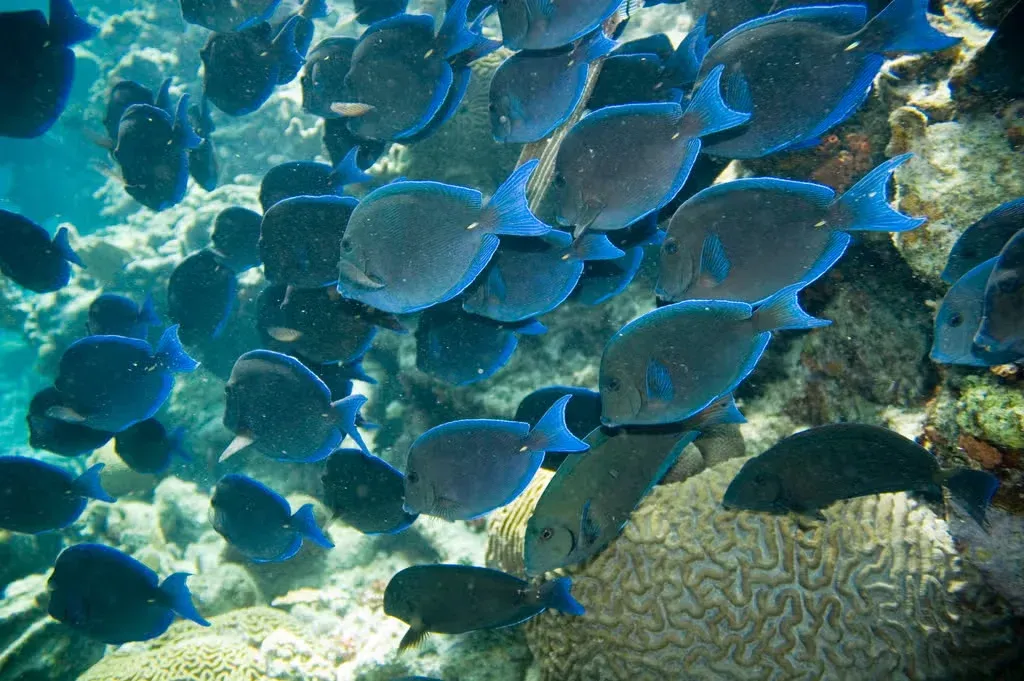
School of blue tang.
Paul and Jill via Flickr
- This fish, like the percula clownfish, became widely known for its role as Dory in the popular animated movie Finding Nemo.
- It goes by several common names, such as blue hippo tang, regal tang, royal blue tang, and palette surgeonfish.
- A seldom-seen variety of the blue tang exists, featuring yellow on the chest and belly. This coloration is only noticeable in larger adults; it appears very faintly on juveniles.
- Because these fish are extensively harvested across the Indo-Pacific, they are quite affordable. Smaller specimens typically cost around $25, while adults usually sell for $70 to $80 each.
- Tangs in general are prone to marine parasites like ich and lateral line erosion, so select your specimens carefully.
Behavior
- Blue tangs are not typically aggressive, which makes them suitable for community tanks. They generally coexist with many fish, but not with other surgeonfish.
- They can be quite aggressive toward their own kind, so some fighting is likely. In the wild, they school, and such behavior can be observed in large aquariums. If you plan to keep multiple blue tangs, you need a sufficiently large tank. Introduce them all at once to reduce aggression, since none will have established territories and most conflicts arise from territorial disputes.
Aquarium Size
- In the wild, they grow up to 12 inches, making them one of the larger fish available for purchase. Therefore, a tank no smaller than 100 gallons is required, and larger is always better; a 200-gallon tank would be ideal.
- Provide ample swimming space, as they are open-water swimmers. The tank layout should accommodate this.
- Given the heavy collection from the wild, you will likely find very small 1-inch specimens. Keep in mind that these juveniles will quickly outgrow smaller tanks within months.
Feeding the Blue Tang
Blue tangs are schooling fish that form large groups in the wild while grazing on algae across the reef, which makes them completely reef-safe. Once acclimated, they accept a variety of foods beyond algae, including krill, mysis shrimp, and brine shrimp—they are not finicky. As grazers, blue tangs consume a lot.
Algae
Make sure a substantial portion of their diet consists of algae, since they eat so much of it in nature.
- Nori is a suitable algae to offer. Its cost varies by brand. Some hobbyists consider Julian Sprung’s Sea Veggies to be pricey, but they produce quality algae sheets. These are also available as flakes, which simplifies feeding. Fortunately, many other brands offer nori intended for human consumption, with varying prices.
- You will need a clip to hold the nori sheet. You can purchase a commercial one or make your own. Some people roll and cut the sheets beforehand, but most feed them whole. Once secured, attach the clip to the tank side, then sit back and watch.
- Formula Two is a high-quality, algae-based mix for herbivores. It contains extra algae along with a blend of seafood, trace minerals, vitamins, and more, and comes as flakes, pellets, or frozen cubes.
Flake Food
- For yellow tangs, the best flake food would be Sea Veggie mixed flakes, followed by Formula Two flakes.
- If you want a well-balanced all-purpose option, New Life Spectrum pellets are a solid choice.
No Lettuce
- Never feed your tangs lettuce! I see this mainly in pet stores, likely to save a few dollars. Nutritionally, lettuce provides very little and should not be part of this fish’s diet.
Any questions or comments? Feel free to drop me a line below!
© 2009 PirateFX
Sources
- Essential Facts for Keeping the Regal Tang — pethelpful