Recognizing and Managing Hives (Urticaria) in Dogs
Taylor Mitchell
Sudden Bumps Under Your Dog's Coat
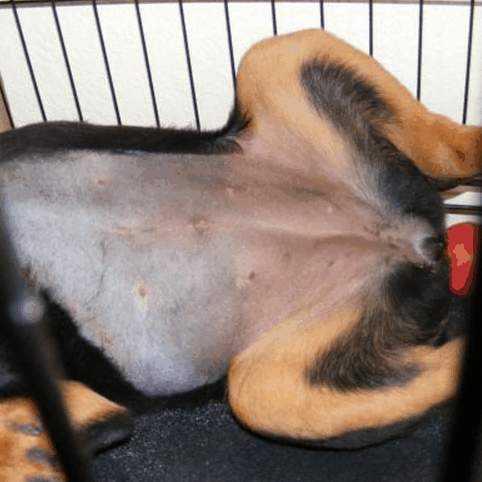
The medical term for hives, welts, or wheels on a dog's skin is urticaria. This skin rash shows up as uncomfortable, raised, red, and itchy bumps. These welts may be limited to specific areas such as the head, legs, belly, or back, or they may cover the entire body and come and go. Some owners liken them to dime-sized lumps on the skin.
Although welts in dogs have numerous possible causes, they frequently stem from an acute (sudden) allergic reaction. Vaccinations are a common trigger, which is why veterinarians often advise watching the dog closely for the first few hours after shots are administered.
Additional triggers include allergic reactions and contact with certain plants, insect bites, household chemicals, medications, foods, and even stress. In some instances, welts can point to other medical conditions. This article concentrates on welts caused by allergic reactions.
In This Article
- Common Causes of Welts on Dogs
- Why Does My Dog Get Welts on Its Body?
- Welts Can Indicate a Risk of Complications
- Veterinary Treatment for Welts in Dogs
- Natural Remedies for Nonsevere Dog Welts
Related: Does My Rescue Dog Have a Skin Infection?

It is important to find out which environmental allergen is triggering your dog’s welts.
Mitchell Orr
Common Causes of Welts on Dogs
- Grass pollen
- Dust mites
- Mold spores
- Insect bites or stings
- Food and medication
- Chemical exposure
- Vaccinations
- Stress
- Miscellaneous environmental allergens
Why Does My Dog Get Welts on Its Body?
When a dog's immune system mounts a response to an allergen, mast cells in the bloodstream release histamine. Histamine causes small blood vessels beneath the skin to leak, and the pooled fluid forms large welts.
In allergic reactions, welts can develop through direct contact with an irritant. This is known as contact dermatitis, and the reaction is usually confined to the area that touched the allergen. Consequently, welts or a rash often appear on the dog's feet and belly if the dog lies down on the trigger. Inhaled allergens like grass pollen, dust mites, or mold can also lead to welts, as can insect bites.
At times, identifying the exact trigger proves difficult, and the underlying cause of the welts remains unknown. A veterinary dermatologist may conduct tests for common allergens, but this process can be expensive and challenging.
Related: How Can I Treat My Dog's Contact Skin Allergies?
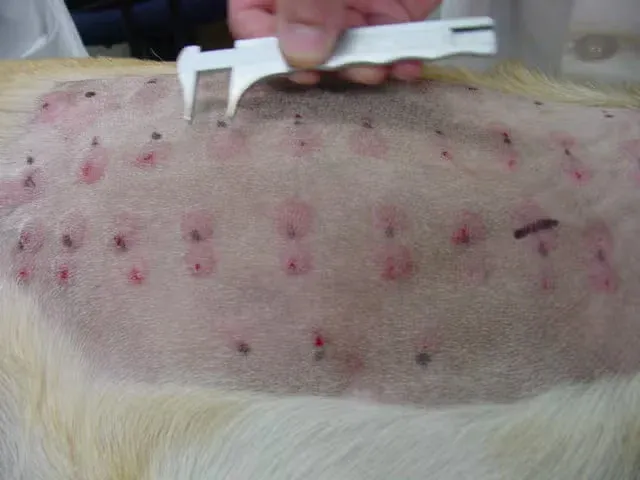
Testing a dog for allergies as they do in human medicine with transdermal injections
Caroldermoid CC-BY-SA-3.0
Welts Can Indicate a Risk of Complications
A concern with welts is that they may sometimes be accompanied by swelling of the lips, nose, and eyes, a condition medically referred to as angioedema. Eye swelling can be so severe that the dog cannot open its eyes, and such cases may need antihistamines and injectable steroids.
Severe cases can also extend to the throat (laryngeal edema), potentially obstructing the dog's airway and leading to anaphylactic shock. Other possible accompanying symptoms include:
- Vomiting
- Abdominal pain
- Diarrhea
- Shock
- Pale gums
- Cold legs
- Incoordination
- Sudden collapse
- Convulsions
- Death
In an emergency, time is critical. According to the Merck Veterinary Manual, dogs can die from anaphylaxis within minutes. These dogs require immediate veterinary care, which typically involves a shot of life-saving epinephrine. For those wondering, yes, EpiPens for dogs do exist!
Respiratory distress can occur if the angioedema involves the nares, larynx, or pharynx.
— Karen A. Moriello, DVM, DACVD
Time is of the essence in a veterinary emergency.
Veterinary Treatment for Welts in Dogs
To treat welts in dogs, the underlying allergy must be identified. Benadryl is an antihistamine that blocks histamine release and can help provide relief. According to veterinarian Dr. Christine M.:
“Plain Benadryl (diphenhydramine) can be given at a dose of 1 mg per pound of body weight every 12 hours until the dog’s symptoms are gone.”
It is always best to consult a veterinarian before giving Benadryl to dogs and to stop its use if the dog exhibits behavior changes such as excitement or lethargy. Benadryl should not be given to dogs with glaucoma.
Other prescription medications include Claritin (loratadine) and Atarax (hydroxyzine), which should be given under a veterinarian's guidance.
Prescription Steroids
For severe reactions, steroids are sometimes administered as a shot or as an oral medication (e.g., prednisone), but these drugs can have uncomfortable or severe side effects and suppress the immune system. In some cases, the dog may develop welts again once the steroid is out of its system.
Antibiotics for Secondary Infections
When dogs have rashes, constant itching and scratching can cause lesions and secondary bacterial or yeast infections, which may require a course of antibiotics. A veterinarian will need to diagnose these secondary skin conditions by analyzing a skin sample under a microscope.
These infections are often treated with antifungal or antibacterial shampoos such as chlorhexidine shampoo for bacterial infections and Malaseb shampoo (an antifungal).
Natural Remedies for Nonsevere Dog Welts
- Omega-3 fatty acids: Omega-3 fatty acids are also beneficial for the skin, but may take some time to kick in and provide relief. Veterinarian Dr. Kara recommends combining fatty acids and antihistamines, as they are more effective in combination than when used individually.
- Bathing under cool water: Bathing may provide relief, as it minimizes the time an allergen is in contact with the skin (pollen and grass accumulate on the skin). Oatmeal baths are soothing for dogs with allergies too.
- A hypoallergenic diet: If the vet suspects that the welts derive from a food allergy, a special hypoallergenic diet may be recommended. This means no more table scraps or treats. Common prescription diets often contain novel proteins a dog has not been exposed to before. Hypoallergenic diets need to be followed for at least two to three months or more for the effects to be seen.
Related: How to Give a Dog a Medicated Bath (Step-by-Step and FAQ)
Resources and Further Reading
- Moriello, Karen A., DVM. (2006). “Canine allergic dermatitis: Pathogenesis, clinical signs, and diagnosis.” DVM360.
- Smith, Katherine, DVM. (2021). “Dog Hives.” PetMD.
This article is accurate and true to the best of the author’s knowledge. It is not meant to substitute for diagnosis, prognosis, treatment, prescription, or formal and individualized advice from a veterinary medical professional. Animals exhibiting signs and symptoms of distress should be seen by a veterinarian immediately.
Questions & Answers
Question: How long does it take for welts to fade away on a dog?
Answer: This depends by a variety of factors such as how severe the reaction is, whether the trigger is still around (is the dog still exposed to it? It’s hard to say if the trigger remains unknown) and whether medications are given. Some dogs have them just for several minutes, others for hours and some for several days.
Often, Benadryl is not enough to control hives in dogs, and stronger meds such as prednisone are needed. Please see your vet for proper treatment. Sometimes welts may progress and cause trouble breathing which may turn into a life-threatening situation.
Question: We have tried so many things with our puppy. He is 4 months old and has had hives for 7 weeks now. What else can we do for our puppy’s hives?
Answer: Have you seen a board-certified dermatologist? If you have had repeated vet visits and got you nowhere, have tried medications, food trials etc. it may be time to see a specialist who has made of skin problems the area of specialty.
Question: What does a welt look like on a dog?
Answer: Welts in dogs typically appear as raised areas of the skin varying in shape and size. They are often itchy.
© 2016 Adrienne Farricelli CPDT-KA, Dip.CBST
Sources
- Recognizing and Managing Hives (Urticaria) in Dogs — pethelpful