Ways to Determine Whether a Female Dog Has Undergone Spaying
Avery Wilson
Understanding What Spaying Involves
When a female dog is spayed—sometimes referred to as fixed—she has undergone a surgical operation known as an ovariohysterectomy. During this procedure, the entire reproductive tract is taken out, which includes the ovaries, oviducts, uterine horns, and uterus. With these organs gone, pregnancy becomes impossible, and the dog no longer experiences the hormone-driven heat cycles that typically occur twice per year, though some breeds cycle only once annually.
Many new dog owners find themselves unsure whether their dog has been spayed, so this situation is far from unusual. A shelter might state that the prior owner had the procedure done, but taking that claim at face value can be risky. Perhaps the previous owners were uncertain themselves, or they may have concealed the fact that their dog was never spayed. Knowing the truth matters, particularly when intact males live nearby.
Eight Indicators That Can Reveal a Dog's Spay Status
The challenge is that spaying leaves no obvious external markers, and your dog obviously cannot communicate her history. Even if she could, she would not recall the operation. These days, dogs are frequently spayed at a very young age—especially those adopted from shelters—and the procedure is performed under anesthesia.
That said, certain clues can point toward a dog having been spayed. They include:
- A surgical incision from the spay
- Less pronounced secondary sexual characteristics
- No heat cycles occurring
- Veterinary medical records
- Tattoo or microchip information
- Hormone testing
- Ultrasound imaging
- Exploratory surgery
A veterinarian would naturally have more expertise in identifying these signs and deciding which tests make the most sense. Below, we examine each of these indicators and diagnostic options more closely.
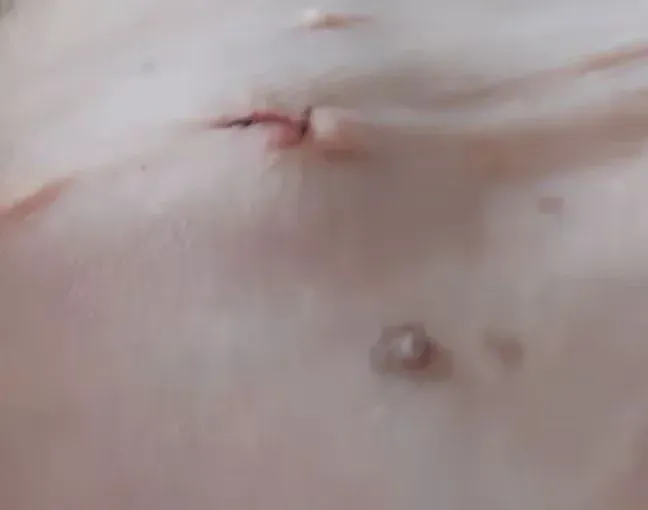
Close-up of a fresh spay incision before the sutures are absorbed
Alexadry, all rights reserved
1. Search for a Spay Scar
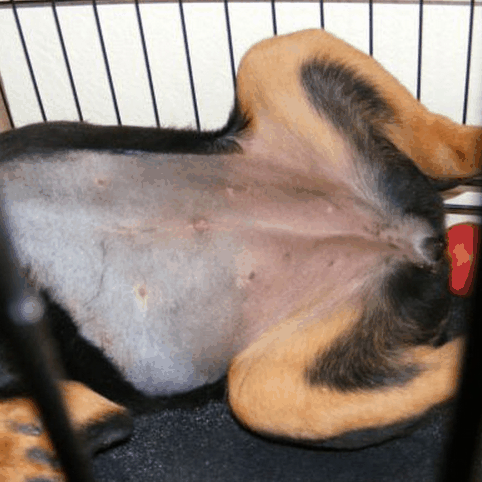
The spay operation involves opening the abdomen to access and remove the reproductive organs. Typically, the dog receives stitches that are either taken out later or dissolve on their own. As a result, most spayed dogs carry an incision mark. This scar, however, tends to be small and sits along the ventral midline, making it hard to spot. Shaving the belly may be necessary to locate it.
Important: Should you find or feel an incision on the abdomen, keep in mind that a hernia repair or a cesarean section could have produced a similar scar. Confirming with a vet is the safer route rather than risking an unexpected litter of puppies.
2. Examine Secondary Sexual Characteristics
A spayed dog may have smaller mammary glands, nipples, and vulva than an intact female. However, the ASPCA notes that no solid evidence supports treating differences in vulva size as meaningful.
3. Wait to See If a Heat Cycle Occurs
Sometimes the simplest approach is to wait and watch for signs of heat. While waiting, handle her as though she were intact, with all the responsibility that entails.
Most dogs come into heat roughly every six to seven months, but breed differences create many exceptions. A female Basenji, for example, might require a full year of waiting if she had recently cycled before you acquired her, since this breed typically cycles just once a year, usually in autumn.
Even so, exceptions exist here too. Occasionally, a dog who was spayed will still show heat symptoms if some ovarian tissue was inadvertently left behind during surgery. In such cases, the remaining tissue can still produce hormones that trigger heat-like signs. This scenario is uncommon, but it deserves mention.
4. Look Into Medical Records
Tracking down records can be difficult, yet the effort may pay off. If you know the former owner's name, for instance, you could contact veterinary clinics in your area to ask whether they still hold the dog's files.
Client confidentiality rules apply, but some offices may confirm a dog's spay or neuter status once you explain your situation. If your municipality requires dog licensing, animal control or the local city hall might also help, since they often keep this kind of data on file.
5. Inspect for a Tattoo or Microchip
Some dogs receive tattoos for identification, and these marks can also record reproductive status. Microchips are another thing to check—they can store important details, including whether spaying occurred. Reading a chip requires a universal scanner, available at a local vet or shelter, though shelters are supposed to scan for microchips before placing dogs for adoption.
6. Request Hormone Testing From Your Vet
When a spay scar proves hard to find, a veterinarian can offer alternatives. One option involves checking for a particular hormone, or examining cells gathered from the vaginal wall.
Measuring luteinizing hormone in the blood is one way to determine if a dog is fixed. A large proportion of spayed dogs show elevated levels of this hormone, while intact dogs tend to have lower levels. It is worth noting, however, that roughly 22% of intact dogs tested also had high levels of this hormone, because intact dogs experience short episodic surges in luteinizing hormone concentrations.
Another approach involves injecting a hormone and then drawing blood samples afterward to look for ovarian activity. These tests are not foolproof, but according to the Oklahoma State University Boren Veterinary Medical Teaching Hospital, they can offer a clearer picture and potentially spare a dog from exploratory surgery.
Broadly speaking, the following tests can assess a dog's hormonal status:
- Vaginal cytology sample (to detect cornified epithelial cells that signal estrogen stimulation)
- Luteinizing hormone test
- Serum progesterone concentration
- Anti-Müllerian hormone assay (measures Anti-Müllerian hormone, AMH)
7. Request an Ultrasound
An ultrasound can shed light on whether a dog was spayed, but it becomes tricky when ovarian tissue was left behind after the procedure. Remnants of ovarian tissue might sit almost anywhere within the abdomen, and even the most skilled ultrasound operators can struggle to locate them.
8. Consider Exploratory Surgery
As a final option, a vet may opt for exploratory surgery. This scenario most often arises with a dog who was spayed but retains some ovarian tissue—tissue that is hard to detect and may require a more direct, hands-on method to find and remove.
Always Involve a Veterinarian
As these points show, multiple methods exist for figuring out whether a dog has been spayed. Combining several of these factors offers a solid indication that your dog cannot reproduce. Consulting a veterinarian to establish your dog's reproductive status is always wise, and assumptions should be avoided—they can prove expensive.
Resources and Further Reading
- Dog Estrous Cycles | Cornell University College of Veterinary Medicine When female dogs enter puberty, they begin to have estrous cycles. The estrous cycle consists of four distinct stages.
- Ovarian Remnant Syndrome | Animal Surgical Center of Michigan If your dog or cat is showing signs of “heat” or estrus after she has been spayed, ovarian remnant syndrome is very likely the underlying cause. Clinical signs are usually all that is needed to diagnose the problem.
- Spaying a Dog: Everything You Need to Know | Small Door Veterinary Spaying your dog is an operation that stops her from reproducing, eliminating heat cycles and providing positive health and behavioral benefits.
This article is accurate and true to the best of the author’s knowledge. It is not meant to substitute for diagnosis, prognosis, treatment, prescription, or formal and individualized advice from a veterinary medical professional. Animals exhibiting signs and symptoms of distress should be seen by a veterinarian immediately.
© 2013 Adrienne Farricelli CPDT-KA, Dip.CBST