Home Management of Minor Dog Wounds When a Veterinarian Isn't Reachable
Hayden Carter
Managing Dog Wounds at Home: An Introduction
Some wounds are simply not suitable for home treatment. However, consider a scenario where it's the middle of the night and no emergency vet is accessible, or icy roads make travel impossible, or you lack transportation and no one can help. Would you just let your dog endure the pain? I wouldn't. If you feel the same, continue reading to learn what you can do.
Prepare a First Aid Kit in Advance
Having a basic first aid kit at home is essential at all times. (Check this article to gather all necessary supplies before an emergency occurs.)
For treating cuts or minor wounds on your dog, the kit should contain sterile bandages, tape, a small bottle of hydrogen peroxide, and another bottle of betadine or chlorhexidine—disinfecting solutions that can clean wounds.
If you already have a well-stocked human first aid kit, you can use it, but you should also have elastic wrapping that the dog won't tear off and a pair of bandage scissors designed for use with dogs. These scissors won't prevent you from accidentally hurting your dog if they wiggle while you bandage the wound. Purchase them at your local pharmacy when you buy betadine.
Once your first aid kit is ready and before you begin, try to have someone help you hold the dog and use a muzzle. (I use the one listed here because it's inexpensive and crucial when treating wounds—almost all dogs will bite when in pain. Buy the correct size for your dog and keep it in your first aid kit.)
Even a dog that wouldn't normally bite may become upset and bite during wound cleaning. If you don't have a muzzle yet, watch the video below and apply the next best alternative before starting.
Step-by-Step First Aid for Your Dog's Wound
There are several straightforward steps to care for a wound, but the approach depends on whether the dog is bleeding. If bleeding is present, address that first. Bleeding from a bite wound is far less serious than bleeding from running into a glass door, jumping out a window, or stepping on glass or metal. Below are the basic techniques every dog owner should know for handling dog injuries at home:
- Attempt to stop the bleeding by applying pressure. Place something over the wound and press down to allow small vessels to clot and stop seeping blood. For a small wound, a gauze square works; for a larger one, grab a clean towel. The wound isn't clean yet, so using something from around the house is fine.
- Control more severe bleeding. If bleeding from your dog's wound is really bad, there might be a "pumper," and blood will shoot out with each heartbeat. This is common if the wound is deep, such as a cut foot. Applying pressure to this wound won't help since it will still bleed. Get a pair of forceps from your first aid kit, reach into the wound, and clamp the tip of the vessel shut. This isn't easy, but keep trying. If you can't stop the bleeding, the dog might bleed out and die. If the bleeder won't stop and you can't clamp it, you'll have to do whatever you can to get them to a veterinary emergency clinic.
- Clean the wound. A bite wound can be quite small, but since a tooth "injects" bacteria under the skin, it will be dirty and infected. "Road rash" will be larger and may look worse but is actually much cleaner. You can use the betadine from your first aid kit to clean around the wound, but to actually clean it, you can use plain tap water. (Use the large syringe in your first aid kit. Fill it with water and spray the wound to flush out bacteria.) Tap water is less irritating than most things we used to pour into wounds. If there is any gravel, twigs, or other material in the wound, now is the time to remove them.
- Disinfect the wound. Your first aid kit should include some dilute betadine or a mild chlorhexidine for cleaning wounds. Never clean a dog's wound with hydrogen peroxide. It will damage the tissue and cause the wound to heal even slower.
- Apply a temporary bandage. This is not a regular bandage with tape and a roll of elastic. A gauze square will work fine on most wounds. Put a small amount of KY on top of the wound to keep hair from falling in, then place your temporary bandage on top. You don't need to tape up the wound or wrap the foot at this point. Just cover it so it doesn't get even dirtier as you work around it.
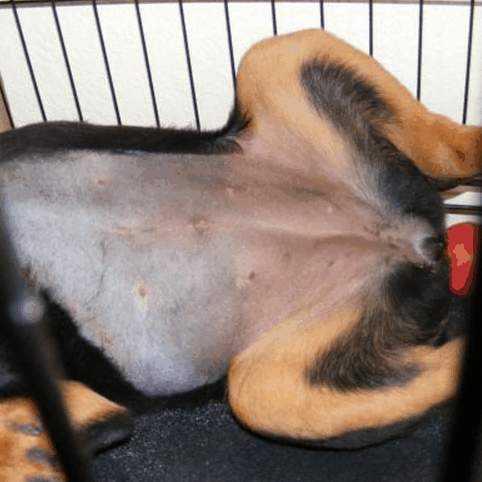
- Clip the hair around the wound. This is really important to help keep the wound clean. Use your scissors (be careful!) to clip the long hair around the wound and collect the hair so it doesn't get the wound dirty. Wash your hands to remove all hair before finishing.
- Remove the temporary bandage, clean off the lubricant, and clean again if needed. As long as the wound is clean at this point, you can proceed to finish.
- Close the wound if possible. If you're doing this at home, you obviously cannot suture the wound; if you've cleaned it and flushed it with water, go ahead and pull the edges together before bandaging, if this is even possible. (Butterfly bandages work great on a small cut.)
- Clean open wounds again. Open wounds are more likely to become infected. If the wound is still open, clean it again with some water and use a gauze pad to gently scrub the tissue before disinfecting.
- Apply a thin layer of antibiotic ointment. You should have a small tube in your first aid kit. This layer should be thin, just enough to keep more bacteria from entering the wound. Cover it up immediately so the dog doesn't just lick it off. (If the wound is somewhere that cannot be covered and you're worried the dog will lick the antibiotic off, it's better to use coconut oil since if he does lick it, it won't hurt him.)
- Put on a final bandage. If the cut is on your dog's side or back, a square bandage will do. If it's on one of the limbs, you can put on a square bandage and then put an elastic bandage on top to hold it in place. If you do use a roll bandage on the limbs, you need to make sure the toes are visible when you're finished. The toes on a normal dog are parallel and close together. Check the foot every hour to make sure the toes look exactly the same as when you started (compare the toes to the foot that is not bandaged if you need to remember what normal looks like). If there is any swelling, you need to take the bandage off and wrap it a lot looser. If you don't, you can cause your dog to lose their leg.
If you've done a good job cleaning the wound, your dog might be okay with simple first aid. A small cut will heal within about a week, but expect it to take longer if it's a larger case of road rash.
Will My Dog Need Antibiotics and Pain Meds?
Wounds that are very dirty (like a bite wound) will probably need antibiotics if not flushed immediately. If the wound needs to be sutured, or it's a large open wound that will become infected, take them to your veterinarian as soon as possible to start antibiotic therapy.
If the wound is severely inflamed or is swollen with pus, your dog has an infection and should be put on antibiotics. Take them to see your regular vet at that time. Your vet will also need to determine if your dog needs pain meds, based on the severity of the wound.
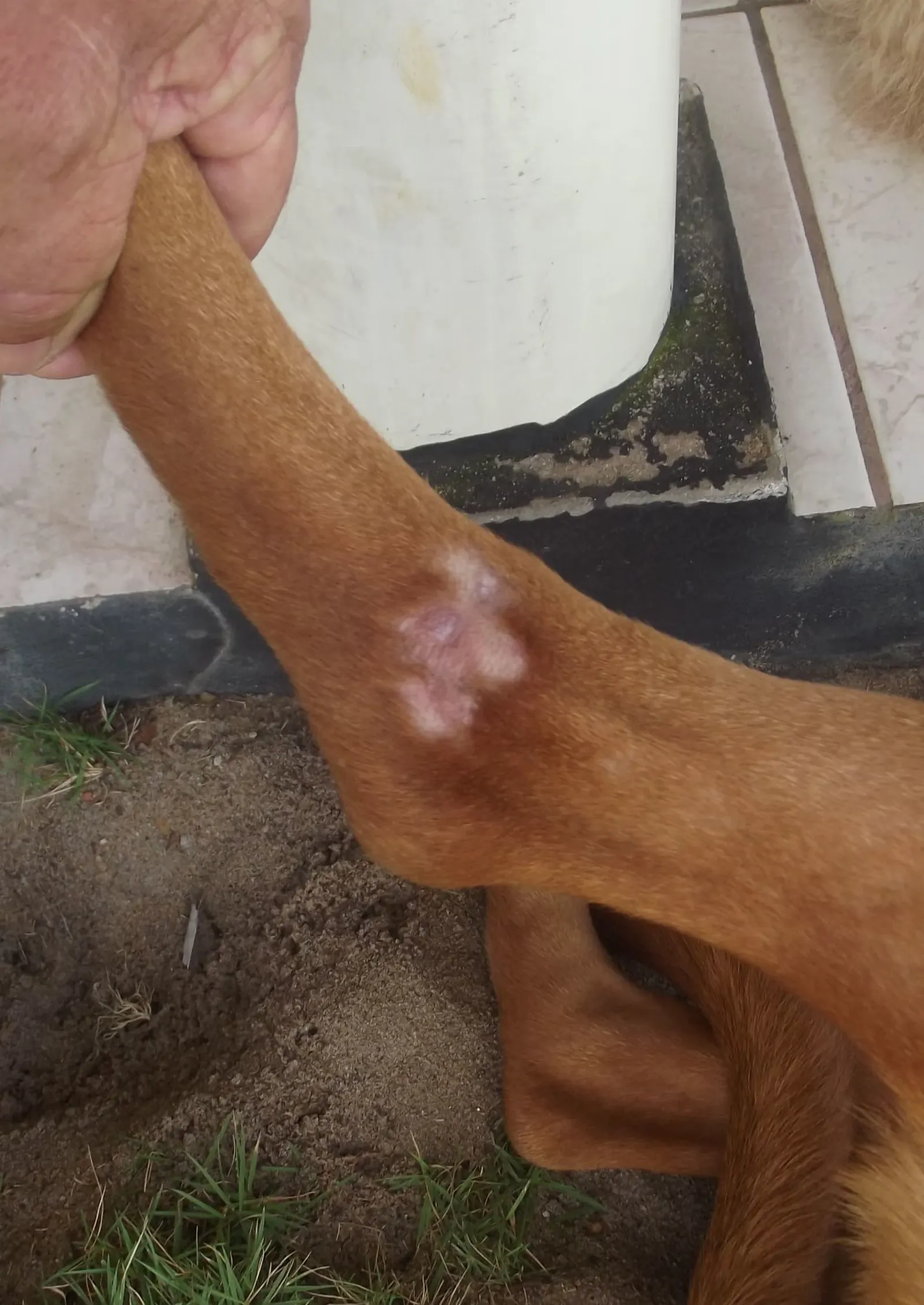
“Road rash” is dirty and should never be closed.
DrMark1961
Should My Dog's Wound Be Closed or Left Open?
A small simple wound may be closed after cleaning. Small wounds that are sutured heal quickly and produce very little scar tissue. If you've cleaned up your dog's wound well, you can try to appose the edges and apply a bandage that will allow it to close and heal even quicker. Some wounds, especially on tissue like that of the nose and footpad, cannot be closed with sutures and are sealed with a surgical adhesive that is similar to super glue.
If your dog has jumped through a glass window and has numerous small wounds that are bleeding, closing them after cleaning is sometimes the best alternative, but if you can apply some pressure and bandage the wounds, it's better. As super glue is working, it gets hot and really hurts; don't be surprised if he tries to get away or bite. Only do this if absolutely necessary.
Do not use this super glue technique on a bite wound. Bite wounds are dirty, and you will be trapping the bacteria, causing an abscess; no matter how bad it looks, it must heal from the inside out.
Do not use super glue to close wounds after road rash, do not use it on lacerations that are dirty, and do not use it if there is any chance the wound might be infected. These wounds should be left open.
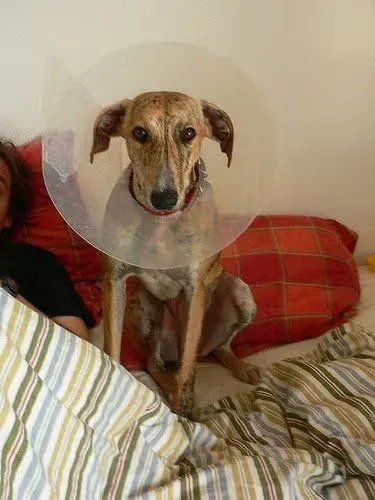
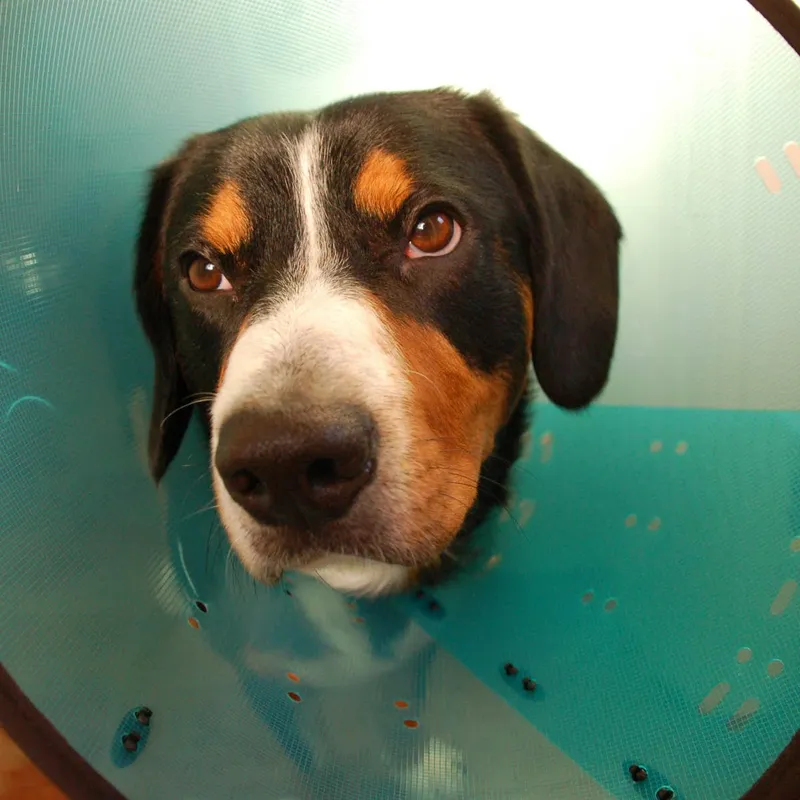
If you take your dog to your vet for further care, they will probably put a collar on them so that they cannot chew on the wound.
cc flikr.com
Cleaning Up
When you're finished, there will be a mess. Hydrogen peroxide breaks up red blood cells and makes cleaning up a lot easier.
Your dog will probably try its best to remove any bandage. Most pet superstores sell plastic collars that will keep your dog from reaching its bandage. If you're not able to bandage your dog's wound, an Elizabethan collar will also prevent your dog from licking the wound. Dog saliva will not make a wound heal faster.
Check the wound daily to make sure it's not infected or in need of further treatment. Your dog will appreciate your efforts.
Questions?
If you have any questions about this article or other health issues with your dog, you can contact me at my Ask a Vet column at Pethelpful.com.
Sources
Beardsley SL, Schrader SC. "Treatment of dogs with wounds of the limbs caused by shearing forces: 98 cases (1975-1993)." J Am Vet Med Assoc. 1995 Oct 15;207(8):1071-5. i.nlm.nih.gov/7559049/
Questions & Answers
Question: My dog has a deep cut in his skin. It didn't hurt the muscle, and it's a centimeter wide. What is the best treatment for this?
Answer: The best thing you can do for a deep cut, even if it does not sever any muscles, is take your dog to your regular vet and have the skin closed with sutures.
Question: My dog has bite punctures on his legs. I tried to pick him up so I could clean them, but he growled and tried to bite me. One of the punctures is very deep. I don't have the money for an emergency vet check. What can I do?
Answer: Bite wounds are very dirty. The wounds will need to be cleaned thoroughly. The vet will sedate your dog, put a muzzle on him so that he cannot bite, and then flush each wound before putting your dog on antibiotics.
If you cannot take your dog to a vet, the only thing you can do is to clean each wound with povidone iodine. You will need to muzzle your dog first. If you cannot muzzle him so that you do not get bit, there is not another option.
Question: My dog lost a toenail that got caught up while playing with a neighbor. Will the nail grow back? We cleaned the area with water, stopped the bleeding, placed a small amount of bacitracin in the area and used sterile gauze to bandage it. Is this sufficient?
Answer: You did a good job cleaning it up, but you should still monitor it for the next few weeks and treat it if it becomes infected. You can use an over-the-counter iodine solution (that you can purchase at a neighborhood drug store) to keep it clean.
Yes, the nail will grow back. Just keep it from becoming infected in the meantime.
Question: My miniature pincher had a small growth on his shoulder, I noticed it was gone but there is an oozing hole there now. Can I put cortisone cream on it?
Answer: The reason I do not put cortisone cream on a dogs wound is that they lick it. Those creams are not meant to be consumed.
A much better thing to do is to clean it with povidone iodine. I also treat most small wounds with coconut oil to increase healing time.
Question: My dog has been knuckling, and has worn a hole into his foot above the toe, and has gotten it infected. What can I do? I'm on a fixed income, and cannot afford vet bills now that I am disabled.
Answer: Cleaning it up should be no problem. You can use a mild product like povidone iodine. I do not recommend you put any antibiotic cream on the spot since dogs usually just lick it off, but if it is still inflamed some virgin coconut oil might help.
If your dog is knuckling over though, he may have a neurological problem or be suffering from an orthopedic disease. I realize it is going to be difficult to get him in for an exam, but you need to try to get him to your regular vet for an exam as soon as you can.
Question: My dog has two wounds around the neck, how should I clean them?
Answer: It depends if they are scratches, deep lacerations, bite wounds, etc. If they are bites, they should just be cleaned and left open to heal by secondary intention. If the wound is deep, like a laceration from a knife, it can be cleaned up as described in the article, but will need to be sutured closed by your regular vet.
Question: My dog has a small puncture wound. I cleaned it and put on antibiotic cream. Will my dog be ok without going to a vet?
Answer: A small puncture wound is usually fine if you cleaned up and left it open so that an abscess does not form. Keep an eye on it, but you should have nothing to worry about.
If your dog has a large wound that requires stitches, however, he will need to be seen by the vet.
Question: My dog was hit by a car, and she has a scrape on her head above her eye that looks like road rash. It's not deep, but I'm really worried but can't make it to the vet. What should I do?
Answer: Road rash cannot be closed up, so the best thing you can do is clean it up. Use povidone iodine or chlorhexidine, make a lather as you scrub and clean with plenty of water.
Be careful! This hurts, and some dogs will bite.
Even if you cannot make it to the vet at this time, take her in as soon as possible for a thorough physical exam.
Question: Can I put super glue on my dog's bite wound if I clean it? I don't have the money for a visit to the emergency vet.
Answer: If you close the wound up with super glue, it will probably become infected and then break apart, leaving an even bigger wound.
If you cannot take your dog to the emergency vet, the best thing to do is to clean the wound and then leave it open to heal. This is called "healing by secondary intention." It is more likely to leave a scar, which is why people do not want their wounds to heal up that way, but dogs do not usually care about scars, so that might be the best option.
Question: My dog had surgery and was licking the wound. Instead of putting a cone on, I bought a band-aid type bandage and put it on her thinking it would help. I didn't realize how sticky it would be, and I can't get it off without seriously hurting her. Is there anything I can use to help with the removal? Or will it fall off by itself in time?
Answer: It will eventually fall off, but the wound underneath the bandage can be pretty severely infected by that time. When someone brings in a dog with a stuck bandage, I usually moisten it with hydrogen peroxide. You can also use betadine as it is less stressful if the dog has an open wound.
Do not use alcohol. It will sting, and your dog might get upset and bite.
Question: Can I use NewSkin on my dog?
Answer: As it sets it tends to burn. If your dog is very mild it can be used in place of sutures but you may end up getting bitten.
The problem with sutures is secodary infections. If the wound is not very clean, the bacteria multiply, the wound breaks open, and you are dealing with a problem even worse than before. It is often better to let a small wound stay open and heal naturally.
Question: My dog jumped into a lake when he got loose. Unfortunately, there were branches so I couldn't jump in to get him. He eventually got out but he had a cut on his head. He's not bleeding but has blood on the wound. Do I have to worry?
Answer: It is impossible for me to judge how deep the wound is over the internet. I would recommend following the directions in the article. If you clean the wound and it is deep you may need to take him to your regular veterinarian. It does not sound like an emergency so please do not worry.