Nasal Discharge in Dogs: Causes, Concerns, and Care
Quinn Murphy
What Could Be Behind Your Dog's Runny Nose?
A clear, watery nose in dogs often isn't a cause for alarm. Excitement or nervousness is the most frequent trigger for a clear nasal drip, and allergies can also lead to a runny nose. In these instances, a vet visit usually isn't necessary. However, other underlying issues might require attention.
Potential Causes of Nasal Discharge in Dogs
- Excitement or nervousness
- Allergies
- Respiratory or lung infections (bacterial, viral, or fungal)
- Cleft palate or other abnormal openings between the mouth and nose
- Foreign objects (such as grass awns, though these more commonly lodge in the ear)
- Abscessed teeth
- Cancer
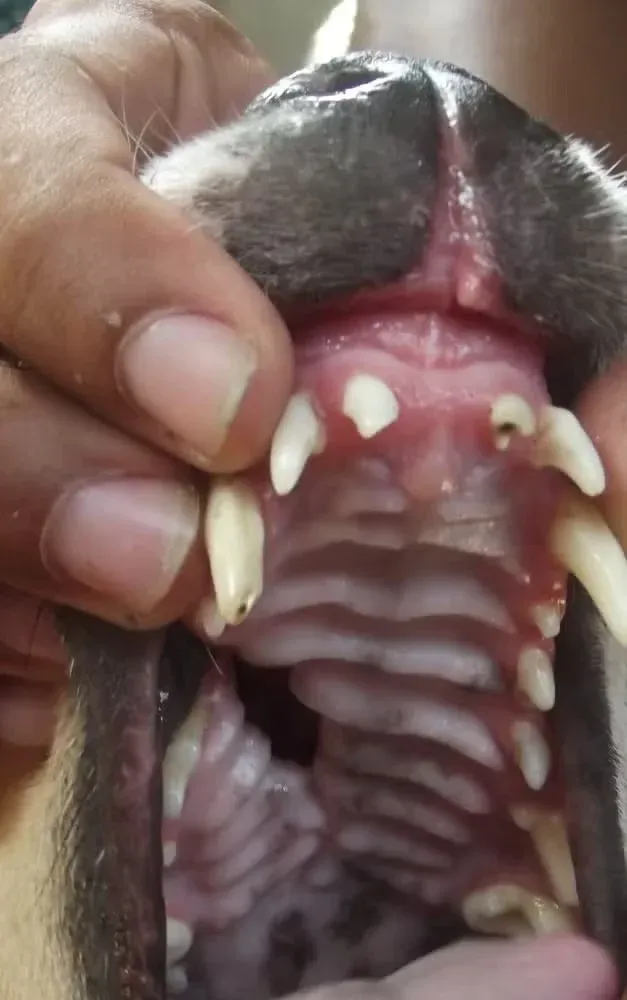
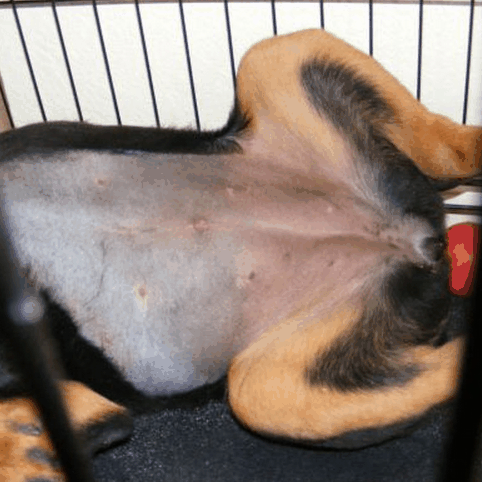
A dog with an oronasal fistula will have a runny nose from one side whenever he eats or drinks.
DrMark1961
Evaluating Your Dog's Runny Nose
Sometimes there's no need to worry.
- If a clear discharge appears only when your dog is nervous and stops once they calm down, it's likely harmless. But if it persists for hours, even if clear, it could point to a viral infection like canine distemper or parainfluenza, and you should consult a vet.
- Dogs with allergies typically show skin issues rather than the runny nose and watery eyes seen in humans. If your dog has a clear runny nose along with itching, addressing the itching may stop the discharge. If you prefer a natural approach, some alternative remedies for allergies exist, but they require time and commitment.
- A thick, green or yellow discharge that lasts several hours suggests an infection, and you should take action. You can gently clean your dog's nostrils with a warm cloth for comfort, but treatment depends on diagnosing the root cause. If you're hesitant about antibiotics, options like cat's claw, Echinacea, or Reishi mushrooms might help, but only after a vet has diagnosed the issue.
- Some dogs with a yellowish nasal discharge also develop coughing, breathing difficulties, or reluctance to move. These signs could indicate canine influenza, which requires veterinary treatment.
- If food, water, or discharge exits only one nostril, check inside your dog's mouth. You might spot an abscess, tumor, or trauma causing the problem. Home care is often limited, but in one case, a rotting stick causing an abscess was removed, and the puppy recovered on its own.
- Any blood from the nose warrants immediate attention. Even a small amount could be an early sign of a nasal tumor, a grass awn, a longstanding infection, or dental issues. A bloody nose can range from minor to serious.
- If your dog is lethargic, panting heavily, coughing, or struggling to breathe, the problem may be systemic. Seek veterinary care as soon as possible.
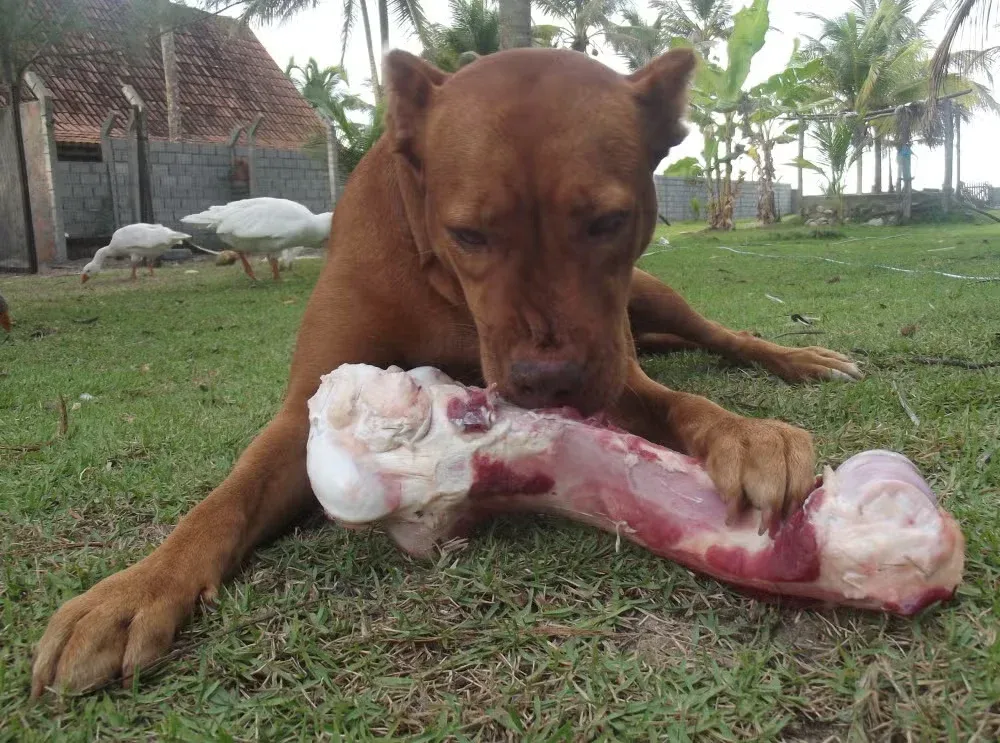
A runny nose can be caused by an abscessed tooth. A diet of raw meaty bones will keep your dogs teeth in good shape.
DrMark1961
Breeds More Prone to Runny Noses
Certain dogs face a higher risk:
- Flat-faced breeds (like English bulldogs, Frenchies, boxers, pugs) are more susceptible to infections and thick nasal discharge.
- Hunting dogs running in fields are more likely to get grass awns in their noses, leading to discharge.
- Hunting dogs may also experience trauma resulting in a fistula (hole) between mouth and nose.
- Small dogs without dental care are more prone to abscessed teeth.
- Long-nosed breeds (like the borzoi) have a higher risk of nasal tumors.
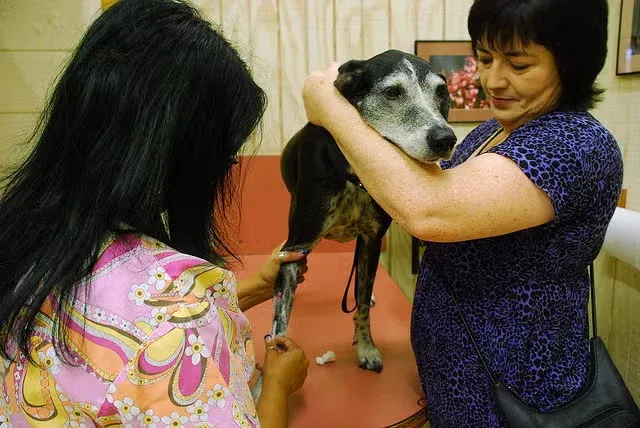
Your vet might need to do blood tests to figure out why your dog has a runny nose.
ikayama 3701670299 via Flickr (CC-BY)
When to See a Veterinarian
Not every runny nose requires a vet visit. However, if the discharge is thick or contains blood, you should investigate and help your dog promptly.
Your vet will start with a physical exam to check for lumps or dental issues, then may recommend a blood test (CBC) to detect infection. X-rays of the nose and lungs can reveal pneumonia or tumors.
Often, these steps are enough. If your dog bleeds from both nostrils, more tests are needed. A clotting time test can check for poisoning or bleeding disorders, and blood tests can screen for tick-borne diseases like Rocky Mountain Spotted Fever.
Additional Health Resources
- DIY At-Home Physical Exam for Your Dog A runny nose is just one thing to monitor; learn how to perform a home exam to know what's normal for your dog before seeing the vet.
Prognosis for Dogs with Runny Noses
The outcome depends on the cause.
Grass awns can usually be removed easily. Infections often respond to antibiotics, and even a runny nose from an abscessed tooth can be resolved by extracting the tooth and treating with antibiotics.
If cancer is the cause, not all cases are simple. Some tumors can be surgically removed or treated with chemotherapy or alternative methods, but if the cancer has spread to the lungs, management becomes challenging.
If your dog has a runny nose, get it checked promptly. Early treatment before the condition worsens can be life-saving.
Identifying the Root Cause
Apple cider vinegar is an alternative remedy that may help in some cases of runny nose. As stressed above, if you're unsure of the cause, have your dog diagnosed by a veterinarian before starting any treatment.
References
Windsor RC, Johnson LR. Canine chronic inflammatory rhinitis. Clin Tech Small Anim Pract. 2006 May;21(2):76-81. i.nlm.nih.gov/16711613/
Smith MM. Oronasal fistula repair. Clin Tech Small Anim Pract. 2000 Nov;15(4):243-50. i.nlm.nih.gov/11270001/
Brennan KE, Ihrke PJ. Grass awn migration in dogs and cats: a retrospective study of 182 cases. J Am Vet Med Assoc. 1983 Jun 1;182(11):1201-4. i.nlm.nih.gov/6345495/
This article is accurate and true to the best of the author's knowledge. It is not meant to substitute for diagnosis, prognosis, treatment, prescription, or formal and individualized advice from a veterinary medical professional. Animals exhibiting signs and symptoms of distress should be seen by a veterinarian immediately.
Questions & Answers
Question: My dog is one-years-old and has been having a runny nose, sneezing fits and acting overly attached for the past few days. Should I be worried?
Answer: The comment about being “overly attached” might mean that she is very sick. Most dogs do not show any behavioral symptoms until they are very sick.
The best thing you can do for her is take her for an exam so that your regular vet can check her temperature and listen to her lungs and monitor for any problems.
Question: My dog is almost fifteen and has a green discharge from her nose. What would cause this?
Answer: A green discharge from the nose is most likely an infection, so with a 15 yr old dog I would assume it was an infection in the teeth. I would want to check her for cancer though, and there is always the possibility that it is just an infection in the nasal cavity.
Question: My 16-month-old dog occasionally has a runny nose. However, the last few days it has been continuously running, and she has been sneezing a lot. She also has no interest in laying on the couch or bed which is not normal because she is always on the couch and bed. What could this be? What should I do?
Answer: If the discharge from your dog's nose is thicker than usual, she is likely suffering from an infection. This needs to be treated with antibiotics so you will need to take her to your vet for an exam. Please have your dog checked out as soon as possible.
Question: My Lhasa puppy is five-months-old. He has been inactive, dizzy and refuses to eat; his pee is also light red. What could be the cause?
Answer: There are many possibilities. His vet will ask you about his vaccine status, whether he has been dewormed, any possible exposure to toxins, and may need to do lab work to check his kidneys, liver, and a UA to check his urine.
With such a small puppy it is imperative that you have him checked by your vet as soon as possible.
Question: My French bulldog puppy had white discharge expelling from her nose. Should I be worried?
Answer: French bulldogs are prone to more respiratory problems because of their anatomy. I cannot tell you what the white discharge was, and it is possible that it was only a mild irritant or infection.
If your dog is showing any respiratory symptoms (nasal discharge, sneezing, coughing, snoring more than normal, etc.), then you should have her seen by your regular vet.
Question: My twelve-year-old Cavalier started coughing and has a cloudy white to yellow nasal discharge for nine months now. My vet has done blood tests and tried three different antibiotics. Do you have any ideas that can help?
Answer: If your local vet has not been able to diagnose your Cavs condition after exams, then I recommend you take him to the veterinary teaching college in your state. They have a lot better chance of figuring out what is going wrong, and will have access to better diagnostics than a regular practitioner. Your vet can give you a referral, or if this is not possible, he can refer you to an internal medicine specialist in the closest city.
Question: My 9-year-old Bulldog has lost weight, and her back gums are growing over her teeth. She also has a badly deformed spine. Now her nose is running and frothy. Is she just aging?
Answer: Periodontal disease will cause a dog to have gingival hyperplasia (gums growing over the teeth), and if they are infected, they may be causing a sinus infection too. Get her examined by your regular vet as soon as possible since she may need to have a tooth extracted and may need to be on antibiotics first. I do not know why her spine is deformed but you should point that out, and it may help to have that looked at during the exam.
Question: Can a clear runny nose be a reaction to vaccines given eight days ago? (Bortedella, DHPP, & Rattlesnake vaccines)
Answer: Definitely. I do not give my dogs that intranasal Bordetella vaccine because it sometimes causes the very thing it says that it will prevent.
Question: My 7 year old rescue Borzoi, which I’ve had for a month has a continual runny (clear) nose and sometimes eyes, but he is not itchy. Looking at previous vet records he’s had this for a long time, could it be allergies?
Answer: I have seen dogs from this breed that have clear runny noses but are in great health. The dogs are dolicocephalic and their anatomy makes them a little more prone to irritants.
If your dog is not having any other problems, and is not itching excessively, I would not recommend putting him on allergy medications.
Question: My 14-year-old Maltese has oronasal fistula; he has food caught in the holes in his mouth, has had an infection, and now he rubs his face after eating (we think he is trying to get the food out of the hole). What can I do for him?
Answer: An aged Maltese probably has an oronasal fistula because of an extracted tooth. Has your regular vet not discussed closing it? If you leave the fistula open, the food is always going to get in there, and the dog will always have problems.
If the dog is not a candidate for surgery, or you cannot afford it, the only thing to do is clean the fistula after each meal. There will probably still be problems.
Sources
- Nasal Discharge in Dogs: Causes, Concerns, and Care — pethelpful