Tackling Tear Stains on Dogs: Natural Cleaning and Prevention
Rowan Wood
Managing Tear Stains on Your Dog
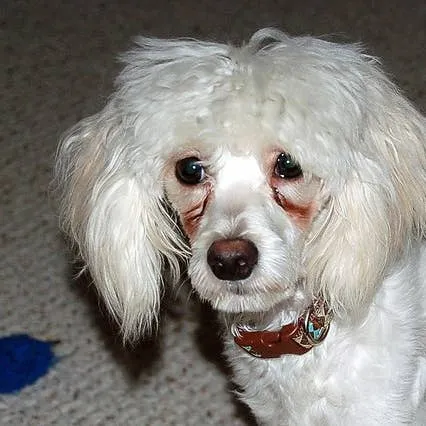
Tear staining is not a health threat, but it can be a nuisance for owners. My Maltese started showing stains around his face as a puppy, and I used several methods to keep the problem under control.
Some breeds are more prone to tear stains than others. Maltese, with their large eyes and small tear ducts, are almost always affected. Bichons, Poodles, and Chihuahuas may also have issues.
Will these methods work for your dog? There's no guarantee. If tear staining had a simple cause, there would be a universal solution. Instead, there are many approaches to try, which is common when a problem lacks a consistently effective fix.
In This Article
- What Causes Tear Stains on Your Dog’s Face?
- How to Clean a Dog’s Tear-Stained Face at Home
- Best Natural Methods to Prevent Tear Stains
- Other Solutions
Your dog’s tear stains can be removed naturally.
cc-by a_ninjamonkey 4967777229
What Causes Tear Stains on Your Dog’s Face?
- Allergies: Allergies to food are often blamed, which is why some owners find that changing diet eliminates the problem.
- Diet: Dogs can also be sensitive to dyes in inexpensive foods, so a diet change is sensible and sometimes reduces staining.
- Water: High mineral content in water can contribute to stains. Try demineralized water, and you can also train your dog to drink from a bottle to reduce staining around the mouth.
- Teething: Teething can cause tear stains, but it's temporary and resolves without treatment.
- Blocked tear ducts: Blocked or tiny tear ducts can cause staining. If tears overflow and keep the face wet, a yeast infection may develop, worsening the staining. Surgical repair may be needed.
- Dust or smoke: A dusty or smoky environment can cause tear stains. If your dog's eyes are constantly red and inflamed, she will tear excessively. The solution is to remove the source of contamination.
How to Clean a Dog’s Tear-Stained Face at Home
Some people shave the face to remove most tear buildup before cleaning. For stain removal, you can try herbal products (such as Pet Alive i-Clenz) and regular saline, but I prefer a cornstarch paste mixed with a little dilute hydrogen peroxide.
- Mix 1 tablespoon of peroxide and 1 tablespoon of water with cornstarch until thick and pasty.
- Apply the paste just under your dog's eyes.
- Let it dry before washing it out.
Important note: Apply carefully just under the eyes, in the stained area, and never let it get into the sensitive skin inside the eye. Peroxide can be irritating, but much less so than bleach, so I never recommend bleach.
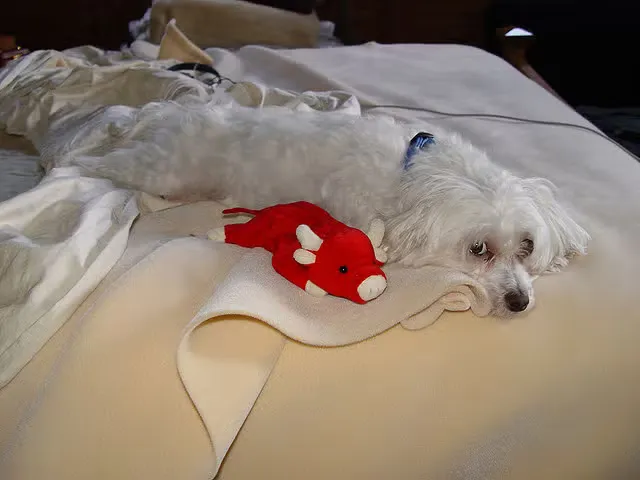
This is a happy, stain-free Maltese.
cc-by batwrangler 172602903
Best Natural Methods to Prevent Tear Stains
- Use apple cider vinegar: To prevent most stains from returning, add a teaspoon of apple cider vinegar to your dog's drinking water. This may not help if the staining is caused by cheap dyes in dog food, blocked tear ducts, or teething.
- Offer a natural diet: Some stains can be prevented by switching to a more natural diet. Even with commercial food, ensure it's free of dyes, chemical flavor additives, and excess carbohydrates. Read the label.
- Provide filtered water: Give your dog filtered (not bottled!) water. This helps in some cases, especially if your tap water is hard.
- Reduce smoke: If there's excessive smoke in your house from a fireplace, address it. You and your dogs will face more serious health problems than tear staining if you don't.
- Go to the vet: If the condition doesn't clear up, have your dog examined by your regular vet. The problem could be due to very small tear ducts.
Other Solutions
- Cutting the hair around your dog's eyes is a very temporary solution.
- Antibiotics may help for a while, but unless you're using them to clear up an infection on your dog's face, I wouldn't recommend them. Tear staining is ugly, but it is not life-threatening. Long-term antibiotic use carries several serious side effects.
If nothing works, learn to accept your dog. She is not a perfect piece of furniture to accessorize your living room; she is a living being with potential faults. Love her as she is—tear stains and all!
This article is accurate and true to the best of the author’s knowledge. It is not meant to substitute for diagnosis, prognosis, treatment, prescription, or formal and individualized advice from a veterinary medical professional. Animals exhibiting signs and symptoms of distress should be seen by a veterinarian immediately.
Questions & Answers
Question: What type of peroxide do you use for removing tear stains on your dog?
Answer: Regular hydrogen peroxide, 3%. It should be diluted with water and mixed with corn starch so that it is not a liquid and does not get into your dog´s eyes since it will irritate them.
Question: What can I use for stains around the dog’s mouth?
Answer: If the stains are mild, you can use the same natural cures for tear stains. If the dog drools a lot, it is not going to do a lot of good since the stains will just come right back.
Question: Is it okay to put apple cider vinegar into my Pomeranian´s distilled water? He gets urinary crystals and eats SO food.
Answer: I assume that you are monitoring your Poms urine pH since he is on SO. It should be less than 7. Apple cider vinegar will also do this, so with the SO it can become too acidic. Talk to your vet about getting some pH strips so that you can monitor the urine pH at home while starting this trial, or take a urine sample every week or so to check the pH.