The Curious Case of Canine Consumption: Understanding Why Dogs Eat Grass and Other Odd Items
Taylor Mitchell

What on Earth Did Your Dog Just Swallow?
My household has welcomed a number of dogs over the years, and each one, at some point, has done something that struck us as decidedly peculiar.
Take our two cockapoos, Mandy and Emmy. My mother would chase them around the yard in a fury because they not only sampled her treasured heirloom tomatoes but also crushed her flower beds in the process. As tomato season approached, it became almost a nightly ritual to hear “Mandy, you bad, bad dog!” and then see our well-fed pup at the screen door, her chin stained green from tomato vine juice, pleading to come inside and avoid punishment. Eating tomatoes by itself might not seem that odd, but the effort she put into reaching them was remarkable: she dug under and boldly leapt over barriers that grew steadily larger and taller.
Then there was Chui, who, as you might expect, chewed on everything. One evening she got hold of my sister’s lipstick and consumed the entire tube. The evidence made it obvious who the culprit was—dusty-rose paw prints leading from the bathroom straight to the dog bed removed any doubt. Perhaps this was payback for my sister and me pinning her down a few days earlier and coloring her head fur with highlighters in alternating shades like a faux hawk. But what possessed her to taste and then eat chemical-laced wax, we couldn’t fathom.
She also ate grass. True, my most vivid memory of this was after I fed her an entire block of cheddar cheese as part of a six-year-old’s “how much cheese can my dog eat?” experiment, but it was still strange to see her grazing in the yard like a cow. At least I got my answer: nearly all the newly bought cheese was gone, and in its place was a large puddle of bright green vomit. Remember, I was six!

When the baby needs a diaper change, Mahi is the only one who finds this concept exciting.
By xlibber (Sleepy Time Uploaded by russavia) [CC-BY-2.0]
Then there’s Mahi, our English Labrador. Often you don’t know what she’s swallowed until it comes back up, coated in bile. We don’t even catch her vomiting; we just step on something wet and find a soggy, half-digested remnant underfoot. Socks, paper towels, or her absolute favorite—baby wipes. When it’s time for a diaper change, Mahi is the only one who gets excited about it.
She’ll sneak quietly into the nursery while you’re busy changing the baby, and the moment you toss a wipe into the trash, she pounces, and in a flash it’s gone, swallowed whole. It happens so fast that I sometimes think I imagined it—until I’m walking around the next morning and step on something slimy. Pull out a wipe to clean spit-up, wipe a toy, whatever, and put it down anywhere, and she’s there, waiting, watching. You reach for it where you left it, and your hand closes on air.
So why do dogs eat things like tomatoes, lipstick, grass, and baby wipes, and with such enthusiasm, even when they’re fed a good amount of high-quality dog food? Why would they leap fences, dig through mud, and knock over furniture as big as they are to get to these odd treats?
Several theories attempt to answer this question.
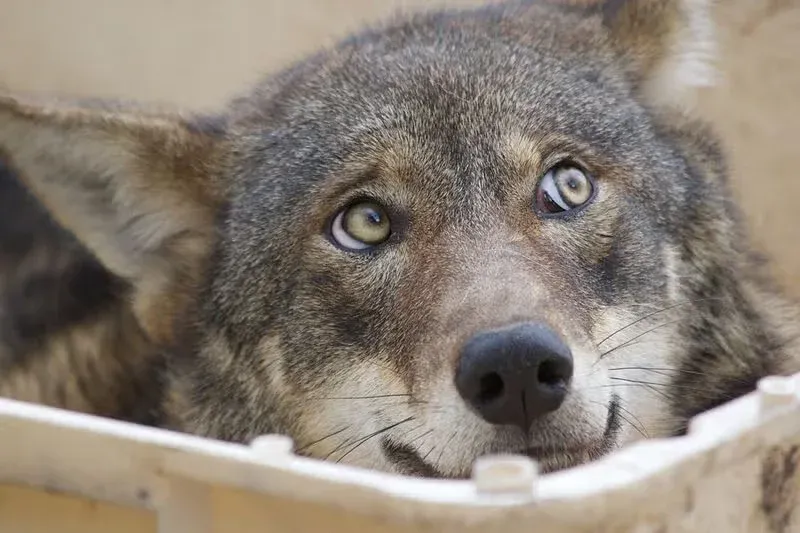
Our dogs are not going to act a certain way because we have decided that they should.
By United States Fishing and Wildlife Service (USFWS) [CC-BY-2.0]
The Modern “Wolf”
One theory centers on a simple truth: our dogs won’t behave a certain way just because we decide they should. The domesticated dog is a direct descendant of the wolf, so before we label a pet’s behavior as “strange,” “unusual,” or even “harmful,” we must recognize that it may be acting on traits retained from its wild, free-roaming genetic ancestry. In short, dogs may have nutritional or behavioral urges that could be satisfied in nature but aren’t met in our modern, human-centered environments.
With that in mind, why would a dog eat grass? Well, why wouldn’t it? A study of wolves in Yellowstone National Park found that their summer diet often included vegetation. (The wolves were pure carnivores in winter, but can you blame them for not wanting to dig through snow and ice for calorie-sparse twigs when energy conservation is critical for survival?) (1). It’s worth noting that although wolves are considered pure carnivores when they devour a kill whole, they also consume the prey’s stomach and the roughage-rich contents within it.
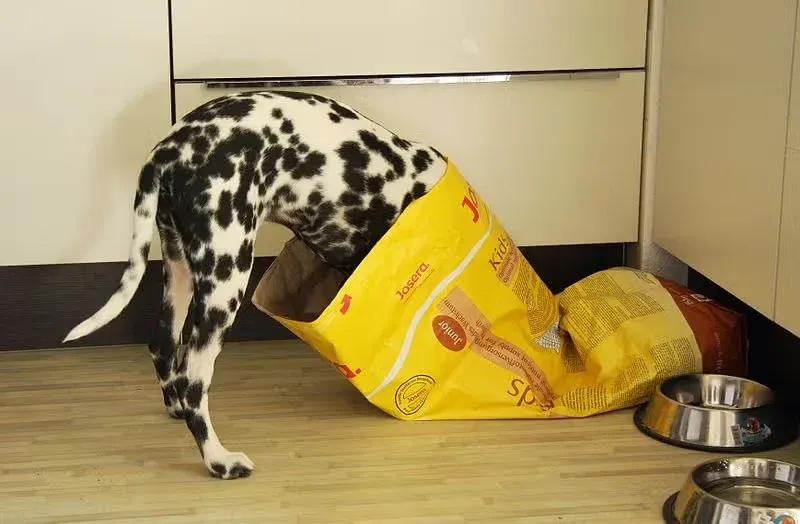
Our dogs may eat strange things just for the sake of eating, urged to chew and swallow by a subconscious need to consume as many calories as possible when possible.
By Maja Dumat (Flickr: Jedes Josera-Krümel ist kostbar...) [CC-BY-2.0]
To survive, wild wolves are opportunistic feeders and will eat fruits (tomatoes are fruits!) and berries, even insects and reptiles when other foods are scarce (2). This scavenging, eat-when-food-is-available instinct can still be seen in modern dogs. Mahi’s veterinarian said she would literally eat herself to death if given the chance, and I’m always amazed at the gusto with which Mahi attacks roadkill or barely edible items on her path, even minutes after enjoying a hearty meal complete with a bacon Beggin’ Strip dessert.
She’s not alone—next time you’re at the dog park, look at the roly-poly pooches barely able to support their plump bodies on their comparatively tiny, spindly legs. Our dogs may eat strange things just for the sake of eating, driven by a subconscious need to consume as many calories as possible when possible, to “survive” even when such behavior is no longer necessary or appropriate.

Wolves don’t have the luxury of being served breakfast, lunch, and/or dinner in a clean dish and washing it down with fresh water from a neighboring bowl like our pampered pets.
By Caesaria (Own work) [Public domain], via Wikimedia Commons
Boredom
Wolves don’t have the luxury of being served breakfast, lunch, or dinner in a clean bowl and washing it down with fresh water from a nearby bowl like our pampered pets. Instead, they travel miles and miles in search of food. Some packs are known to roam over 30 miles in a single day! (3). Now contrast that 30-mile figure with the amount of exercise you give your dog. I’m guessing your daily routine falls far short. Not that that’s necessarily a problem…
After all, dogs, though related, aren’t actually wolves. Most don’t have the same endurance (I once pet-sat a mini dachshund that found running the length of the room, tiny legs pumping a mile a minute, exhausting), but most do have the same innate need to run, jump, and sprint daily for optimal health and energy release. And while domesticated dogs also don’t (hopefully) need to actively search for hours for their next meal, that doesn’t mean the drive to seek out, chase, and devour prey has vanished either. Just ask your neighbor with the cat.
This brings us to a possible explanation for why your dog may devour seemingly “inedible” things left lying around: boredom. Without running around looking for food and then throwing itself into the thrill of the hunt and chase, the dog has to fill its free time somehow.
And if its owner is out working or zoned out in front of the TV, pizza in one hand and a beer in the other (in other words, not going anywhere anytime soon), tearing apart a discarded sock or snacking on a stick of lipstick is far more entertaining than the alternative: lying around doing nothing. A dog still requires physical and mental stimulation, and it knows how to find it when it’s not provided!

The imbalanced diet theory
By carterse (Flickr: How Others See Me) [CC-BY-SA-2.0 (ivecommons.org/licenses/by-sa/2.0)], via Wikimedia Commons
Nutrient Deficiency
Then there’s the theory that focuses on a different problem: an imbalanced diet.
The dog caught grazing on the lawn may lack dietary fiber. Ideally, pet foods should contain 2-4% total (4). Less than that, and your dog will need to supplement by nibbling your backyard greens…or suffer chronic constipation. On the other hand, foods with levels over 10% can do more harm than good, creating larger, more frequent stools and leading to flatulence…not a good thing for the dog…or the humans nearby (4).
Similarly, things like baby wipes or diaper rash cream (yes, I’ve also found Mahi, snout stuck in the A&D jar) often contain various vitamins or minerals a dog may need or be deficient in. Aloe vera juice, the second ingredient in Pampers Sensitive Wipes, has vitamins A, C, E, and B12, folic acid, choline, and 9 minerals, including calcium, potassium, and zinc (6). Lanolin, the main ingredient in A&D diaper rash cream, is a great source of vitamin D-3. In fact, lanolin is often recommended as an alternative supplemental source for people allergic or intolerant to fish oil and who need more of the vitamin in their diet (7, 8).
Both products, though hardly palatable to you or me, do have important nutrients that may make them a highly desirable snack to a dog. (This may also explain why after I apply deodorant, sunscreen, or any moisturizing lotion with various vitamin-based skin-softening ingredients, I have to literally run out the door or be licked clean).
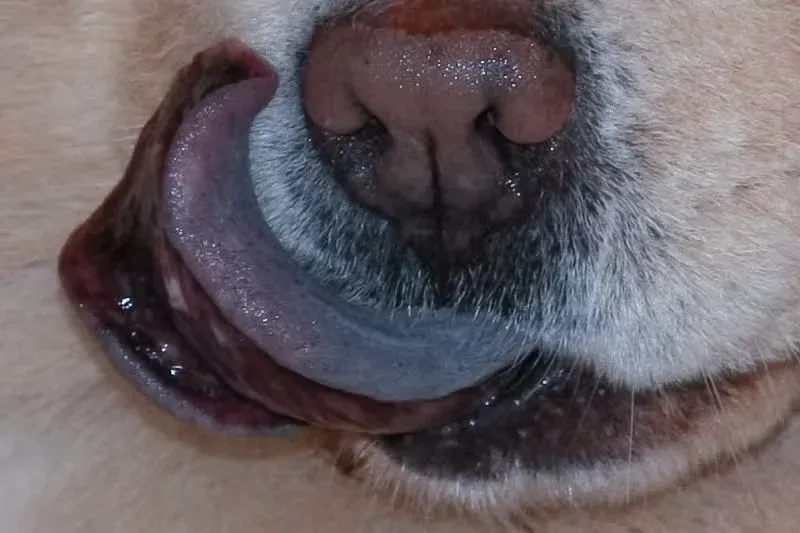
Even lipsticks contain various waxes, oils, and fats (as well as lanolin) that a dog might need.
Ebertek at en.wikipedia [CC-BY-SA-3.0]
Even lipsticks contain various waxes, oils, and fats (as well as lanolin) that a dog might need. Beeswax, a very common cosmetic additive, is used medicinally by individuals who want to reduce cholesterol levels, fight pain, minimize inflammation, or cure diarrhea (9). It may be similarly helpful to a pooch. And humans aren’t the only ones who benefit from consuming olive oil, also sometimes present in lipstick and packed with both omega-6 and omega-3 fats.
So was Chui’s ingestion of my sister’s makeup revenge? Probably… as eating an entire block of cheddar cheese most likely set her up to satisfy her fat requirements for life. But possibly not.
Disease
Then there’s the theory we all dread: that our dogs perform strange behaviors due to some underlying medical condition or ailment.
Let’s again address the grass-eating canine, whose behavior most attribute to a need to regurgitate and empty the contents of an upset stomach because they are “sick.”
Believe it or not, although most people think that they should, dogs do not usually throw up after eating grass (a practice which, in addition to wolves, is frequently seen in wild dog populations). In fact, less than 25% of dogs vomit and fewer than 10% look unwell before ingesting greens, according to certain studies (10).
Could the dog be eating grass because it has some sort of non-obvious affliction, such as an internal parasitic infection? Well, again, if dogs are trying to eat grass to expel parasites from their body and they fail to vomit, they also fail in the expelling. What about the other direction, you may wonder (via the feces). It’s possible. But it’s far more likely that they get infested by eating contaminated grass than that they cure a present infestation with grass eating.
The experts seem to believe that routine grass eating of clean, chemical-free lawns is okay and normal, but only if the dog does not throw up. Some even believe that dogs simply like the flavor or texture of grass (11). I’m sure Chui enjoyed the flavor of the cheddar cheese (as do I) and perhaps Pampers wipes or diaper rash cream are similarly yummy, to a dog…I will not be determining how good they do or do not taste myself.
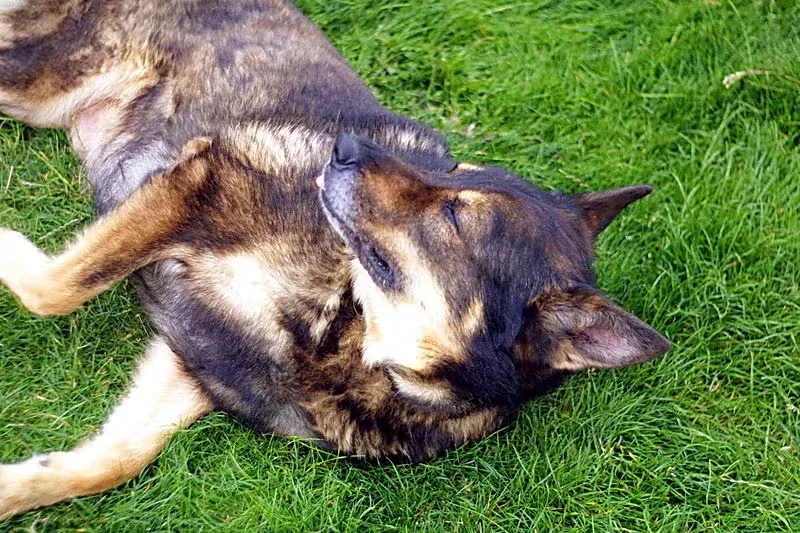
The ASPCA website has a listing of foods dangerous or toxic to pets that is worthwhile reading.
s.wikimedia.org/wiki/File:Dog_tongue.jpg
Is Odd Behavior Dangerous?
Odd behavior is not necessarily dangerous behavior or indicative of a serious problem. Experts do warn, however, that sudden changes could be a cause for concern. Did your dog abruptly, out of nowhere, for the first time in its life gobble down a large amount of grass and then vomit repeatedly? Did your dog who’s usually calm and well-behaved suddenly knock over and eat all of your cosmetics in one sitting? A veterinarian’s opinion as far as whether there may be an actual issue, whether one of a physical or psychological (stress, anxiety, etc.) nature, is recommended in such instances.
And, of course, making sure that whatever your pet did eat isn’t toxic is always a good thing to do…The ASPCA website has a listing of foods dangerous or toxic to pets that is worthwhile reading. And, if in doubt, don’t hesitate to call and ask your veterinarian. You may feel silly asking questions such as “Will my dog be seriously ill since she just half-ate a dirty diaper?” but, knowing what dogs are capable of, I’m sure they’ve pretty much heard it all.
This article is accurate and true to the best of the author’s knowledge. It is not meant to substitute for diagnosis, prognosis, treatment, prescription, or formal and individualized advice from a veterinary medical professional. Animals exhibiting signs and symptoms of distress should be seen by a veterinarian immediately.