When Affection Between Humans Triggers Canine Interruption
Taylor Mitchell
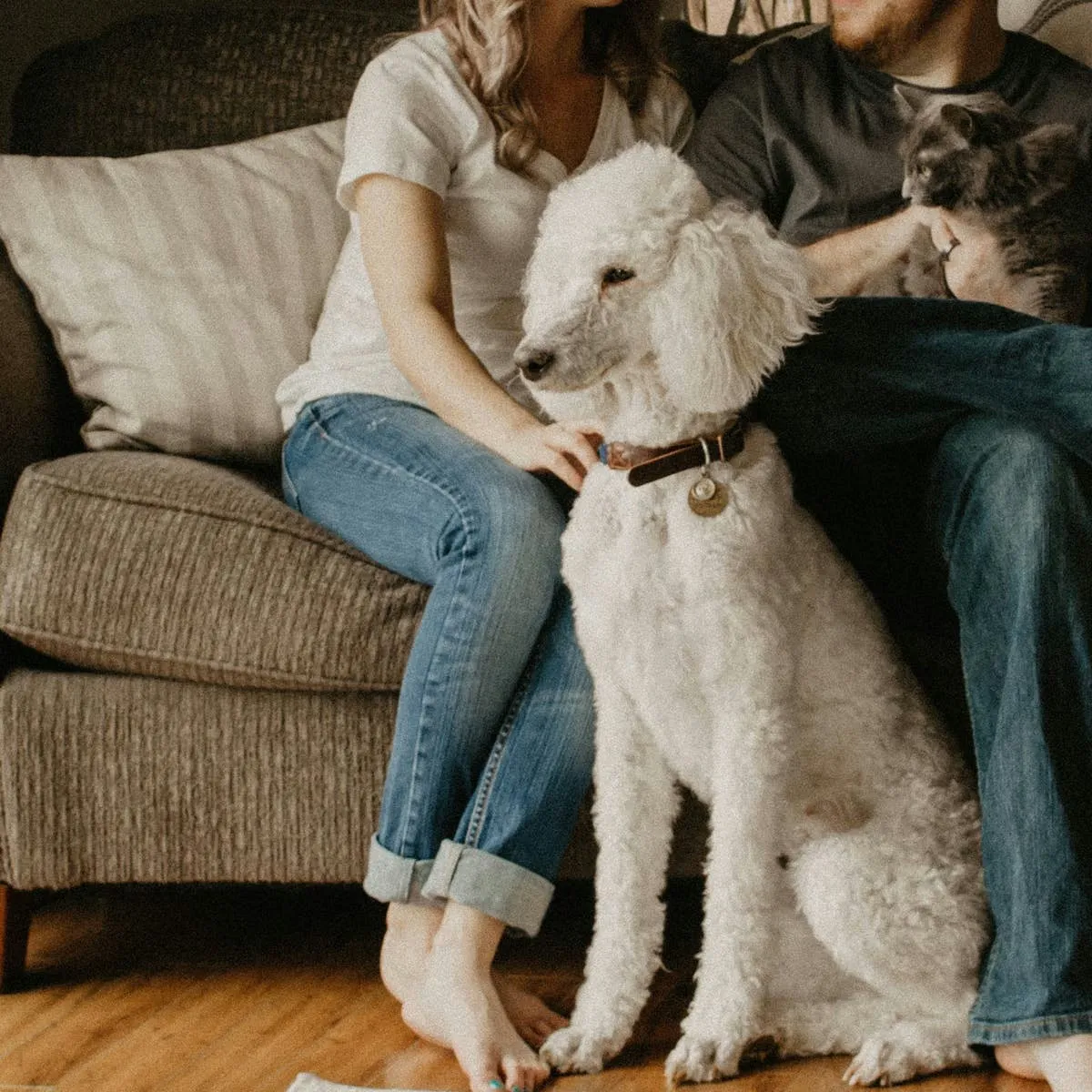
Why Does a Dog Push Between Partners During a Hug?
Picture yourself relaxing on the sofa with your significant other, the movie fading into the background and the popcorn forgotten. The moment becomes romantic, and you begin to embrace and kiss. Then, without warning, your dog inserts himself squarely between the two of you. You send him away, but the pattern repeats until you finally confine him to a crate or another room.
Many pet owners encounter this scenario and quickly label it jealousy. But is jealousy really what dogs experience toward humans? Or is there a more straightforward reason behind the behavior?
Related: Why Is My Dog Suddenly Growling?
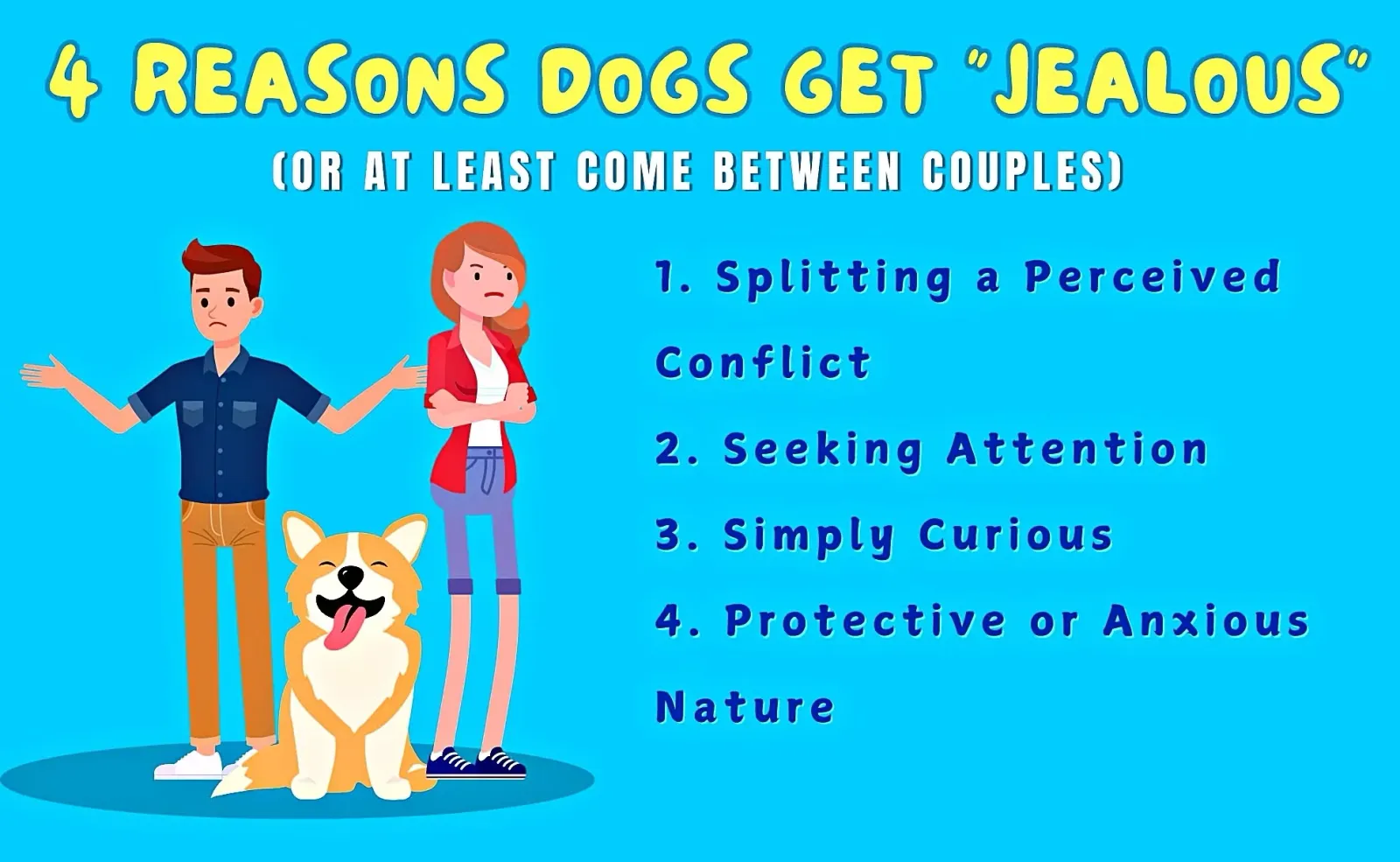
Examining four common reasons dogs appear to get jealous when couples kiss, hold hands, hug, etc.
Canva.com/Photoscape
Four Possible Triggers for Interrupting Kissing Couples
Anthropomorphism refers to assigning human traits to non-human animals. Although a dog may look jealous when inserting himself between two people, other motivations typically drive the behavior. Below are several more plausible explanations.
1. Attempting to Break Up What Looks Like a Conflict
Certain dogs become uneasy watching their owner being hugged or kissed, and they may feel compelled to step in by physically separating the two people in an effort to reduce what they perceive as tension.
Turid Rugaas, a Norwegian dog expert and author of On Talking Terms With Dogs: Calming Signals, notes that dogs often wedge themselves between other dogs that appear to be in conflict as a way to calm them.
In the canine world, kissing and hugging are not natural actions, so a dog may struggle to understand what is happening, especially when the romantic behavior appears intense. Dogs can read intense intimacy as a confrontation between you and your partner. Inserting himself may be your dog's attempt to soothe you and defuse what looks like a fight.
2. Looking for Attention
Some dogs simply crave attention. They spot something interesting happening and want to be included. In such cases, your dog might try to join by licking you, wagging his tail, or barking. He may just be after his share of attention.
Attention-seeking dogs can become pushy when their owners are on the phone or otherwise ignoring them, and others become pushy when their owners are being intimate with a partner. They simply want to be part of the activity.
Related: Why Does My Dog Bark at Nothing? A Trainer Explains the Truth
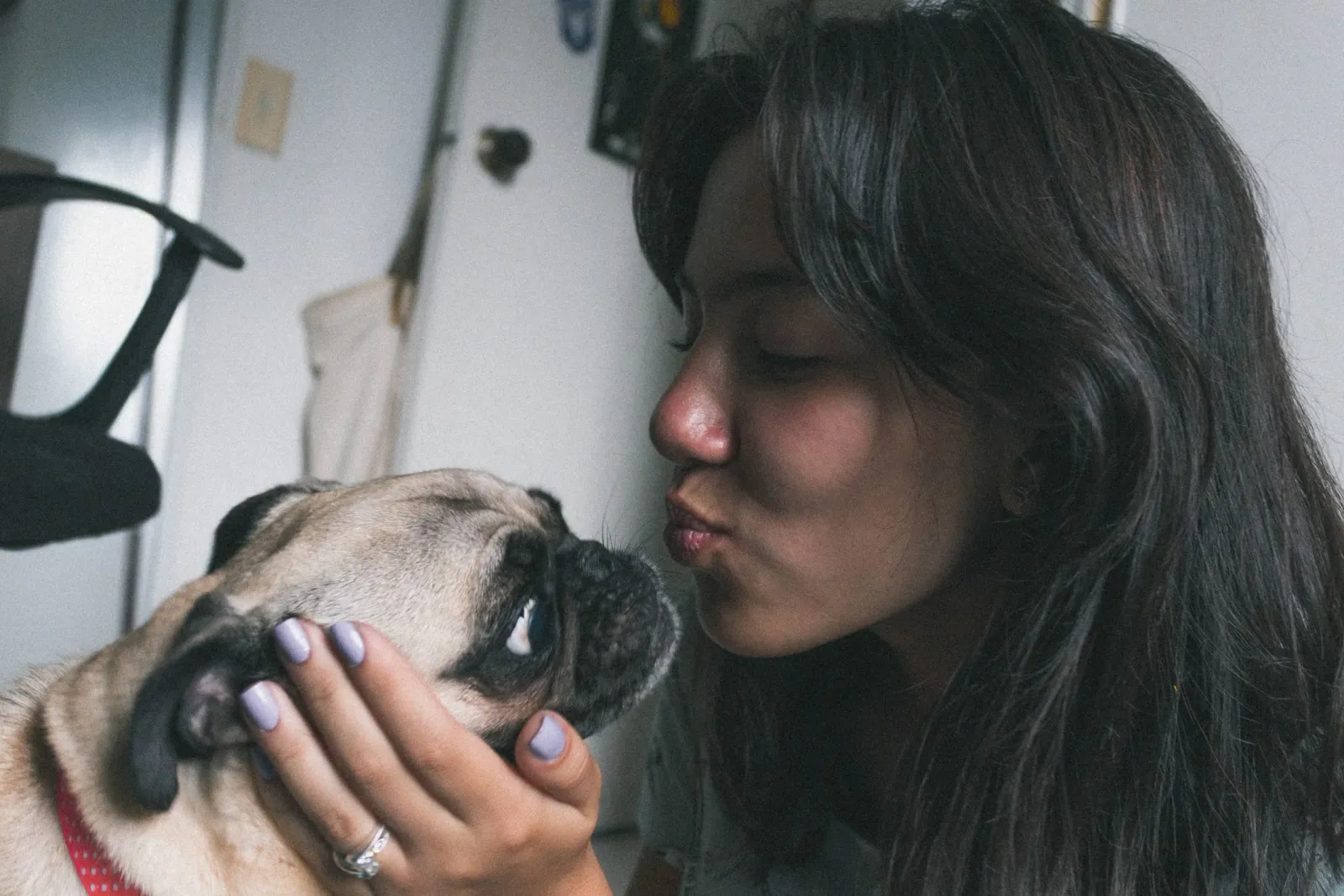
Kissing, hugging, and other displays of human affection do not exist in the dog world, so it is unlikely that they would incite jealousy in a canine observer.
nrd via Unsplash
3. Curiosity
If the house has been quiet and you and your partner suddenly begin kissing and making smacking sounds, your dog's attention will be drawn. His ears may perk up, waking him from a relaxed nap. His natural next move is to hurry over and investigate.
It is also possible that he interprets your smacking noises as you calling him, particularly if you frequently use similar sounds to get his attention.
4. Protective or Anxious Disposition
Some dogs naturally act protective and wary when someone approaches their owner. This often shows up as barking, growling, and sometimes snarling. Frequently, though, dogs perceived as protective are actually insecure and anxious.
Dogs who were not fully socialized may be distant, suspicious, and wary of strangers—and they are also more likely to vocalize or behave aggressively when their human interacts intimately with someone unfamiliar.
A Safety Note
If your dog shows aggressive or violent behavior, consult a behavior professional for an assessment and suitable behavior modification.
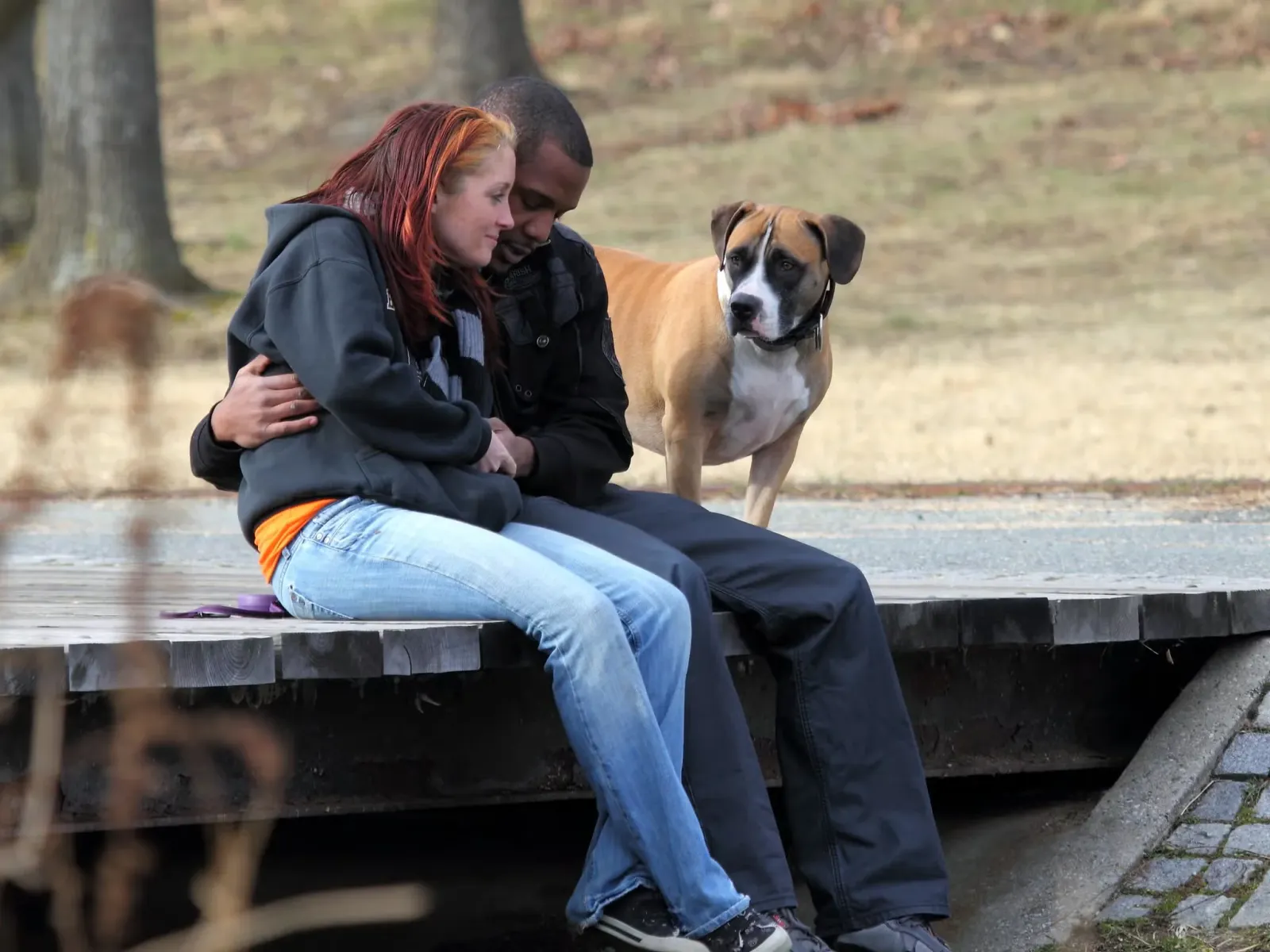
Regardless of the reason for your dog’s intrusive behavior, there are steps you can take to try to condition it away.
Mr.TinDC, CC BY-ND 2.0 via Flickr
Training Strategies to Reduce Intrusive Behavior
I once handled a case in which an owner's dog became anxious whenever they hugged—or were hugged by—another person. In that case, as in most, the dog responded best when given an alternative behavior to perform rather than punishment. Depending on your situation, one of the following training methods may prove helpful.
Differential Reinforcement
One approach to reduce your dog's intrusive vocalizations or actions is differential reinforcement of incompatible behaviors. Suppose you want your dog to stop placing himself between you and your partner or barking when you kiss or touch—you should teach him the "go to your place" cue.
- Place a rug at a distance from you and prepare a stuffed Kong.
- Say, "Go to your mat," and toss the Kong on the rug.
- When your dog goes to the rug and gets the Kong, say, "Good boy."
After several repetitions, he will learn what "go to your place" means. If you stuff the Kong well, he will likely be distracted by it, giving you the chance to share alone time with your partner. If you do this every time you want privacy, your dog should eventually learn to enjoy his own "alone time" as well.
Counterconditioning
Another option is to desensitize and countercondition your dog to hugs, kisses, and similar actions. This technique works best if your dog seems worried or anxious about your intimate behavior.
- If your dog has hugging issues, for instance, start by having your partner place their arm lightly on your shoulder while you toss your dog a treat.
- Progress gradually in small steps to a real hug, and continue giving him treats.
- If your dog reacts at any time, it means you are moving too fast. If this happens, stop and restart a few steps back.
With time, your dog should look forward to hugs and smooches because great things seem to happen every time they occur.
Up Next:
This article is accurate and true to the best of the author's knowledge. It is not meant to substitute for diagnosis, prognosis, treatment, prescription, or formal and individualized advice from a veterinary medical professional. Animals exhibiting signs and symptoms of distress should be seen by a veterinarian immediately.
© 2011 Adrienne Farricelli CPDT-KA, Dip.CBST
Comments
Julie Phillips on August 25, 2020:
Karma is my other half's dog, but he's more protective of me, than of him!
When my other half approaches me for a hug/kiss Karma growls at him. (He'd never do anything more aggressive to him)
He just does a short growl to protect me from the perceived threat.
I find it adorable.
It's like if he hears/sees something he thinks is a threat he'll sit or stand infront of me to protect me.
I always feel 100% safe with Karma…even when I'm outdoors…which is a rare thing for me due to my various mental illnesses. I mean i still have all that stuff in my head, but I know Karma wouldn't let anyone hurt me. I know he'd risk his life for me, which i find amazing. ♥
Adrienne Farricelli CPDT-KA, Dip.CBST (author) from USA on October 02, 2011:
Cresentmoon it could be protectiveness, anxiety or attention seeking from not understanding what may be going on (and for this reason she may be in conflict, thus displaying opposite and contradictory behaviors), I would redirect to another place and feed a stuffed Kong or bone so Tinkerbelle can relax, what breed is she? Some breeds with a history of herding can be the most obstructive!
Don A. Hoglund from Wisconsin Rapids on October 02, 2011:
I do recall a dog we had some time ago that had this behavior and I did not know what her problems waas.Rated up and useful.
Cresentmoon2007 from Caledonia, MI on October 02, 2011:
We have two dogs in our house hold, while my own dogs won't really get too bad when it comes to this my mother's dog will. Her name is Tinkerbell. Now Tinkerbell will jump at us, she'll bark and growl and even a couple time snapped at my boyfriend but what gets me is that the entire time she has her tale wagging. What do you make out of this behavior?