Teaching Your Canine to Turn Down Food Offered by Unfamiliar People
Morgan Green

Why Food Refusal Training Matters
Depending on where you live, the danger of a dog being poisoned by someone unknown may be minimal, but the ability to turn down food from a stranger can still be the difference between life and death. If poisoning is a known problem in your region, there is no reason to delay starting this training. Even in areas where you believe no such threat exists, a burglar might spot your guard dog and try to poison her to get inside, or a hostile neighbor could target your dog simply out of dislike.
In any case, I believe every dog should learn this skill. The question is: what is the most effective way to teach a dog to reject contaminated food?
Using the “Leave It!” Command
Many dogs can pick up food refusal from strangers fairly easily when the “leave it” command is used.
- I hold a treat in my right hand, let the dog sniff it, then tell her, “leave it,” and close my hand.
- Some dogs will sit and bark for the treat, some will try to get the treat out of your hand, and others will just stare at the hand. When the dog stops focusing on my hand, I praise her and give her a different treat from my left hand.
- Repeat the first two steps as often as necessary. When the dog always leaves your hand alone and stops staring as soon as you tell her, “leave it,” go on to the next step.
- The next step is to put the treat on the floor and let the dog sniff it. As soon as she does, I cover it and tell her, “leave it.” When she stops focusing on the treat and looks up at me, I give her a treat with my left hand. (If she does not respond when you tell her “leave it,” put a leash on her and tell her to “sit” so that she will start thinking about the leash and stop thinking about the treat.)
- Try dropping a treat on the floor and telling your dog “leave it” without covering the treat. If she goes for the treat instead of obeying, you should go back to the beginning and train her to ignore the treat in your hand.
- Once the dog has learned “leave it,” and you are positive that she will respond to your command 100% of the time, have her learn to refuse food from strangers. Using bait that she really likes (fresh meat, hot dogs, liver chunks, etc.), the stranger walks by the yard and tosses the food to the dog while you are present. If she goes to smell the food, tell her to “leave it” before she even starts to eat. (If you are not positive that she will respond all of the time, go ahead and leave her on a leash when teaching this exercise.)
- Once you are confident that she will not take the food when you are close, sit in the house where you can see her when the stranger tosses bait. If she goes to smell it, yell “leave it” from the window so that she assumes you are always watching.
The process may sound harder than it actually is. Certain dogs pick it up within a single day, while others need a longer period.
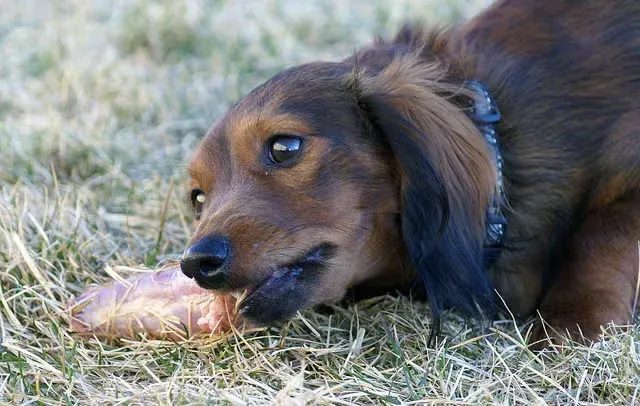
Small dogs are unlikely to be poisoned by thieves but may be harmed by malicious neighbors.
cc-by flickr onyx860 6954797205
Other Ways to Teach Your Dog to Accept Food Only From You
The “leave it” approach does not succeed with every dog. My pit bull mastered it quickly and consistently obeys; she will not accept food that I have not given her. My Schnauzer, on the other hand, will obey if I am present but forgets about me as soon as I am out of the picture.
What can you do to strengthen training for a dog that does not respond to “leave it”?
- It may help to train your dog to take food only from the bowl. Have a visitor at your house offer her a treat by hand, and when she starts to take it, tell her “no” and take her to her bowl to eat a treat. (If you use this method and it does work, you have to make sure you take your dog’s bowl with her if she is boarded, hospitalized, etc. If you do not, she may not eat.)
- Use a slip collar (choke chain) and attach it before taking the dog for a stroll throughout the yard. Let the dog stop to sniff bait placed in the yard by a stranger, but as soon as he goes to eat it, pull up on the collar and say “no.” When the dog loses interest in the bait, it is a good idea to give him a treat and lots of praise. (This may take longer than teaching the “leave it” command, but the amount of time required will vary depending on the dog.)
- Some trainers recommend the use of an electronic collar. Have food thrown in the yard by strangers, as I detailed above under the “leave it” section. As soon as the dog goes for the bait, give him a zap so that he associates the food outside in the yard with a negative stimulus. (I do not recommend this method.)
- A popular trainer here in Brazil recommends that the bait be set up with a battery and an electric wire so that the dog receives a small shock when he tries to put the food in his mouth. (I do not recommend this method.)
- I have also read that some people have strangers hit their dogs when taking bait. I do not recommend this since it is more likely to make your dog shy of strangers or aggressive to all humans.
Training your dog to eat only from the bowl is not as good as “leave it” but is the next best thing. Walking the dog through the yard on a leash may also be helpful.
A Skill Worth the Effort
Certain dogs seem to have a natural reluctance to accept food from people they do not know and require very little instruction. Dogs are scavengers, however, and naturally test almost everything they find to see if it is edible. My dogs still think things they find on the beach are worth testing for taste, despite all of their training.
Keep working at it—someday, it may save your dog’s life.
A demonstration of the method used to teach a dog “leave it.” In this video, the dog is being trained so that he will be more polite.
This article is accurate and true to the best of the author’s knowledge. It is not meant to substitute for diagnosis, prognosis, treatment, prescription, or formal and individualized advice from a veterinary medical professional. Animals exhibiting signs and symptoms of distress should be seen by a veterinarian immediately.
© 2015 Mark dos Anjos, DVM