Taming the Terrier: Effective Strategies to Curb Destructive Chewing
Charlie Ross

Understanding Terrier Destructiveness
Terriers have a well-earned reputation for tearing apart household items. Whether it's a scrap of paper or an important document, your terrier seems to take glee in shredding it—almost like a human popping bubble wrap. They also love to grab small rugs, shake them vigorously, and drag them around. This behavior often extends to welcome mats and the edges of bed skirts. Your terrier is not just a little naughty; he is exceptionally destructive.
I speak from experience—I've shared photos of the damage my own miniature schnauzer has caused. Can you relate? My miniature schnauzer is four years old, well beyond the puppy phase.
While other breeds can be destructive, terriers have a particular knack for wrecking your home. With their strong prey drive and endless energy, they often act as if they're finishing off a small rodent in their jaws.

This guide will help you figure out how to get your beloved little terrier to stop ripping up all your possessions.
BubbleJuice, CC, via Pixabay
Are You at Your Wit's End?
I suspect that those of us who share our lives with terriers might be missing a certain something in our brains. We must enjoy a challenge! It's what keeps life interesting, right?
I know your terrier is adorable. Trust me. The naughty, spirited, bossy, mischievous, and manipulative terrier has a personality that's larger than life. Sometimes, instead of shaking your head in disbelief, you just have to laugh at his antics. Don't worry. With training, your terrier will still act in the moment, but in a more controlled manner. The charm and spunk will remain, but your belongings will be safe. The effort you put into training will be well worth it. And like me, you might finally be able to shop for new furniture without fear.

Their energy and prey drive make terriers a threat to rip up your stuff.
xinita.org
Exercise: The Foundation
I'm going to assume you're already providing enough exercise for your terrier. That might be an unwarranted assumption, though.
It's absolutely crucial that you drain some of your dog's energy on a daily basis before you can even hope to stop his destructive habits. Remember, a tired dog is a good dog.
Aim to walk your terrier at least once a day for 30 minutes. Twice a day is even better, but if you can't manage that, there are games and other physical activities that can help. Teaching your dog a complex trick is a great mental workout that can tire him out (think about how you felt after a tough exam). My miniature schnauzer, Meadow, gets a 1.5-mile walk every morning, and I plan to increase our daily walks once this Texas heat wave passes.

In his photo, Meadow is taking a breather on her daily walk.
When Does the Destruction Happen?
Is your dog destructive only when you're home? Or does he tear things up after you've left the house?
I have to admit that Meadow confines her destructiveness to times when I'm home. It's almost as if she craves more attention, and any attention—even negative—will do. When I leave for several hours, Meadow is a perfect angel. I've also spoken with a professional dog trainer, Julie Bjelland, and she believes that some dogs see their owner's presence as a source of excitement and stimulation, which can sometimes lead to destruction.
If your terrier is destructive when you're away, make sure he doesn't have separation anxiety. Talk to your vet about this. Your dog might also be bored while you're gone, and if he doesn't get enough exercise, you're asking for trouble.
In any case, here's what has been working for me. I used Bjelland's book, Imagine Life With a Well-Behaved Dog, as a guide. I highly recommend her work.
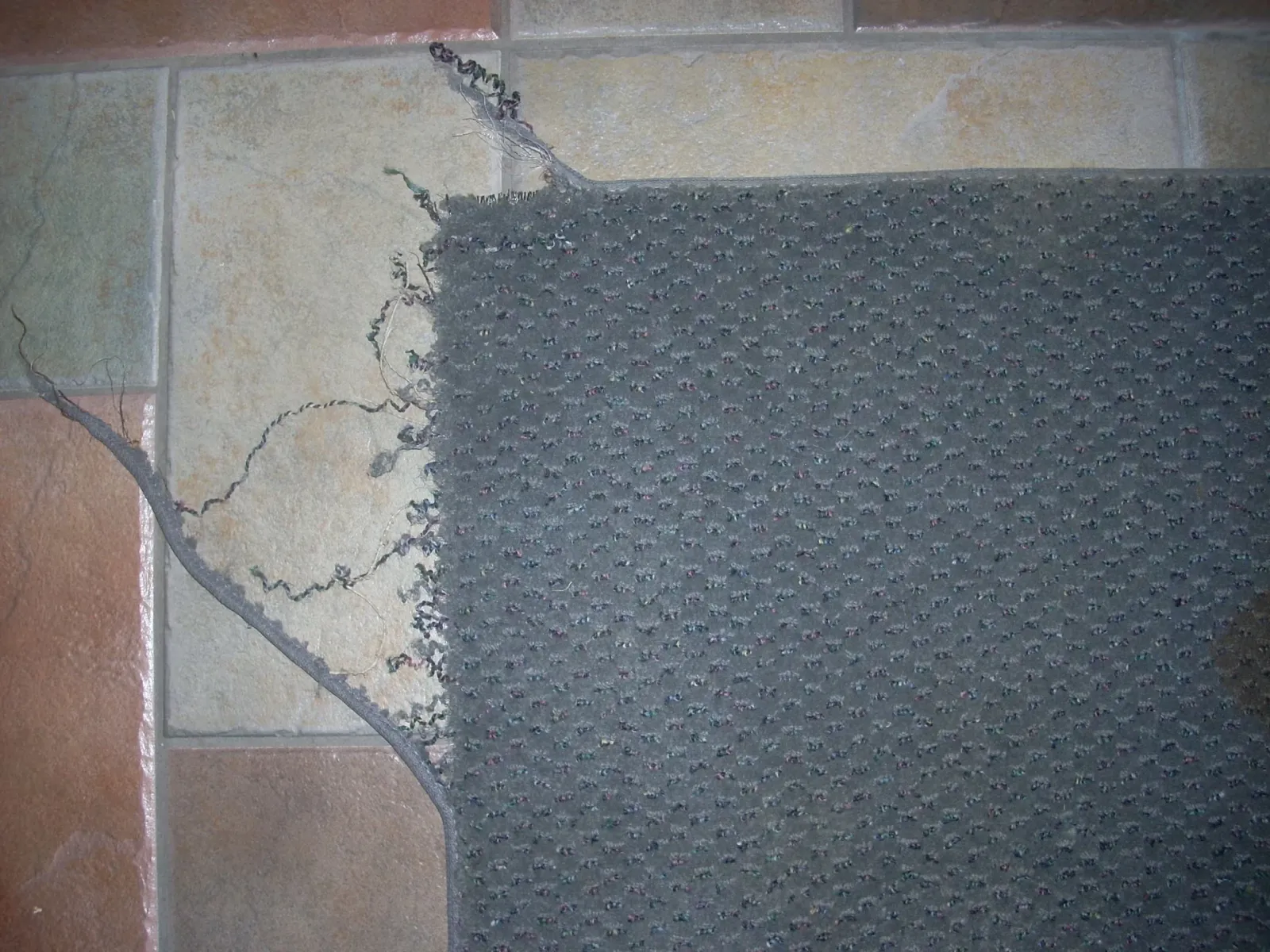
This is a welcome mat that was chewed up by Meadow.
Getting Started: The 10-Day Tethering Method
Now that we've covered exercise, it's time for two key steps.
First, wear a belt around your waist, put your dog on a leash, and tie the end of the leash to your belt. Keep your dog tethered to you most of the time while you're home. It's not as hard as it sounds—honestly!
Tethering is a standard technique recommended by many trainers. Why? If your dog has a behavior you want to correct, having him close by means you can catch him in the act. This is often suggested for dogs struggling with housebreaking, but it's also great for destructive dogs.
While tethered to you, your destructive terrier can't reach most forbidden items. He has to pay attention to you and follow your every move. This gives him something to do while you teach and reinforce obedience commands. If he doesn't have the freedom to get into trouble, he at least has the chance to do good things, which you, as a responsible owner, will notice and praise, right? After all, you'll see almost everything he does. Keep treats handy while you're on the computer, and praise him when he lies quietly at your feet. He's being so good that you can't help but reward him!
I recommend keeping your dog on-leash with you for ten days to two weeks. This is easy if you're home a lot, but if you work, I suggest doing it during a vacation, with a week and two weekends to work with. Dedicate that ten days to intensive training with your dog.
When I kept Meadow on-leash and worked on obedience, I noticed a difference in her behavior within four days.
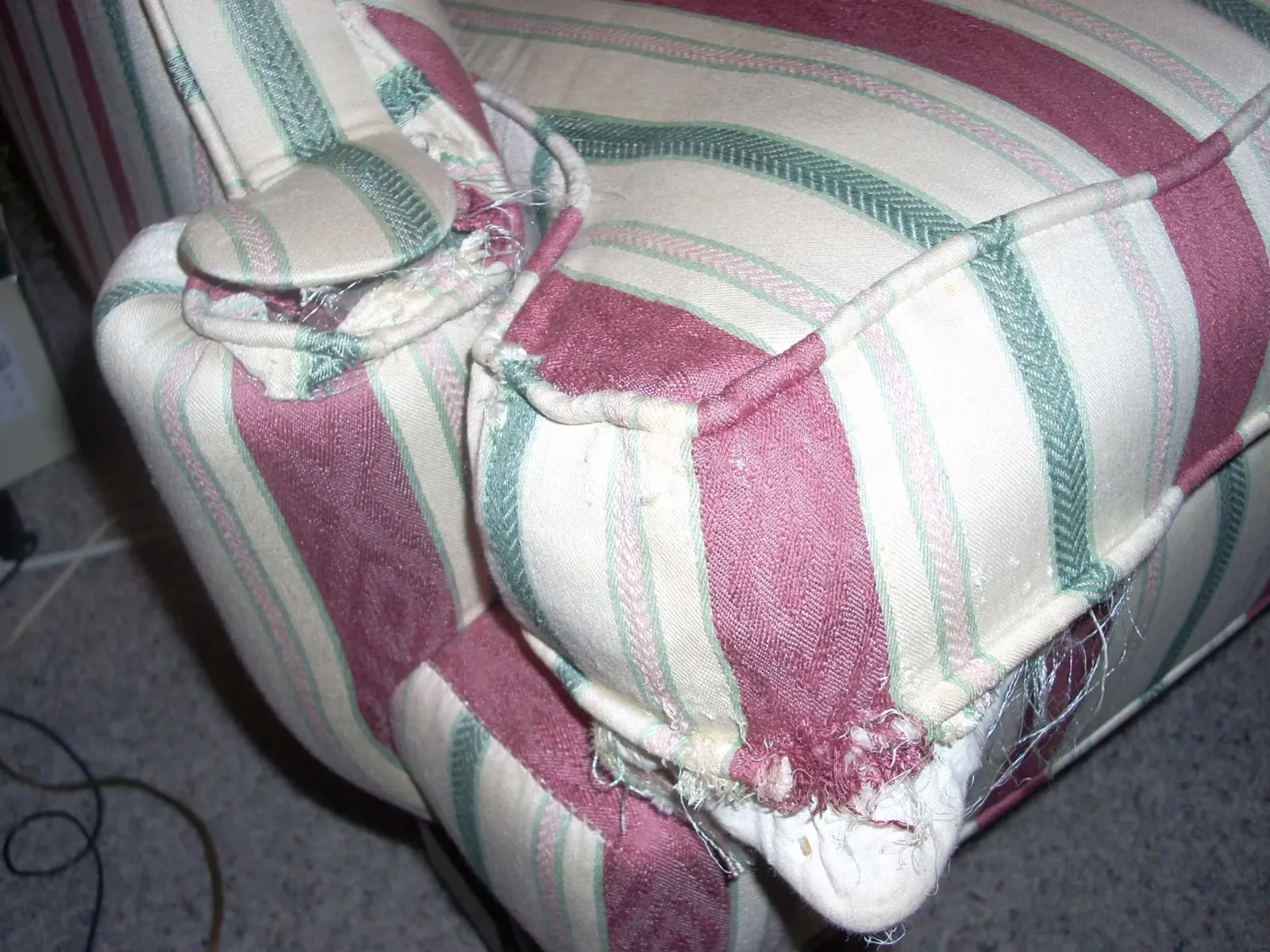
This wing chair shows the scars of destructive terrier behavor!
Obedience Training
The next thing you should do during that two-week period is teach your dog obedience commands, or reinforce ones he already knows.
At the very least, teach him "sit," "sit-stay," "down," "down-stay," "leave it," "come," and "drop it." You can find many books at your public library that cover the basics, and there are plenty of articles online. I've included some training links at the bottom of this article.
You'll need to be very determined with your terrier. Your terrier is stubborn and wants things his way, so be prepared. Keep practicing the commands, and eventually, add distractions. You want your dog to follow your commands both inside and outside, on walks, or during a Thanksgiving visit out of town.

Meadow, doing the “sit” command
Terriers and Trainability
How easy are terriers to train in obedience? How smart are they?
According to Stanley Coren's book The Intelligence of Dogs, the ten most intelligent breeds do not include the terrier group. The top ten features breeds like the border collie, poodle, German shepherd, golden retriever, and Doberman. These dogs are easiest to train because they not only learn commands quickly but also perform them consistently—about 95% of the time. I also have a toy poodle, and I know this is true from experience.
The miniature schnauzer ranks number 12 (in the next group of #11-26) on the list. This group is designated the "excellent working dog" group. The mini schnauzer is the only terrier in this smart group.
In the next group, the "above-average dog," many terrier types appear—including the Yorkshire terrier, Airedale, Cairn, Norwich terrier, and American Staffordshire terrier.
Why do I bring this up? Because I want you to understand that there's a reason your terrier is harder to train. But don't give up too soon. Never give up on your terrier. Be patient, and you'll see results.
I still don't have a solid and consistent "down" for Meadow, and we've been practicing for two weeks. We'll get there.
What to Expect
During the first two weeks, I predict you'll begin to see your dog's mind working. Has your terrier always loved to flip up the kitchen mat? Does it look ragged because of that? You may see your terrier hesitate for a few seconds, walk past the mat, and go get an appropriate chew toy instead.
You see, your terrier has always known that certain objects are off-limits. He knows there are toys and rawhide chews he should get when he feels restless and bored. That's mainly because he usually got scolded when you caught him with a piece of your mail. He continued, however, to show a lack of respect for your possessions, either because you weren't consistent with corrections, his energy wasn't drained properly, or some other obvious reason.
Consistency is key in training. Don't be like the woman in the video with her schnauzer. I'm tempted to laugh at this video of Chester and his owner, and I still do, because I've seen this exact naughtiness so many times with my own schnauzer. Terriers have their own irresistible charm, don't they?
Training Aids
For long-standing behavior problems, training aids can sometimes help. I own all of these and highly recommend them.
The first, the Sofa Scram, is great for deterring dogs from jumping on the sofa or removing throw pillows—which was my problem. One or two times is all it takes. The alarm is highly sensitive to paw touches, even from tiny dogs. It emits a loud, squealing sound. You can also place it under the edge of a rug if your pet shows too much interest in it. It will make them think twice about urinating on the rug or lifting the edge. After a few times, you can probably remove the battery and store it, or lend it to a friend. As long as you don't fold and unfold it too much, it will last.
The second item is the Pet Corrector, a product from the UK. This is a canister you can carry on walks if needed. Press the button, and with a brief spurt, you get the sound of compressed air escaping—a hissing noise. This is extremely effective. I've even seen it break up dog fights. It scares dogs badly and makes them jump back. But it may work best if you give a verbal warning first. Then, if your dog ignores you, press the button. The Pet Corrector is in a red can with white lettering, and it can also serve as a visual deterrent if you place it on a forbidden object like a keyboard or rug.
The last item is a Tattle Tale Sonic Pet Training Alarm, which emits a sound lasting a few seconds if a pet tries to get a forbidden object. The alarm detects vibrations, which trigger it. Again, one or two times is all it takes. This little alarm works best if you put it under a single object like a pillow or a piece of clothing. It also detects vibrations, such as a cat jumping on a countertop. You could even mount it on a window for security. I used it on my settee, under a pillow, and neither of my dogs ever got on that settee again.
Change Your Mindset
Above all, remember that you must change your attitude toward your terrier. He now exists to please you, and he will learn to live within your rules, boundaries, and limitations, as Cesar Millan often says. Give affection, but I recommend giving it only when your dog responds well and performs a command on cue. Don't reinforce bad behavior—only pet them for good behavior. When they begin to learn respect, you can lavish affection more freely.
I think you'll find that your terrier will continue to test you daily, even just a little, no matter how much obedience you drill into him. That's just his nature. It's similar to what happens with some kids. Your terrier wants to please you, but part of his brain is always seeking adventure. But at least you can greatly improve his destructive tendencies through obedience, redirection, games, and exercise. I know it's working for me.
I have to go now. By the way, Meadow has been tethered to my belt the entire time I've been writing this article. I've decided that her worst times for destructive behavior are when I'm on the computer for more than a few minutes. She will now be my constant computer-side buddy!
Resources
- Dog Owner's Guide: Obedience Training
This article is accurate and true to the best of the author's knowledge. It is not meant to substitute for diagnosis, prognosis, treatment, prescription, or formal and individualized advice from a veterinary medical professional. Animals exhibiting signs and symptoms of distress should be seen by a veterinarian immediately.