When Cats Turn the Tables: Managing Feline Aggression Toward Dogs
Taylor Gray

Understanding Feline Aggression Aimed at Dogs
It might seem counterintuitive to discuss cats attacking dogs, given how often we see the reverse in media—dogs chasing cats is a staple of cartoons and comics. Yet, there are real instances where cats become aggressive toward dogs. As a dog trainer who has also lived with both species, I've fielded questions from clients about this very issue. While my expertise is in dogs, the principles of learning theory apply broadly, and many behavior professionals now work with both cats and dogs.
Let's examine the possible triggers for this behavior and what steps you can take to prevent and interrupt fights.
What This Article Covers
- Why cats may show aggression toward dogs
- Strategies to stop your cat from attacking your dog
- How to safely break up a cat-dog fight
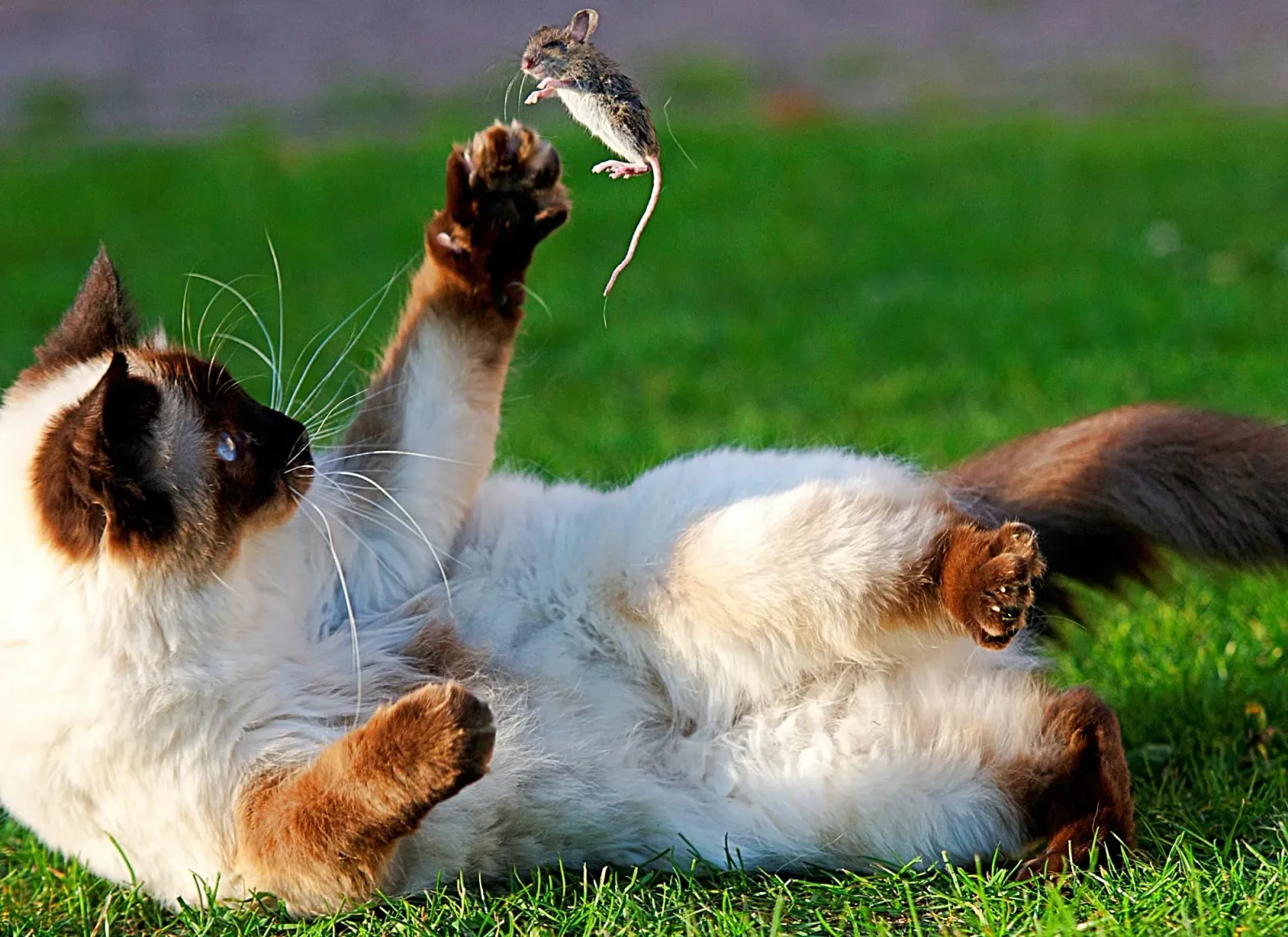
If you’ve ever wondered why a cat might be aggressive toward dogs, remember that this is a species that enjoys toying with mice before killing them.
Photo by Niels Hartvig, CC 2.0, on Wikimedia Commons/Photoscape
Why Cats Sometimes Attack Dogs
Just as with aggressive dogs, the reasons behind a cat attacking a dog can vary widely.
- Prey drive might be a factor. Some cats enjoy chasing and biting ankles, and a bold cat might extend that to rough play with a dog.
- More often, though, I observe a fear component at work. The specific circumstances dictate what happens.
When a Playful Dog Meets a Cornered Cat
If your dog is being rowdy, the cat's attack is likely not unprovoked; your cat may simply be exhausted and signaling the dog to stop. Many dogs miss or ignore feline body language cues. After repeated ignored signals to back off, a normally sweet cat may resort to aggression.
Cats are often reserved by nature, and some tolerate petting only briefly. So it's understandable that a cat might reach her limit after a dog has been pestering her for several minutes.
Most cats will try to escape when they've had enough, but if cornered and feeling threatened, scratching or biting becomes the next option. When flight isn't possible, expect the cat to fight.
Training tip: If your dog is the instigator, teaching self-control commands like "leave it" can be very helpful.
Aggression as a Last Resort
Like dogs, cats experience the fight-or-flight response. When flight is blocked, fight becomes the fallback.

If your cat is suddenly aggressive towards a dog, here are some possible explanations and solutions.
Stocksnap from Pixabay via Canva.com
Preventing Your Cat From Attacking Your Dog
Simply wondering why your cat is attacking your dog won't solve the problem; you need to take proactive measures to prevent trouble.
Many dogs suffer corneal ulcers from cat scratches, and bites can become infected. Additionally, a dog may fight back and seriously injure your cat. Intervening is essential to keep both animals safe. Here's what you can do:
Management: Provide an Escape Route for Your Cat
This is your best immediate option while you devise a longer-term plan. Management means keeping everyone safe. If your dog harasses your cat and the cat attacks because she's trapped, give her an escape route.
Create areas that only your cat can access, so she has a safe haven and knows the dog can't follow. A baby gate with a small cat door, a cat tree, or a high window perch can suffice.
Another option is to separate cat and dog when you can't supervise. While this seems obvious, it's often overlooked.
Stress Relief: Try Over-the-Counter Products
Is your cat stressed by a new dog or recent changes? Cats may appear tough, but they're sensitive to even minor changes. If your cat is stressed and overreacts, she's over threshold, and that stress reinforces itself.
Because your cat's aggression keeps her safe and makes the dog leave, it's reinforcing. She learns that hissing and scratching work, so she repeats them.
- Example: Imagine dealing with a school bully. If screaming and slapping makes the bully back off or brings a teacher to help, you'd likely continue those behaviors.
To change the pattern, your cat needs to feel safer and calmer. Over-the-counter products like Feliway plug-ins or Composure soft chews may help while you address the problem.

If you have a cat that playing too aggressively with your dog—especially a smaller dog—redirect their prey drive with cat toys.
Photo by PxHere/Photoscape
Prey Drive: Redirect the Play
Some cats have a strong prey drive and will chase and pester dogs, especially smaller ones or puppies. Many love to pounce on a wagging tail. As puppies grow, cats may learn to avoid larger dogs.
In such cases, redirect your cat to appropriate play. When you notice the behavior, interrupt and engage your cat with a toy like a string with aluminum foil. The novelty should attract her, leaving the dog alone.
Ensure your cat has plenty of catnip toys and interactive options to keep her entertained.
Note: Some suggest attaching a leash to the dog so the cat plays with the leash instead, but the leash could get caught, so I'm not comfortable with that idea.
Redirected Aggression: Block Outdoor Access or Views
Cats can develop redirected aggression. They might see a trigger outside, become highly aroused, and then attack a dog or even a person.
If this is the case, block access to windows and prevent your cat from seeing outdoors. Placing her in a dark room can help her calm down.
Possessiveness: Give Each Pet Their Own Space
Dogs aren't the only possessive ones; cats can be too. Your cat may not appreciate the dog sniffing her food bowl or litter box.
If your cat has never lived with a dog, this can be particularly irritating. If she acts aggressively when the dog approaches her resources (food, toys, sleeping areas, play areas), possessiveness may be the cause.
Provide separate areas for cat and dog. Your dog can also get upset if the cat approaches his bone or food bowl, and that won't end well.
Incompatibility: Rehoming May Be Necessary
Stress can be temporary, and prey drive can be redirected, but sometimes the energy levels of cat and dog are too mismatched. Animal behaviorist Dr. Gary Landsberg says:
"The biggest problems are related to specific compatibility issues where the dog is too playful and the cat is too fearful [...]. Also a cat that is fearful and aggressive and a dog that does not know how to react."
In such cases, consider what would improve life for both. Keeping them permanently separated might be kinder, and if that's not feasible, rehoming one may be best.
If you've had your cat for a long time and get a new puppy, rehoming the puppy may be wiser. Therefore, think carefully before adding a new pet; impulsive decisions can have negative consequences.
Desensitization and counter-conditioning can work for cats too! Reward your cat when she sees the dog and behaves calmly. Start from a safe distance and gradually allow closer encounters. If she gets nervous, increase the distance again.
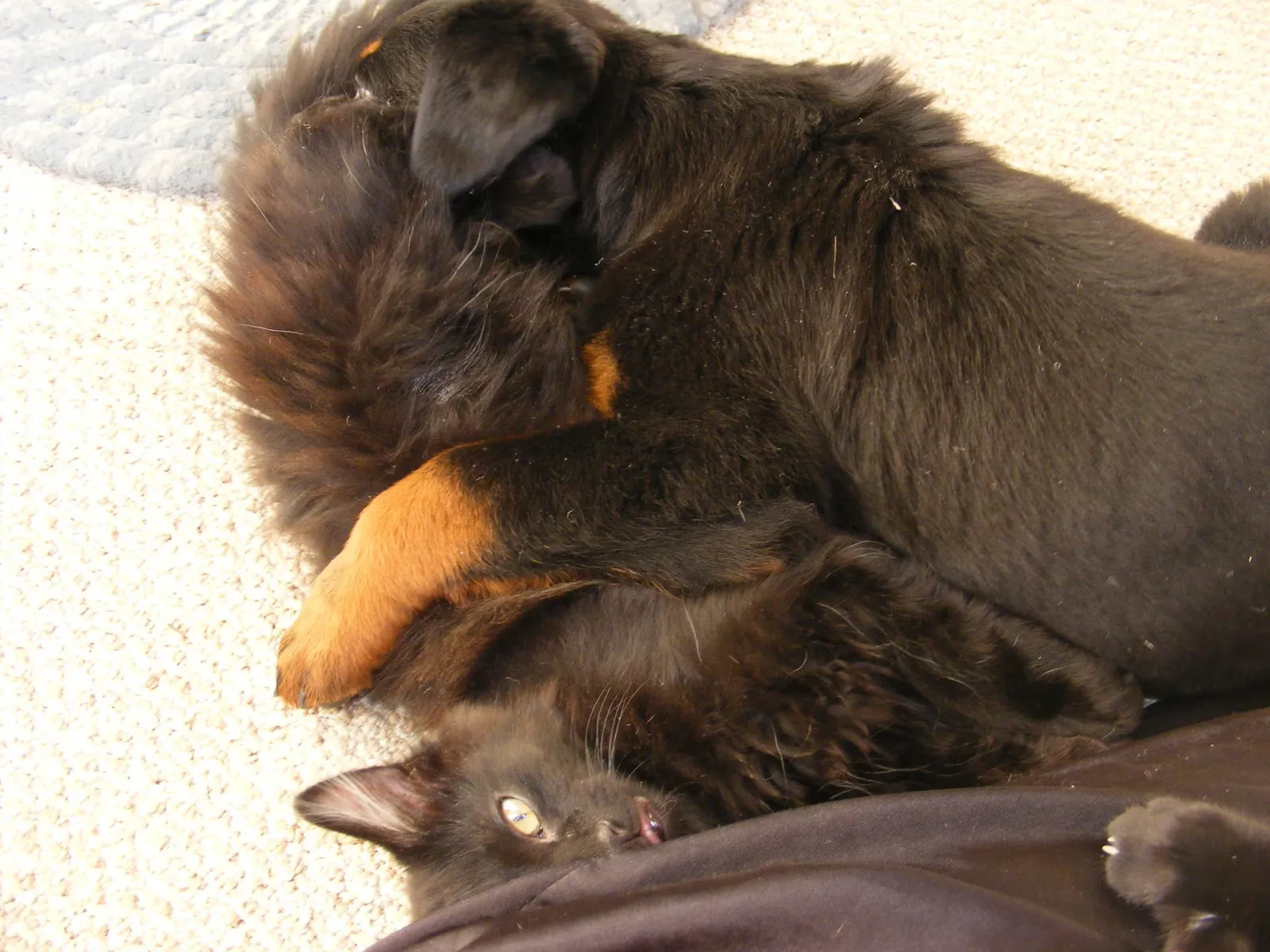
As with dog fights, yelling may serve no purpose other than increasing arousal levels in both cat and dog.
all rights reserved
How to Break Up a Cat-Dog Fight
If your cat and dog are actively fighting, you need to stop it safely. Yelling often only increases arousal in both animals. These strategies may help:
- Make a sudden, loud noise, like banging pot lids together
- Toss water on them using a bucket or hose
- Throw a blanket over the animals
Never get between fighting animals; you could be injured by redirected aggression.
This article is accurate and true to the best of the author's knowledge. It is not meant to substitute for diagnosis, prognosis, treatment, prescription, or formal and individualized advice from a veterinary medical professional. Animals exhibiting signs and symptoms of distress should be seen by a veterinarian immediately.
Questions & Answers
Question: My dog isn't ever boisterous, he just lays around on his spot doing nothing. The cat just attacks him without provocation or warning. Why?
Answer: It could be many things, predatory behavior, stress, anxiety, and in some cases, even play (if the body language suggests that).
Question: My cat has been with my dog for over two years but recently started attacking the dog. It's rather scary; the cat just goes crazy. We have been supervising the cat and dog and when not home the cat is locked downstairs. Do you have anymore suggestions?
Answer: It may help determine whether your cat may be ill or stressed. Feliway may help some cats calm down. Some cats get very aroused or stressed if they see things out of the window and then redirect it to people or other pets. Blocking windows may help if this is a case of redirected aggression.
Question: I introduced a new puppy to my three cats. My older dog passed earlier this year, so I didn't think there would be a problem. The two older cats have accepted him, but after roughly six weeks my youngest cat continues to attack the puppy for no reason. What can I do?
Answer: You are likely seeing a stressed cat who is redirecting on the puppy for some reason. It is difficult dealing with stressed cats or cats prone to redirected aggression. You can try calming aids (Feliway, calming products) and providing your cat with areas to retreat to if the puppy's boisterous behavior stresses the cat. You may have to keep the puppy and cat separated though if this continues as injuries to the puppy are possible (especially the puppy's eyes).
© 2012 Adrienne Farricelli CPDT-KA, Dip.CBST