Decoding Canine Cognition: Three Scientific Investigations Into How Dogs Communicate With Humans
Jordan Gray

An Examination of the Canine Mind Through Science
For ages, dogs have been called man's best friend, a label that any content dog owner would confirm. Yet most friendships do not instantly become deeply trusting and mutually advantageous; such bonds typically require years to build.
In contrast, a puppy meeting a person will almost right away begin yipping, licking, and showing affection. In this sense, dogs might more accurately be described as "man's best genetically suited friend." Thanks to the shared evolutionary history of dogs and humans, dogs are genetically inclined to excel at comprehending our commands and, from an early age, are more eager to communicate with us than any other species.
Below, we will look at three separate experiments conducted by researchers and consider how dogs interpret our eyes, grasp our pointing, and, from a young age, recognize us as a source of assistance and a friend in times of need.
This article will take a scientific look into the intelligence of dogs and how we communicate with them.
safepaws, CC0, via Pixabay
Canine Communication Through the Eyes
Both humans and dogs share a similar eye feature: white sclera (the whites of the eye). It has been suggested that animals with a high degree of within-species interdependence have white sclera because it makes it very easy to tell where other members of your species are looking.
While humans stand out in their ability to express a wide range of emotions through their eyes, other animals—dogs in particular—find that knowing where fellow pack members are looking is advantageous for social life. Doubt it? Take a look at the photo below and note the similarities between our eyes and a dog's eye.
So the question is: Can dogs actually take in information from our eyes? The answer is yes, and they do it better than the long-revered geniuses of the animal kingdom, chimpanzees.
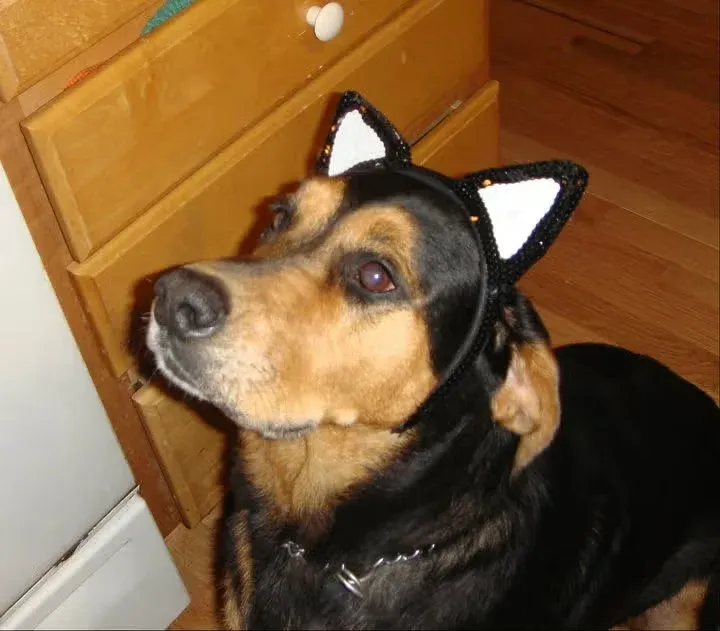
This is my Austrian black and tan hound, Maggie, who is the inspiration for this article. Clearly, she’s about to get a treat.
Author
Experiment 1: Can Dogs Follow Our Gaze?
When there is no chance of a treat, dogs show no particular inclination to follow where you are looking. But once they have learned that a correct guess earns a treat, the situation changes entirely. Here is a breakdown of the experiment conducted by Krisztina Soproni and a team of researchers (I will skip listing every methodological detail):
Two bowls that blocked sound and scent were used, one of which held a tasty treat for the dog. The researchers trained the dog to understand that picking the correct container would earn the treat as a reward, giving the dog an incentive to choose correctly. Finally, the researchers used three different ways to cue the dog toward the correct container.
- "At Target": The researcher turned her head toward the bowl and focused her gaze on the bowl.
- "Above Target": The researcher turned her head toward the bowl but looked above and beyond the bowl (toward the ceiling, basically).
- "Eyes Only": The researcher only shifted her gaze toward the bowl while her head remained straight.
There were 12 trials in total.
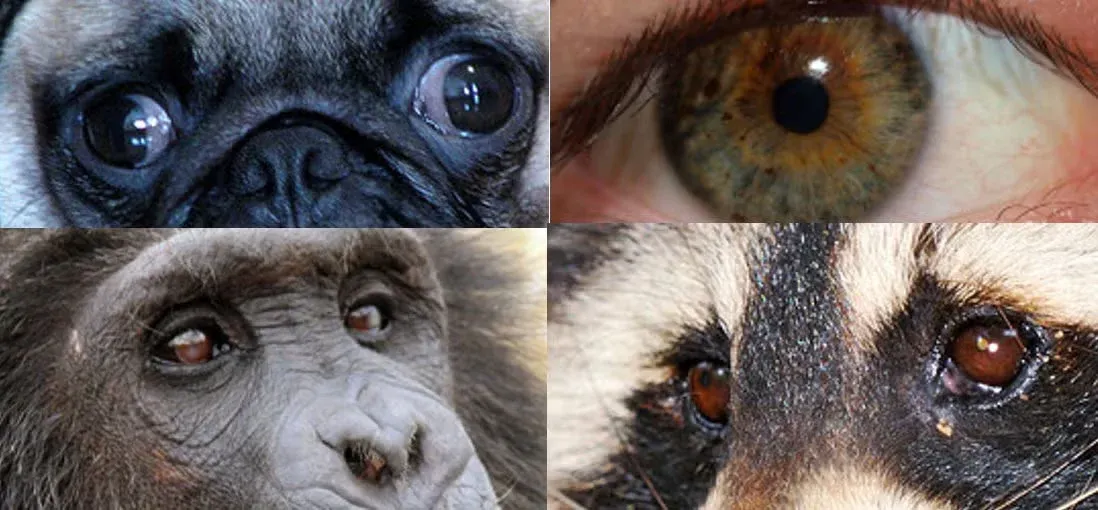
The eyes on the top belong to a dog and a human, whereas the ones on the bottom are the eyes of a chimpanzee and a raccoon. Notice how the whites are very visible on the top set of eyes and practically non-existent in the bottom set.
From left to right, top and bottom,Flickr.com: MShades, MSVG, Fwooper, Tambako the Jaguar - ickr.com/photos/mshades/1397026932/, ic
Experiment 1 Results: Can Dogs Follow Our Gaze?
The results of the test are as follows—there is also a table below titled "Table 1" if you want numbers.
A quick note before you look at the tables and the results: Averages near 50% (45-55) are called "At Chance," which means guessing. Averages below 45% or so are considered "Below Chance," and those above 55% are called "Above Chance," both showing that less guessing is involved.
At Target: In the At Target trials, everyone involved performed at more or less the same level, which is impressive for the dogs considering they were competing against humans and chimpanzees.
Above Target: The chimpanzees performed best in the Above Target trials, with babies and dogs doing quite poorly. However, this is actually a good thing for the dogs and the babies, and a bad thing for the chimps. Why? Because chimpanzees were simply looking at the direction the researcher's head was pointing and paid no attention to the eyes. For dogs and babies, when the researcher had her eyes up and above the bowl containing food, the dogs and babies saw it as a sign of indifference or inattentiveness. The dogs see the eyes not focused and think, "Hey, this human doesn't care about what's going on here, so I'm going to go about my doggy ways." It is pretty interesting to discover that when you take out the use of your eyes, your dog finds it much harder to understand what you are trying to communicate, or simply thinks you are ignoring it.
Eyes Only: In the Eyes Only trials, dogs performed the worst of the three, with the babies and chimps performing at the "At Chance" level, which means they were more or less just guessing. You are thinking, "If dogs are so good at reading our eyes, why did they do the worst?" The reason might surprise you!
Why This Test Shows Dogs Are Special: Explaining the Eyes Only Results
So why did dogs do so poorly in the Eyes Only trials relative to the other participants? The reason is actually very interesting, but see if you can figure it out on your own by looking at the second table.
Table 1: Average Percentage of Correct Guesses for Chimps, Babies, and Dogs
| At Target | Above Target | Eyes Only | |
|---|---|---|---|
| Chimps |
|
Approx. 75%
|
Approx. 65%
|
Approx. 55%
| |
Babies
|
Approx. 75%
|
Approx. 48%
|
Approx. 50%
| |
Dogs
|
Approx.. 75%
|
Approx. 52%
|
Approx. 49%
|
This is the mean percentage of correct guesses for each subject over all trials. Surprisingly dogs didn't do well in the 'Eyes Only' trials, but there's a very interesting reason why which will be explained below. Data Taken from Povinelli et al.
Table 2: Average Percentage of Correct Guesses by Dogs Only Based on Test and Divided by Trials
| Trials 1 through 3 | Trials 4 through 8 | |
|---|---|---|
| At Target |
|
Approx. 70% Correct
|
Approx. 83% Correct
| |
Above Target
|
Approx. 50% Correct
|
Approx. 55% Correct
| |
Eyes Only
|
Approx. 31% Correct
|
Approx. 60% Correct
|
This table shows the average amount of correct guesses for all dogs over each trial. Pay special attention to the large increase in amount of correct guesses in the 'Eyes Only' trials over time. Data taken from Soproni et al. (2001).
The Answer and More
Figure it out? The initial performance of the dogs in the first three trials of the experiment was so wretched that it could only mean one thing: the dogs were choosing the wrong container on purpose (probably because the dogs thought the researcher was marking her territory by looking at "her" cup).
However, in the next four trials, you can see that the dogs started performing way above chance because they figured out that the container being looked at meant "treat for them." And this, folks, is why dogs did so poorly on the "Eyes Only" tests. It's because they purposefully went for the wrong containers for the first few trials, and then very accurately guessed the right containers later in the testing. The figure above is an average, and take this as a lesson for why tables and graphs can't always be trusted.
So what does all this mean? It seems to show that when it comes to only using eyes, dogs are indeed smarter than chimps and babies at understanding gaze as significant in relaying information. They were just the victim of the averaging of results, and whereas babies and chimps were just guessing (staying near 50% is considered "At Chance," and shows guessing), dogs, in reality, immediately picked up that the eyes were being used to signal.1
Experiment 2: Can Dogs Understand Pointing?
In a study conducted in 2009 by Nicole Dorey, Monique Udell and Clive Wynne at the University of Florida, the ability of dogs to understand pointing cues (humans pointing in a certain manner at a cup hiding food) was researched.
The basic idea of how they did the test is shown in the picture (below revel in my amazing MS Paint skills) and also the video. One note though, the experiment done in the video is not nearly as accurate as the one I've explained (they don't control for smell in the video), and it also talks about dogs being "born with" the skill to understand points. Both of these make it a little shaky, but still a very good visual example of what's being explained (it also goes into the Eyes Only experiment discussed above).
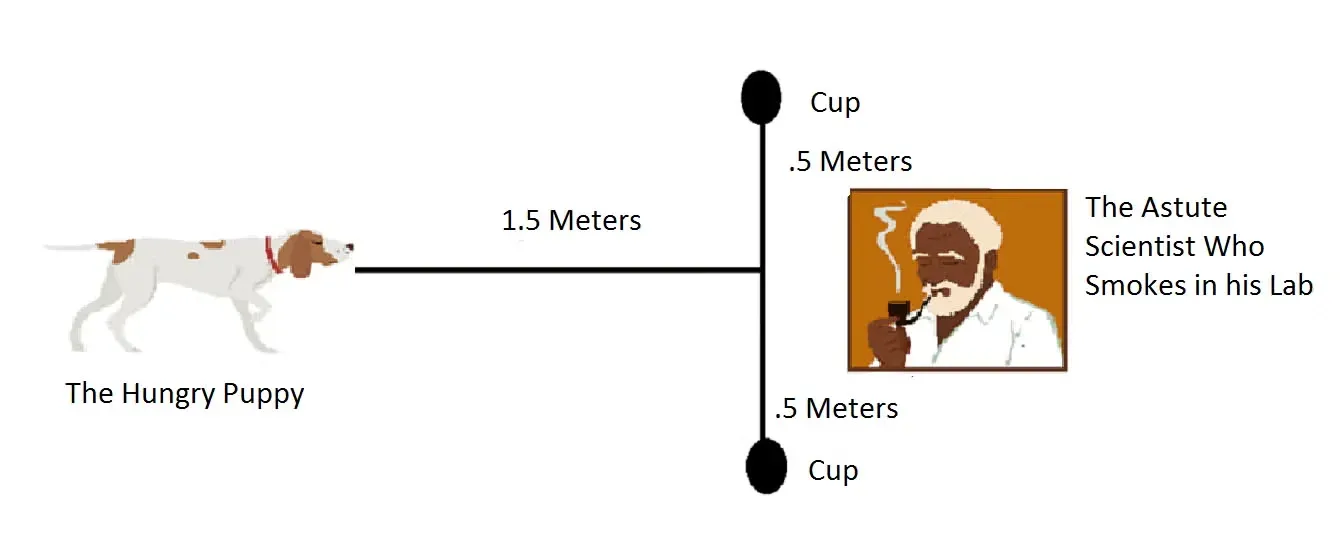
Basic Sketch of Pointing Experiment
The Method
Now the idea for this test is in no way unique (hence the video), and it has been done numerous times before. Using this to their advantage, the researchers made a point to not repeat mistakes that previous researchers made. Here's the basic method of this experiment, to go along with the diagram above:
- The researcher sat 0.5 m away from the middle of the two cups.
- The researcher baited both cups hidden from the puppy and then removed the bait from one of the cups. This was to make sure the puppy wouldn't go to a cup because of the noise it heard from one side during baiting. To neutralize the smell, the researchers used two plastic cups (think red party cups) and stacked them on top of each other. Then, they put a piece of reward in between the two cups to make both cups smell equally of food. Think of a PB&J sandwich with the smell nullifying piece of food being the PB&J, and the two cups being the bread.
- The researcher called the puppy to get its attention, and then, with hands starting from a neutral position, reached out her arm to point at a cup (her finger stopped 10cm from the cup) for approximately 1 second, and then went back to the neutral starting position.
- Once the researcher had went back to a neutral position, the puppy was released. After 3 seconds if the puppy had come within 10 centimeters of the correct cup, it was considered a correct guess.
That's it for the method. They made sure to not leave the arm outstretched while the puppy chose a cup because a previous test had found that puppies as young as 6 weeks of age were guessing 'correctly' using this type of visual cue. However, it turns out the puppies were simply coming to the outstretched hand of the researcher. So what were the results?
The Results of the Pointing Test
Back to the blip about puppies supposedly being able to listen to human cues as young as six weeks old, this led researchers to think that dogs could "communicate" with humans regardless of their ontogeny (their upbringing and environment). The results from this test, however, seem to prove otherwise. The puppies chosen to do the tests were aged from 9 weeks to 24 weeks, and here's how they performed.
The Number of Correct Guesses by Puppies Grouped by Age
| Average Number of Correct Guesses | |
|---|---|
| Group 1: Puppies 9 to 12 Weeks Old |
|
Average 48% Guessed Correctly
| |
Group 2: Puppies 13 to 16 Weeks Old
|
Average 51.6% Guessed Correctly
| |
Group 3: Puppies 17 to 20 Weeks Old
|
Average 62.5% Guessed Correctly
| |
Group 4: Puppies 21 to 24 Weeks Old
|
Average 74.4% Guessed Correctly
|
Notice how at 21 and more weeks of age, the puppies performed way above chance. Data taken from Dorey et al. (2009).
Summary of Experiment 2: The Pointing Test
So what does this show? That puppies do need some time to develop and grow, and perhaps experience humans. But eventually, they become quite adept at deciphering our commands from the very young age of five to six months. According to the results, however, they aren't necessarily born with the skill that makes them able to decipher human pointing cues (like the video said).
That's pretty impressive, and even our own offspring (babies) probably couldn't manage to decipher pointing without it being used in their daily lives. So even though dogs may not be genetically disposed to being able to heed our every command from birth, they do have some pretty impressive brains that allow them to bond with us. Here's a study that compares dogs and their close genetic relatives, wolves.2
The Wolf vs. Dog Debate: Who's Smarter?
Over my short lifetime, I've heard of people owning wolves and had to deal with the person telling the story of a friend of a friend talking about how cool it was and how it was just like a dog. This next test, however, seems to prove otherwise.
Experiment 3A: Dogs vs. Wolves in Human Compatibility
At the university of Eotvos Lorand located in Hungary (the biggest university in the country), researchers conducted an experiment comparing the personability of dogs and wolves when it comes to socializing with humans, and also overall dog intelligence.
For the most part, dogs have been considered dumber than their more feral counterparts, with the common conception being domestication equaling an irreplaceable loss of brain cells. Since the dog no longer has to think about and struggle for sustenance and shelter, the brain and body grow dull right? Wrong! Let's refer to a study done in the 80's. Scientists observed wild wolves as best they could attempting to perform relatively difficult tasks. What was discovered was, a wolf, after seeing a human unlock a gate once, could then imitate the action and unlock it itself. Dogs, on the other hand, after watching the human unlock the gate numerous times, sat there with a blank stare and bacon on the brain. Or so they thought . . .
Thinking that dogs were actually smarter than given credit for, the head researcher at Eotvos Lorand figured that dogs were perfectly capable of unlocking a gate, but simply were waiting for the command to do so. He tested this not by pitting a dog against a locked gate, but seeing how successfully dogs accomplished tasks without their owner's help, and then with it.
Method
28 dogs were selected with varying degrees of closeness to the owner, with some spending the majority of their time outdoors and not in close contact with humans, and vice versa. Food was placed on the opposite side of a fence, with a clearly visible and biteable handle sticking out from underneath the fence. The idea was that the dog would bite the handle, and then drag the plate of food to their side.
Results
When the dogs were simply pitted against the fence and plate of food on the other side, those dogs that spent more time outdoors and had a lesser relationship with their owner fared much better than those with close relationships to their owners. This alone would make one think that domestication does indeed make dogs stupider, as the dogs that had more independence and spent more time in the wild performed better. However, when the owners were then allowed to give verbal permission during the task, the gap between the two groups vanished.
Experiment 3B: The Real Test of Dog Compatibility
Curious to further test dogs' unique compatibility with humans versus their genetic neighbors, the wolf, the same university had students raise both wolf cubs and dog pups. The students hand fed, played with, cooed at, and loved as best as they could their respective animal buddies.
Three weeks later, to test both the wolves' and dogs' relationships to their owners, they placed both in a room with their respective student owners, and this is where the differences started to show. The wolves sat motionless, while the puppies tried their best to get attention from the student they were paired with, nipping at their hands, barking at high pitches, and walking over to them. The next phase of the experiment is the more interesting one though.
Method for Phase 2 of Experiment 3B
At three months of age, in order to test if dogs have a specific genetic disposition towards wanting to bond and interact with humans, the university conducted the following test:
- Similar to the fence problem above, a piece of meat was attached to a rope, with the meat being unattainable unless the dog yanked on the rope and dragged it towards her.
- The dog and wolf pups along with their owners were placed on the side of the fence with only the rope.
- Both were then allowed to figure out for themselves how to solve the problem of attaining the meat.
As I'm sure you've guessed, when left alone, both animals were able to drag on the rope to get the meat. This is no surprise, nor is it particularly interesting, which leads me to the next part.
The Truly Interesting Phase of this Experiment
With everything exactly the same as the experiment above, the meat was now anchored to the ground on the other side of the fence, and this is where the true differences showed. When the puppy pulled on the meat and realized that it wasn't coming any closer, it went over it its owner and, in its own unique way, asked for some sort of assistance. The wolves, on the other hand, proceeded to pull on the rope until they got tired, practically ignoring their owners and focusing only on the meat.
What does this show? That even though both animals were raised pretty much exactly the same from birth, one had a clear desire to communicate with humans, and seemed to realize that humans could help solve problems, or give the hints or commands on how to attain treats. That animal, of course, is our genetically compatible buddy, the dog.3
Closing Thoughts
After going over all this scientific research and mumbo jumbo (save for the third part), I'm sure you just have strengthened your initial belief that your dog is special. Dogs may not be able to debate politics or give you stock tips, but they're pretty smart when it comes to communicating with us and paying attention to us.
With the way they can read our eyes and body movements, it might be scary to actually play a game of poker against a dog. Further, not every animal is capable of doing what a dog can do, even one that's supposedly the ancestor and therefore close genetic relative. Dogs have something special that allows them to be good companions for us, and hopefully after reading this you've attained a slightly more scientific and empirically backed argument as to why you're a "dog person." Thanks for reading!
References
- 1Soproni, K., Miklosi, A., Topal, J. & Csanyi, V. 2001. Comprehension of human communicative signs in pet dogs (Canis familiaris). Journal of Comparative Psychology, 115, 122–126.
- 2Dorey, N., Udell, M. & Wynne, C. 2009. When do domestic dogs, Canis familiaris, start to understand human pointing? The role of ontogeny in the development of interspecies communication. Animal Behavior, 79, 37-41.
- 3Colin Woodard Correspondent of The Christian Science Monitor. (2005, October 26). Why your dog is smarter than a wolf :[ALL Edition]. The Christian Science Monitor,p. 17.
This article is accurate and true to the best of the author's knowledge. It is not meant to substitute for diagnosis, prognosis, treatment, prescription, or formal and individualized advice from a veterinary medical professional. Animals exhibiting signs and symptoms of distress should be seen by a veterinarian immediately.
© 2011 Akbok