Golden Retrievers as Family Pets: Trainers Explain the Benefits and the Responsibilities
Robin Morgan
If your children have spent months asking for a puppy, you may now be seriously weighing the idea of bringing a family-friendly dog into your home. It makes sense to look for a breed that is playful, biddable and comfortable around kids. The Golden Retriever is probably the first breed that springs to mind. So we asked several trainers what is actually involved in raising one, to answer the common question: are Golden Retrievers good family dogs?
Goldens are frequently held up as the gold standard among breeds—friendly, gentle, intelligent, loyal, playful and deeply affectionate, and undeniably cute besides. Yet popularity and a friendly image do not settle the matter on their own. Before committing to adoption, it is worth asking whether a Golden is genuinely the right family dog, or whether there is more nuance to weigh.
Below you will find what you need to know about this much-loved breed: its typical temperament, how Goldens tend to behave around children, and what makes them such strong companions. Use it to judge for yourself whether they belong among the best dogs for families.
Are Golden Retrievers Good With Kids?
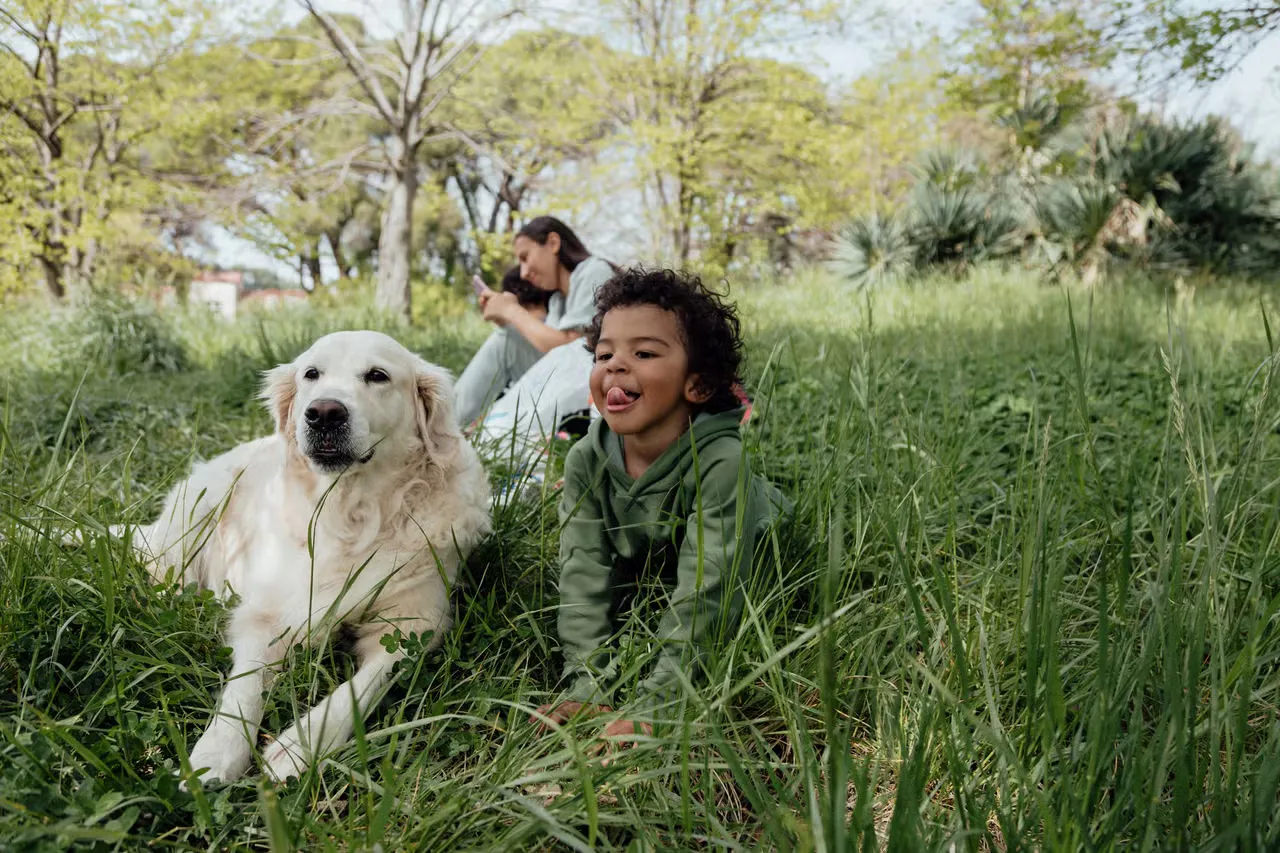
A child and a Golden Retriever relaxing together in a field.
For any parent considering a dog, the central question is whether Golden Retrievers are good with kids. Goldens are among the most popular breeds, yet there is no simple yes or no. Broadly, they tend to be good-tempered, sweet-natured animals inclined to be affectionate and playful with their families. If your children are very young, though, a Golden's exuberant energy can be too much of a good thing, which is why a child's age deserves thought before you become a pet parent.
"Goldens can be great with kids," says Dion Studinski, a canine behavioral consultant and founder of Ancillary K9 Dog Training in Denver, CO. "But they are large, energetic dogs. A Golden can absolutely knock over a toddler without meaning to, so supervision and boundaries are non-negotiable. The dog needs proper training, and kids that will be around them need structure, too."
The encouraging part is that Goldens are highly intelligent as a breed and respond well to training, provided it is delivered correctly. Their adaptability to new surroundings also works in their favor—something Studinski considers essential in a busy family home.
"In a household with kids, noise, and activity, this resilience matters," Studinski says. "A well-bred Golden often has emotional elasticity that allows them to adapt easily without getting stressed. That said, the popularity of the breed doesn't automatically mean 'easy.' It means they're capable and adaptable when properly raised, trained, and managed and can be thought of as a kid-friendly dog breed."
Our second expert likewise cautions against relying on breed alone, particularly when a child's safety may be at stake. "People tend to rely too strongly on dog breed selection to do the work for them—with Golden Retrievers, especially," says Jme Thomas, a dog trainer and executive director of Motley Zoo Animal Rescue in Redmond, WA. "People seem to think if they pick a 'good breed' or 'good stock,' things should just work out. But the reality is a dog of any breed, from any background, who is not socialized or trained properly is likely to have trouble being the perfect family dog. Pedigree is really a human ego stroke more than anything—it is not going to guarantee you a good dog, never mind a good 'family' dog around kids."
Why Are Golden Retrievers Popular Family Dogs?
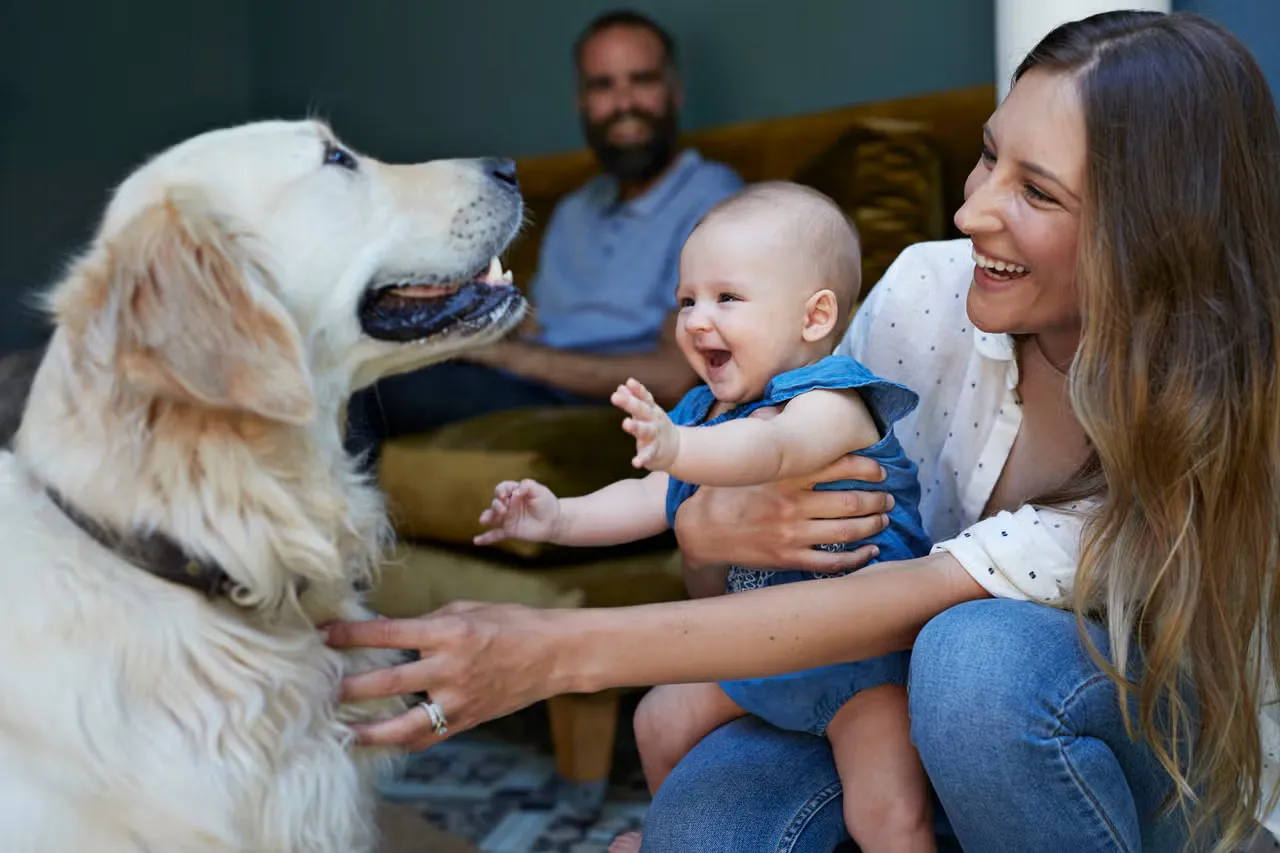
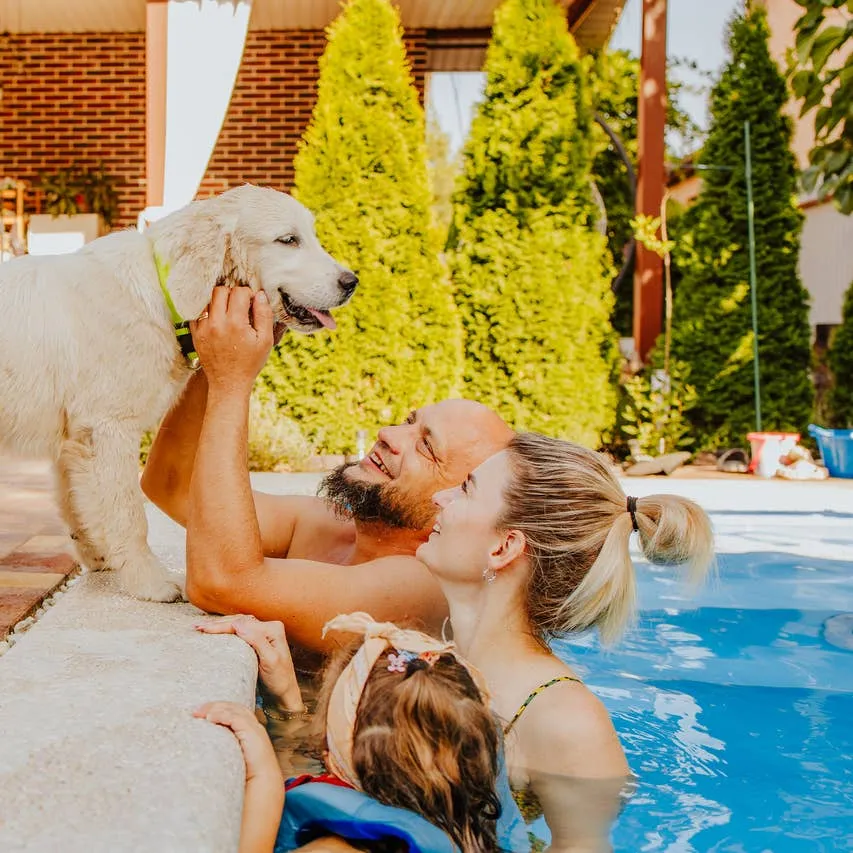
A Golden Retriever at home with a family.
The image of the Golden Retriever as the quintessential family dog did not arise out of nothing. So what puts a Golden at the top of most people's list for family life? "Golden Retrievers are popular for a reason," Studinski tells us. "They're generally social, people-oriented, and highly trainable. They were bred to work with humans, which makes them naturally responsive and eager to engage. Their willingness to learn and work with you is a major asset in a family setting."
The breed's genetic history shapes more than its sweet, friendly disposition. Thomas explains that the Golden's origins as a water fowling dog built its reputation for gentleness and its well-known "soft" bite. "Generally, another reason people like Golden Retrievers if they want a family pet is because they tend to have traits that are pretty middle of the road when it comes to things like prey drive, working drive, and more," Thomas explains. "Unlike some breeds that were bred over time specifically for their ability to hunt, or to herd cattle, Goldens have been bred to have a 'soft' mouth."
Your Dog's Personality Should Match Your Lifestyle
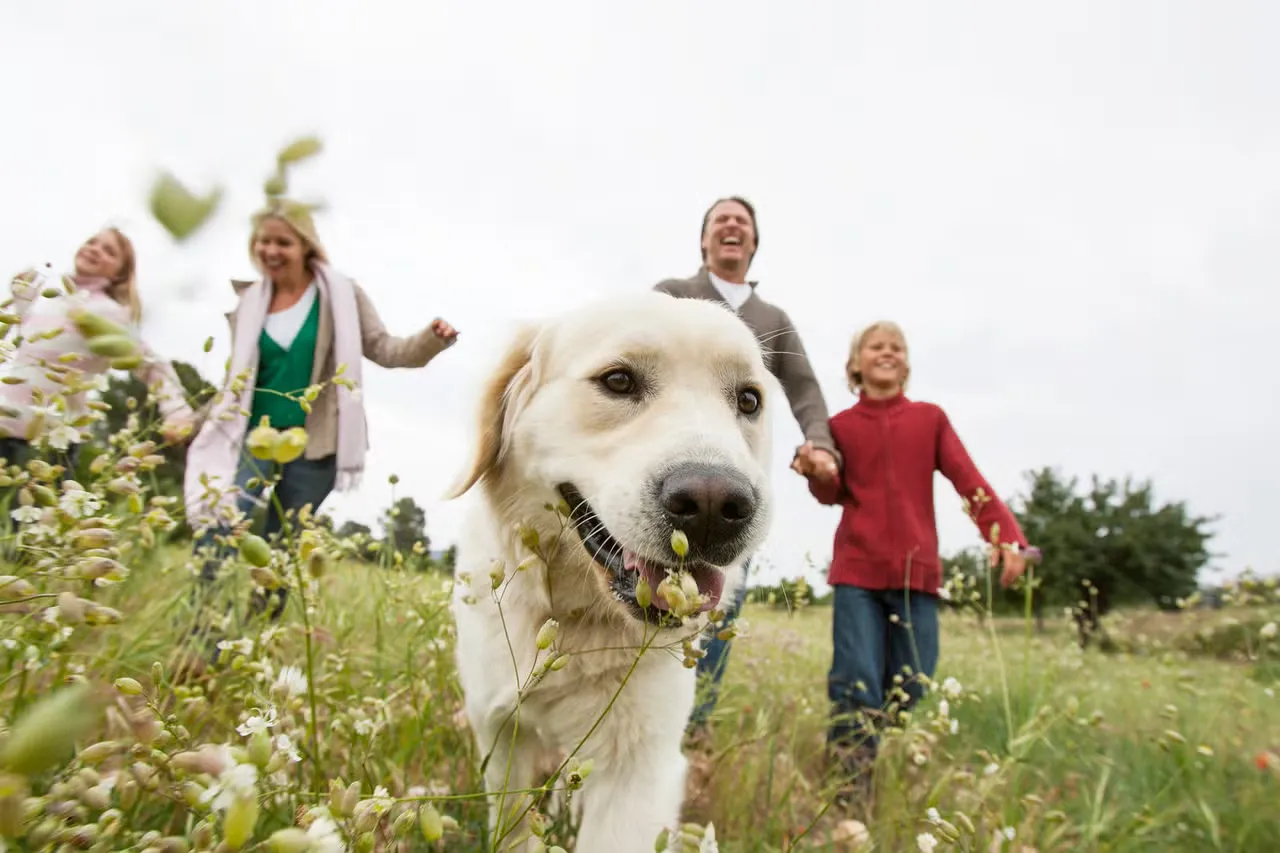
A family and their Golden running through a field.
In many cases Goldens do make wonderful family dogs. The error lies in assuming that any Golden will slide effortlessly into family life without further work on training, socialization, or matching the dog to the right household. Rather than asking whether Golden Retrievers as a whole suit kids or family life, ask instead: will this particular Golden, with this particular personality and temperament, fit with my family's way of living?
"Lifestyle plays an important role in choosing a dog," Thomas affirms. "There are going to be pretty hyperactive and busy dogs, and there are going to be those with more laid-back, lazy personalities—even within one breed. Finding a dog of your favorite 'couch potato' breed that clearly needs more activity than your lifestyle offers is still not going to be a good fit, just because the breed is known for certain qualities."
If you are considering adopting a Golden, here are several lifestyle questions worth weighing:
Time & Availability
"For busy households, the key question isn't 'Is a dog nice?' it's 'Do you have time for a dog?'" Studinski warns. "Many families underestimate how intense a young Golden can be for the first 2 – 3 years. They are sporting dogs bred for stamina, drive, and enthusiasm. This means their energy level needs to be taken into consideration. Goldens are not low-maintenance companion ornaments. They need daily interaction, training and exercise. A family that's busy but structured can do great. A family that's busy and inconsistent may struggle."
Ability To Maintain Their Mental and Physical Health
Goldens are active and people-oriented, so they require plenty of hands-on care. Time management is therefore not the only consideration. You also need to ask whether you or your family have the energy to keep pace with everything your Golden needs day to day.
"They shed heavily. They need grooming. They need structured exercise," Studinski lists off. "They can develop separation-related issues if left alone excessively. And like many popular breeds, quality of breeding varies widely. Poorly bred Goldens can also struggle with anxiety, hyperarousal, or health issues."
Commitment to Training
Studinski and Thomas both emphasize that a Golden will not simply mature into a calm, obedient, socially adjusted dog on its own. Thomas in particular warned about the "pure-bred puppy myth"—the widespread notion among adopters that a puppy will grow effortlessly into the ideal dog and display its breed's best qualities. Just as children need school, Goldens need training. What does that involve?
Training and Socialization Tips for Golden Retrievers
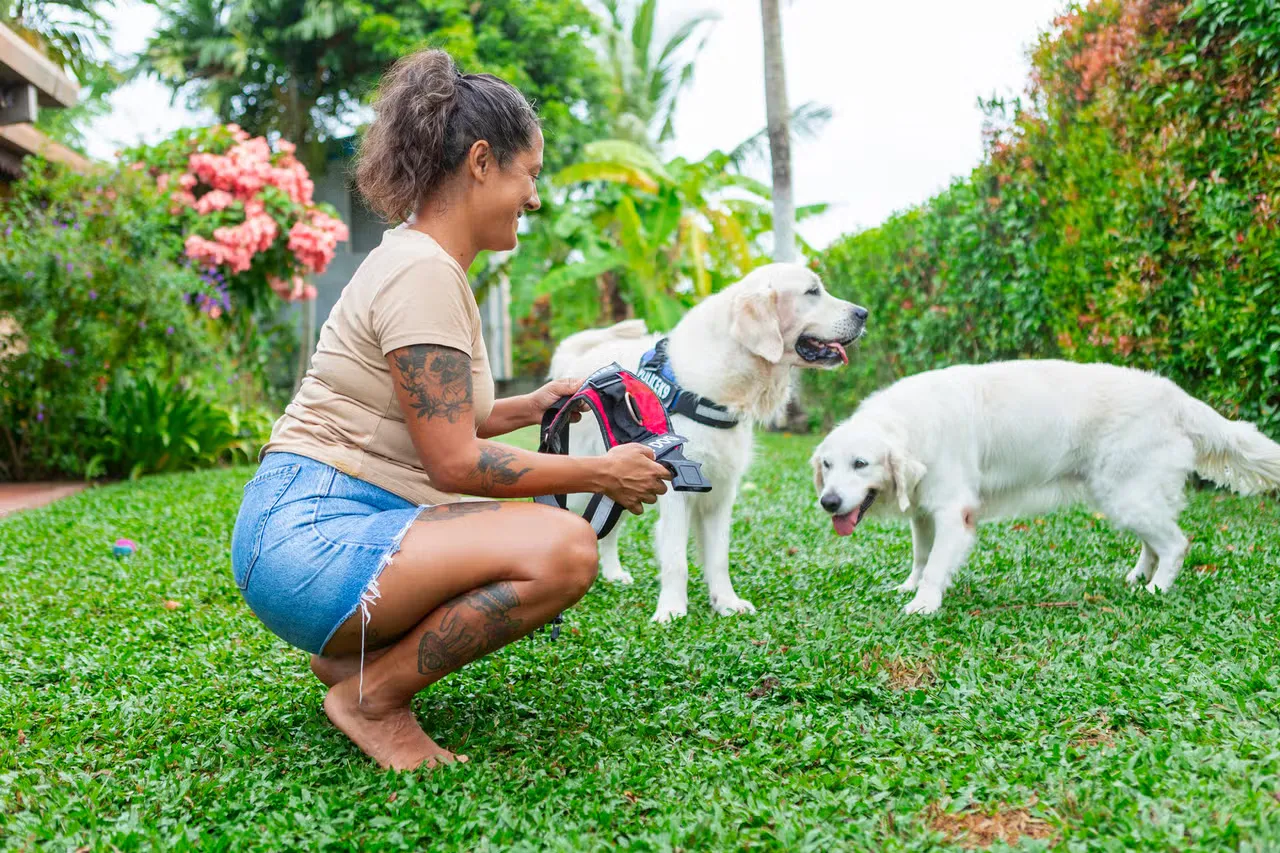
A woman training her Golden Retrievers.
The real work of dog ownership begins once the dog is home. A regular, deliberate socialization plan matters greatly—particularly with a puppy. "A puppy should meet more than five hundred people, places and things before they are seventeen weeks old," Thomas tells us.
Taking a puppy to dog parks and other unfamiliar places is one part of socialization, but it is neither the whole of it nor the right place to begin. Proper socialization is systematic and unhurried: first introduce the puppy to its immediate new family, then to friends, then to low-stress new locations, gradually meeting more and more strangers, and so on.
"Socialization should focus on neutrality, not overstimulation," Studinski states. "A Golden doesn't need to greet every dog and person. They need to learn to observe calmly and reliably disengage. Consistency is key. Goldens are intelligent and highly responsive, which means they learn good habits quickly and bad ones just as fast. If raised with clear leadership, boundaries, and engagement, they can be exceptional family dogs. If raised casually, they can become overwhelming."
Training is equally essential to settling a dog into your lifestyle—so much so that Thomas compares it to fuel in a car: "You wouldn't buy a car if you literally could not afford the gas, so getting a dog and thinking training is optional is truly a fallacy." This does not mean training has to be costly or needlessly grueling, but it does demand commitment and care to help your dog build positive behaviors and avoid undesirable ones. Good training should be:
- Consistent: Regularity underpins any training regimen; sporadic, infrequent sessions will not stick. Consistency reaches further than a fixed schedule, though. As professional trainer Rachel Lane notes in an AKC piece on consistency in dog training, you must also be consistent about the rules you set and the phrases and hand signals you use. Otherwise your dog becomes confused and you become frustrated.
- Contextually Appropriate: You cannot teach a dog to pirouette or jump through a hoop before it has mastered sit, stand and heel. Fundamentals come first, so begin with simple commands and obedience rules before advancing to more complex work. If you have adopted an older dog that has already been trained, you can move ahead somewhat, but with puppies you always start from the beginning.
- Positive: Training can be frustrating, but never punish a dog for falling short. Instead, mark and reward success, which creates a feedback loop in which the dog repeats the desired behavior in hopes of earning your approval (and perhaps a treat). This is positive reinforcement, and it is far more effective at encouraging wanted behaviors than punishment or restriction.
Exercise and Activity Needs of a Golden Retriever

A man and his friendly Golden Retriever playing in a snowy park.
Breed has only limited influence over an individual dog's personality traits, but it is a better predictor of activity and exercise needs. Goldens, Thomas says, are moderate-to-active working dogs with working dog drives, and without proper direction and support those drives can quickly turn into destructive behaviors. This goes well beyond putting the dog in the yard each day to run loose—an activity that offers neither structure nor personal interaction. Studinski tells us that most adult Goldens need at least 60–90 minutes of active exercise daily, while Golden puppies need structured outlets in shorter bursts.
Engaging your Golden physically is essential, but so is engaging it mentally. Goldens are intelligent working dogs that can develop anxiety and stress-related problems without adequate enrichment. Thomas recommends daily "brain games" to stimulate your Golden mentally. Some good options:
- Puzzle Feeders: Rather than a standard food bowl, Thomas suggests puzzle feeders or Kong Wobbler-type toys that require dogs to "push, pull, and forage for the food" to satisfy their working drives. Snuffle mats and lick mats can also provide mealtime enrichment, though Thomas notes they may work better alongside a regular meal, since serving an entire meal in a snuffle mat would be challenging.
- Shell Game: A dog-friendly version of the classic carnival guessing game—place a treat under one of three cups, shuffle them, and see if the dog can pick where the treat is. Depending on your training stage, this can also be a chance to practice obedience routines.
- Hide the Thing: Similar to hide and seek. Have your dog wait while you find its favorite toy, then hide it somewhere the dog can reach. Then send the dog to find it. Thomas says this one is a hit with many dogs—"while you may tire of going and hiding things, chances are they will not tire of the game!"
- Flirt Pole: A flirt pole is a toy with a string at the end, much like feathered cat toys but larger. Thomas says playing with a flirt pole is a great way to "enhance engagement, entertain their brains, and satisfy drive!"