Living Alongside Black Bears: Understanding and Coexisting in Foothill Neighborhoods
Blake Hall
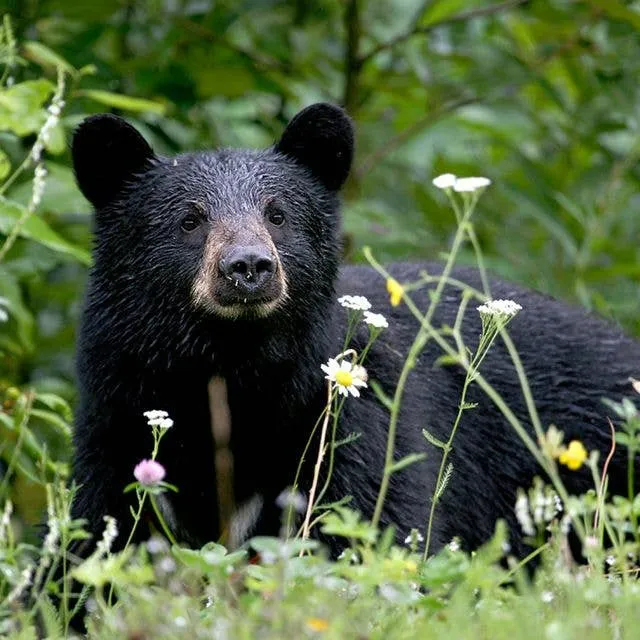
Understanding Bears in Residential Areas
Many people recognize that human expansion has forced wildlife into shrinking habitats where they struggle to find food and raise their young. Few want to see bears disappear entirely, so there's often a willingness to assist them—provided it doesn't lead to injury or unintentionally make them permanent neighbors. The central question is whether we can safely share our communities with black bears.
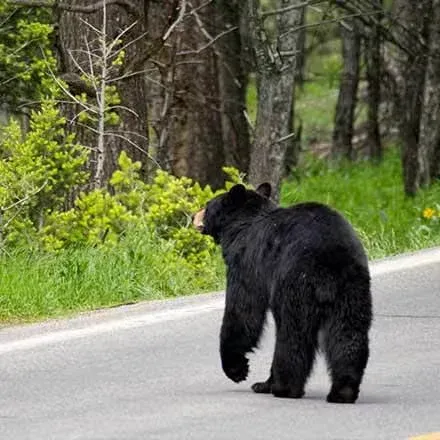
Black bears are often seen ambling alongside or across mountain roads.
Public Domain via Ontario Ministry of Natural Resources
The Arrival of Black Bears in Southern California
- Southern California was historically grizzly country, not black bear territory. Black bears typically inhabit more remote forests than grizzlies but have surrendered nearly 60% of their range to human development.
- Grizzlies once lived along the coast and in mountain riparian zones near fishing streams in Southern California, until hunters and farmers eliminated them for preying on livestock. After their disappearance, 77 years passed before bears returned to the region.
- In 1993, the California Fish & Game Commission relocated 27 black bears from Yosemite Park in Northern California to Big Bear Lake in the San Gabriel Mountains. The goal was to benefit the ecosystem and draw tourists. However, due to grizzlies' fearsome reputation, lodge owners initially reacted with fear and illegally shot the bears to safeguard visitors and outdoor refrigerators.
- Today, roughly 4,000 black bears inhabit Central and Southern California, as reported by the California Department of Fish & Wildlife—all tracing back to those original 27.
Identifying Black Bears: Size and Coloration
- American black bears are smaller than grizzlies—measuring four to seven feet in length (or height when standing) and standing two to three feet tall on all fours.
- Females typically weigh about 300 pounds, while males reach around 500 pounds when food is plentiful.
- Their coat is thick and shaggy, usually black but also dark brown, cinnamon, or yellow-brown, occasionally with white patches. Spirit Bears, a subspecies found along British Columbia's Canadian coast, are creamy white.
- Black bears possess powerful legs and large paws, excel at climbing trees, and can sprint up to 35 miles per hour. They generally keep their distance from humans.
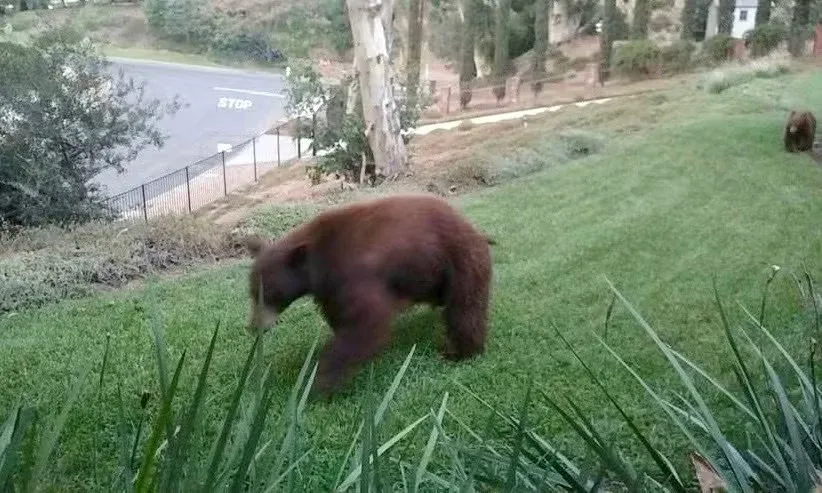
This black bear, roaming through the neighborhood of Arcadia, is actually a cinnamon color, rather than black. She’s being followed by two cubs.
From Katy Goulding, used with permission
Wild Behavior and Diet of Black Bears
- In the wild, black bears can live up to 30 years, primarily in remote mountain conifer forests. They emerge from dens before sunrise to forage throughout the day, taking brief naps, and settle down for the night an hour or two after sunset.
- They have strong memories and an excellent sense of smell, which help them locate food and gauge the temperament of any predator they encounter.
- While they occasionally consume fish, small mammals, insects, and carrion, 95% of their diet consists of plants—wild vegetation such as herbs, grasses, roots, buds, shoots, honey, nuts, fruit, berries, and seeds.
- Each autumn, bears embark on an intense feeding spree, accumulating fat reserves for winter hibernation. They sleep through the winter in dens located in dark, secure spots like caves, culverts, or hollows beneath fallen logs, awakening in spring.
- Bears contribute to nature in three primary ways: dispersing seeds through their scat, opening forest canopies so sunlight reaches the ground, and accelerating the decomposition of old trees by tearing them apart in search of grubs.
- Their only natural predators are mountain lions, wolves, brown bears, and humans.
For more details on bear diets and wild behavior, consult this U.S. Forest Service brochure.
A Personal Encounter
Last autumn, I shared with my student aide a story about bears a friend had captured on his night camera the previous week. We were driving a yellow school van along a narrow, winding road toward her home atop a wooded hill. She was the final passenger to be dropped off.
A few months earlier, I had spotted three deer while returning to the bus yard, so I asked if she had seen any other wildlife recently. She said deer were all she had ever seen, and they appeared infrequently.
My friend Bruce, who lives a couple of hills away from her, is an apiarist—he keeps bees and sells their honey. To protect his hives and observe nighttime visitors, he installed an infrared camera in his backyard. He has posted several night videos of bears wandering through, foraging, and playing in his watering holes.
As my aide and I chatted, I rounded a curve and instinctively braked upon seeing a quick movement on the left. Was it a deer? No—a bear! A small one crouched by the roadside, clearly preparing to cross. "Oh look!" I exclaimed as I slowed to a halt.
I opened my window and called out gently, "Hey you. How're you doin'?" The little black bear lifted its nose, turning its head side to side, sniffing the bus and registering my voice. Forgetful that I was stopped in the middle of the road, I launched into a one-sided conversation, thrilled to see my first wild bear.
Despite having lived in Africa for three years observing diverse wildlife and in Oregon for five years where loggers had displaced bears, this was my first wild bear sighting. When my aide reminded me a car could come around the bend and hit us, I reluctantly drove on, intrigued and amused by the slight tremor in her voice.
When Bears Enter Human Spaces
Since black bears are relative newcomers to Southern California, it's not a case of humans encroaching on their territory, as often happens elsewhere.
However, when mountain conditions deteriorate—during droughts and wildfires—black bears may move into human areas if it's their only option for food and shelter. They then forage at night. Being naturally wary of humans, they return to safer mountain locations as soon as possible.
Legal Status of Bear Hunting
Hunting bears in residential areas is prohibited. If bears must be removed, the Department of Fish & Wildlife handles it using noisemakers, flashbangs, and if necessary, stun guns, followed by relocating them to the wild.
A common myth suggests hunting reduces bear-human conflicts, but in reality, hunters target wilderness bears, which are not the same individuals scavenging near people.
Another myth claims hunting controls bear populations, but that's also false. Bears self-regulate their numbers. When a bear is killed, more food becomes available, enabling females to produce more cubs.
Bear hunting season lasts only three months annually. A license is required, dogs are prohibited, and only one bear per season may be taken. Shooting cubs or mothers with cubs is illegal. For details, see California's Big Game Hunting Digest.
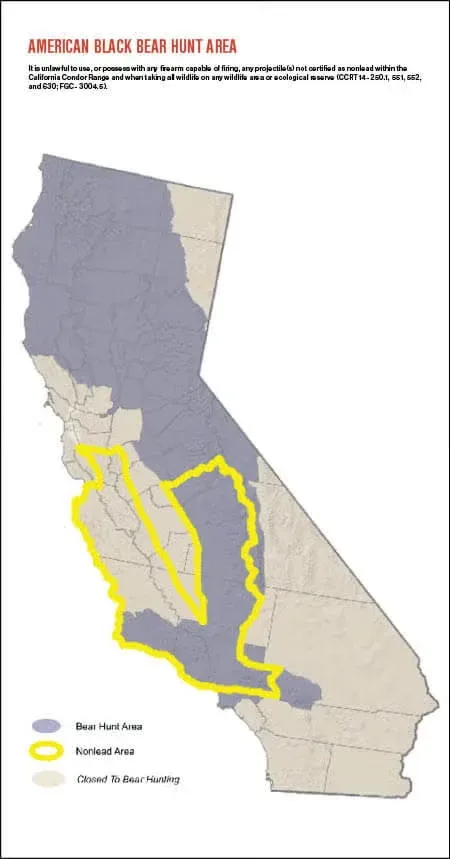
This map shows the areas where licensed hunters are allowed to shoot black bears—only one per season..
CA Department of Fish u0026amp; Wildlife, Public Domain, via CA Big Game Hunting Digest
Coexisting with Wildlife
California's recurrent droughts and wildfires have pushed coyotes, mountain lions, bobcats, and bears into foothill neighborhoods. Since these conditions are frequently caused or worsened by human activity, we must learn to share space with bears and other wildlife that have lost their habitats.
Black bears don't transmit diseases, and they rarely attack animals. They are simply desperate for food and water, so I believe we can and should assist them during difficult periods.
Black Bears in Foothill Towns
In my part of Southern California, bears visit communities such as Tujunga, La Crescenta, Altadena, East Pasadena, Sierra Madre, Arcadia, and Monrovia—all the foothill towns along the San Gabriel Mountains. I've seen photos and videos of them, and Next Door apps report bear sightings weekly.
I first became aware of bears in Altadena when I woke one morning to find garbage scattered on the ground and our can overturned. Annoyed, I righted the can, picked up the trash, and discussed it with my landlady in the front house.
A week or so later, as I was getting ready for bed, the phone rang. I walked to my landline and saw it was my landlady. Fearing an emergency, I answered, "Are you ok? It's 11:00 at night!"
"I know," she said, "but I think you'll want to hear this." She told me a bear was in our yard. It had just raided the trash can, defecated under the grapefruit tree, then ambled up the drive to lie under the Monterey pine, not 15 feet from my front door.
I hung up and rushed to the window. I could see a dark shape … I thought … but I wanted to confirm. I hurried to the back patio door, slipped outside, tiptoed across the grass, then chuckled to myself, knowing the bear could hear every sound. I peeked around the corner and indeed, she was lying there, head raised, staring right at me.
"Oh hi," I said, "just wanted to make sure you were real." Then I went back inside, logged onto Facebook to tell everyone, and went to bed laughing.
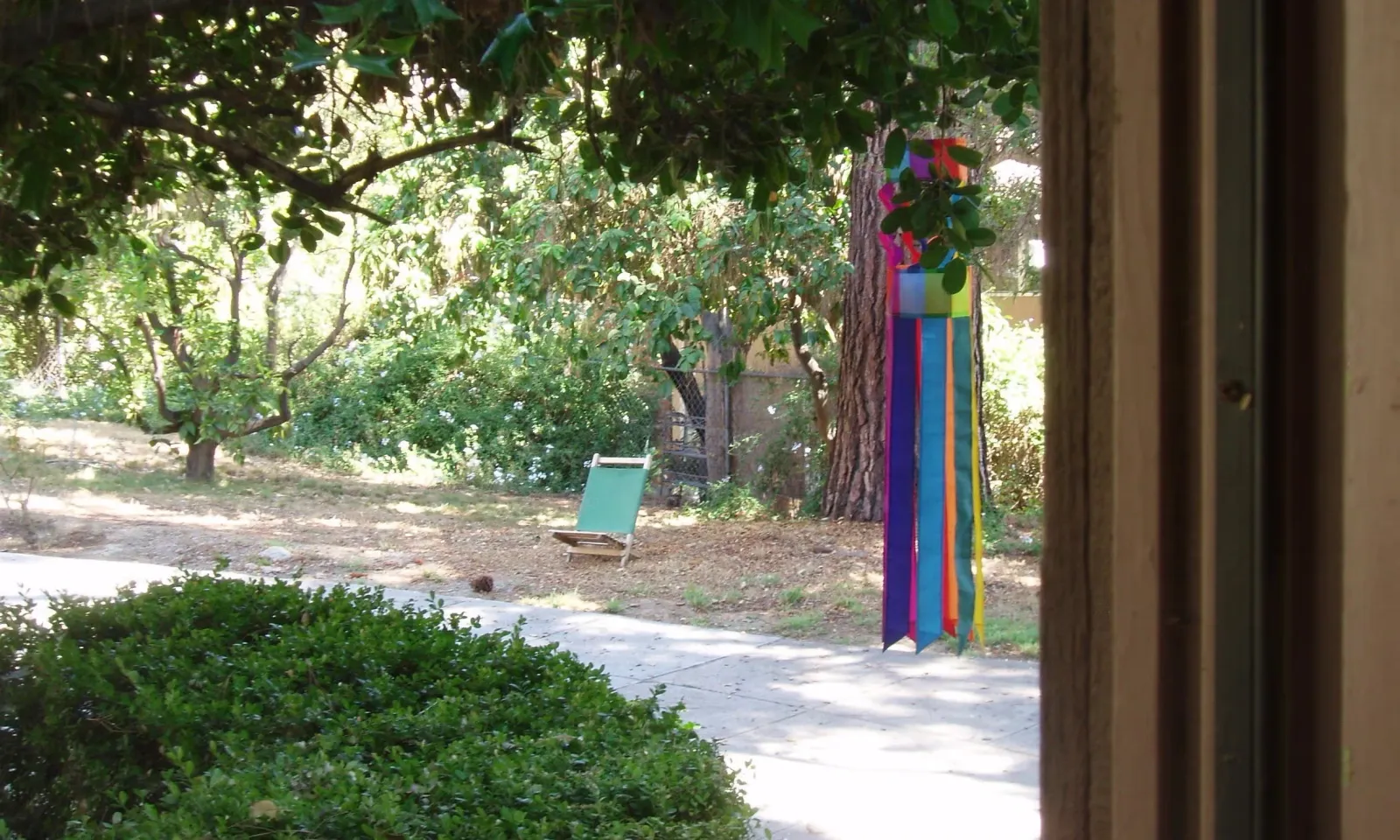
The bear lay down not 15 feet from my front door, in the spot where I’ve placed the camp chair.
Susette Horspool, CC-BY-SA 3.0
The next day we discussed how to prevent bears from rummaging through our trash. I figured they could smell the garbage, so rinsing off all food and wrappings before tossing them into the trash should work—something I was already doing for insect control. She tried it, and it worked.
How Humans Can Assist Black Bears
Black bears generally avoid humans, so they only come down if they're starving or if they're sick or injured and have found easy food near people—like pet food on back porches.
Officials usually advise against feeding bears or letting them become too comfortable around your home, partly because they go wild for food in autumn—consuming an average of 20,000 calories per day. But that doesn't apply in the southwestern U.S., where winters are mild and food is available year-round.
How can we provide for them when the mountains offer nothing? And how can we do so without putting ourselves at risk?
In my view, there's merit in cultivating the hills above a community to offer an alternative food and shelter source for bears. Since they like to shelter and raise young in cave-like spaces, culverts and downed trees could be installed in the hills.
A wildlife community group could plant and maintain trees, berry bushes, open hives, and other food sources in the foothills. Eventually, it could become a great hiking spot for humans too.
Because bears establish territories, if a few black bears claimed that land, they would deter other bears from coming through to human habitation, effectively becoming protectors for foothill neighborhoods. Humans could continue their noisy lives below the bears' quiet sanctuary, and bears would still have the upper mountains to retreat to when the foothills get too noisy or hot, and food is available there again.
Such an endeavor would be time-consuming and expensive (at first), would prevent humans from spreading further (probably a good thing), and would cost a lot to water the plants until they're established. A cheaper but less effective alternative might be to:
- Set up a neighborhood park to support wildlife when times are tough. Include food and water (no shelter) and a safe pathway between the mountains and the park.
- Plant the city parkways up each street with bear-friendly trees. Make it harder for bears to enter people's yards.
- Block off all culverts and ravines running through the town. Even with food and water available in the neighborhood, bears should go back to the hills to find shelter.
Bear Interactions, Danger, and Safety
The final question is how humans can stay safe from bear attacks if shooting them is illegal. Sometimes bear "attacks" are actually provoked by humans unknowingly, so learning to understand bears and their signals would be a good start. Here's how they interact with each other:
- When they meet face to face, they stop and assess each other—looking, smelling (from a distance), listening. They use grunts and snuffles to communicate their intentions.
- If one bear feels threatened, it will rear up and bluff, then walk away.
- A black bear will fight only if it sees no other choice—either to protect itself or its cubs. If dogs attack, it will fight.
Many Native American tribes have viewed bears as human counterparts in the animal kingdom. Could it be that bears "see" us that way too—as a different type of bear? If so, it would make sense for humans to adopt a few of their signals in areas where bears are anticipated.
Tips for Safety
Here are a few things a person could do when a bear is approaching. You could prepare ahead by watching videos and practicing moves with the kids:
- If you round a corner and find a bear there, back off and stand your ground. That will tell the bear you don't intend to hurt it, but you're not going to run scared either. If the bear makes a clicking sound with its jaw, that means you're still too close.
- Face off with the bear. Expand the space you take up—open and spread your coat or sweater, widen, and solidify your stance. Huff noisily (repeated noisy breaths out).
- Wait a bit, then talk to it with a friendly voice, "Hey dude, what's up?"
- If it comes closer and you don't want it to, give a warning growl. It may test you—bear comes closer (you growl), bear steps back (you talk friendly).
- If it keeps coming closer yet, command the bear in a strong voice, "Hey! You go!" and point away. In 95% of the cases, they'll amble off.
- The next step is throwing things, then pepper or bear spray, but those shouldn't be needed.
I did see a video recently where a bear curiously approached a female hiker to smell her hair. She faced him and stood still, letting him sniff. Then he went away a few yards and came back again to sniff.
Before I thought it through, I figured this girl must have used a shampoo he liked, but then he sniffed other places—her neck, underarms, behind the knees—and it began to look like it was her perfume. When he cuffed her, I realized that was a play cuff—the kind of invitation dogs and cats give.
Paying attention to what bears are saying with their actions is important. This bear was saying he does not want to fight for dominance or a mate but sees himself as of similar social rank, by which bears share elaborate greetings of rubbing and sniffing like he is doing. He's curious. Wants to know more.
How to Deter Bears
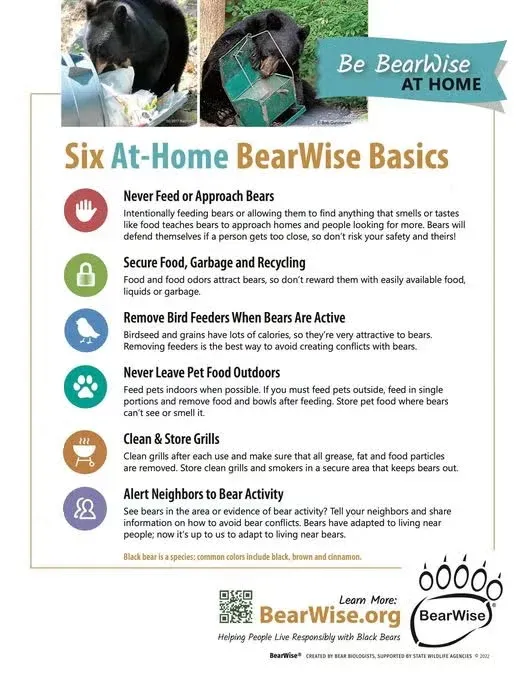
If you don't want bears around at all, then don't provide for them, even accidentally:
- Move your trash cans inside the garage or gate and close it at night.
- Keep your barbecue grill free of drippings (i.e. clean it).
- Feed your pets inside the house when bears are around, not outside.
- If you have bird feeders, set them up away from your house.
- Cover or lock up anything that smells interesting.
- If you have an outdoor refrigerator, make sure all the seals are tight, and the door can't be opened.
- Block the crawl space under the house, so bears can't use it as a shelter.
- Ask the county to fasten big metal screens over each end of big culverts nearby.
- And if you go hiking, don't wear perfume.
If a bear comes around anyway, look to see what drew it and eliminate that. For me, it was the trash. For my neighbor, it was the food she was putting out for the coyotes. The Department of Fish & Wildlife has several suggestions for bear-proofing your home or campsite.
Note
These steps should keep bears away from your house, but they will not do anything to help bears through tough times.
How to Handle "Nuisance" Bears
Those bears it's important to be most cautious about are those that have a reputation for causing problems. They're usually young males just entering their prime or females with young cubs. These bears need to be reported to the authorities, who will trap or tranquilize them, then carry them back to the hills to a place that makes it difficult for them to return.
When reporting a nuisance bear, there are several key questions to which the authorities need answers, so most state Departments of Fish & Wildlife provide an online form to fill out. California's is here.
If a bear is actively attacking someone, do what you do with any other emergency and call 911. The following video shows how removal is carried out.