When a Dog Kills a Cat: Understanding Predatory Drive and What to Do Next
Elliot Watson
"If a Dog Kills a Cat Will It Kill Again?"
It's natural to see your dog in a different light after he or she kills a cat. Many pet owners are baffled and ask: "Is my dog aggressive?" "Will my dog kill again?" "Are my children safe?"
Owners are often stunned that their dog could kill another animal, particularly a beloved pet. Some are so upset that they view their dog as a monster and may contemplate giving him up or, in extreme cases, euthanizing him.
First, Try to Figure Out What Happened
Before jumping to conclusions and labeling the dog as evil, it's crucial to understand the behavior and what likely occurred. There can be many different reasons for this behavior. If you saw the incident, you might find clues by considering what happened before:
- Did your dog chase the cat?
- Did the cat come too close to a resource?
- Did the cat enter your dog's territory?
- Were the cat and dog playing?
We'll examine some potential causes and tips for dealing with the situation—and preventing it from happening again. Understanding what might have happened requires stepping back from the shocking event and looking beyond immediate emotions.
Seek a Behavior Professional
This article is not a replacement for hands-on professional behavioral advice. If your dog is chasing and killing animals and you're worried about future harm, please consult a behavior professional for proper assessment and management options.

If your dog is chasing and killing animals and you are concerned about potential future harm, please seek the aid of a behavior professional for proper assessment and management options.
Destiny Wiens via Unsplash
Why Do Dogs Chase and Kill Fleeing Cats?
If your dog chased a fleeing cat and fatally wounded it, you should consider that this might be entirely normal behavior. You might think, "How can it be normal? I never thought my dog would do something so horrible!"
I felt the same way when a friend told me that a kitten I gave her was killed by a neighbor's pack of Cirneco dell'Etna hunting dogs. Every time I saw those dogs, I thought of them as evil creatures with fangs ready to kill any cat that walked by.
Today, I see things differently. The issue is that we humans often attribute human traits to dogs, a phenomenon known as anthropomorphism. Unlike us, dogs act on instinct and lack moral values, which is simply part of being a dog, just as killing mice may be part of being a cat.
Chasing a fleeing cat (or a squirrel, rabbit, or mouse) is as normal for them as it was for our ancestors to hunt, and for our food industry to keep stocking meat departments in grocery stores so we can eat steak and ribs. The instinct to chase and kill fleeing animals comes from the dog's past.
The Predatory Drive and Your Dog's Ancestry
To fully understand predatory behavior in dogs, we need to go back to ancient times when dogs' ancestors didn't rely on humans for food as they do today. Let's briefly look at how predatory behavior works.
Before dogs were domesticated and fed kibble from a shiny bowl, their ancestors were hunters at heart. What is predatory behavior? It's an animal's ability to track, chase, and kill animals for food. All dogs have some level of predatory drive. The fact that your dog eagerly chases a ball or shakes a toy is due to this drive. Hunting and killing were a way of life in dogs' evolutionary past.
The predatory drive follows a precise sequence that scientists call a "fixed action pattern." The sequence is eye, stalk, chase, grab-bite, kill-bite, dissect, and consume. Not all dogs will follow the entire sequence, though. This varies based on genetics, history, motivation, and other factors.
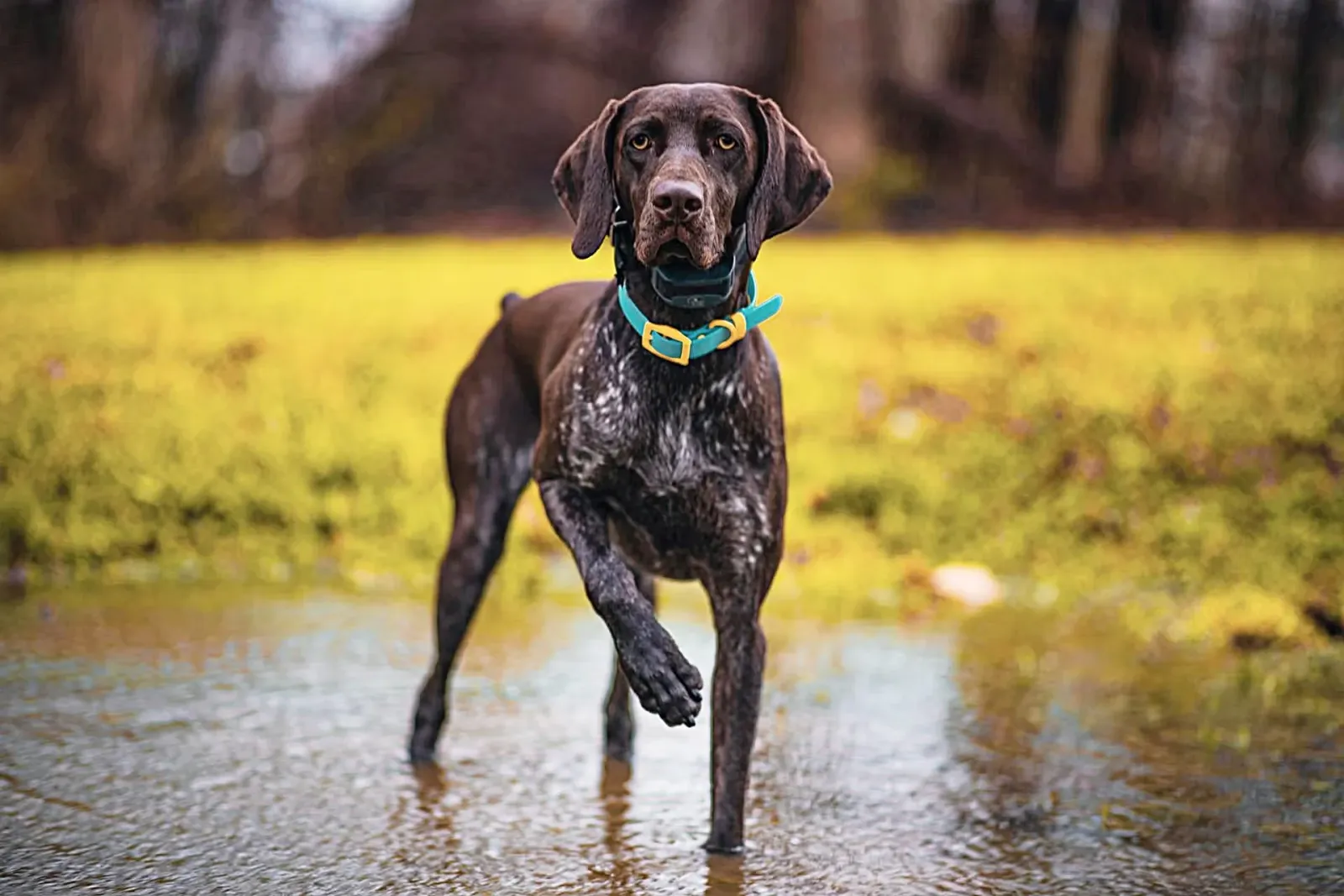
A cat suddenly moving—or especially, fleeing—could trigger a dog’s prey drive, an automatic, reflexive response in dogs that has nothing to do with rage.
Photo by Brixiv on Pexels/PhotoScape
The Importance of Movement
If your dog saw a fleeing cat, the predatory drive could have triggered him to chase. What triggers a dog's predatory drive is movement. Movement triggers an automatic, reflexive response in dogs. When a dog spots prey at a distance, he may fixate on the source with his gaze, ears upright, body quivering, listening for the faintest sounds, and ready to spring into action.
If the dog sees a sudden movement nearby in a bushy area, he may decide to pounce on the prey, or he may decide to chase. If the chase is successful, the dog may grab the prey by the neck, bite down, and shake. Shaking is typical predatory behavior meant to quickly finish off their prey.
Usually, in such a case, you don't see any blood, and the affected animal looks intact. "Predatory aggression by a dog does not reflect a psychological problem and neither is the perpetrator vicious, malicious or vindictive."
Rage Is Not a Factor
Behaviorists call predatory killing "the quiet bite" because it's not done out of rage. Brain research has shown that during a kill, the circuits responsible for rage are not activated, and killing bites are far from the loud, screaming fights seen among two animals fighting. When an animal is on the kill, he'll just bite down hard and shake, explains Temple Grandin in the book Animals in Translation.
All this predatory behavior may seem to make sense if a dog is hungry, but why would dogs kill cats if they aren't starving and are well-fed? Aren't they just acting out for the morbid pleasure of killing? Again, we must consider instinct.
Indeed, in a laboratory setting, it was found that an animal's killing bite instinct could be easily turned on by simply implanting electrodes into the predatory circuits of the brain and stimulating them with electricity. The animal didn't have to be hungry, nor did it have to see prey, adds Temple Grandin.
Dogs remain instinctive beings who don't abide by our moral values, as we humans sometimes do. Their brains aren't as complex as ours and don't kill out of rage (as discussed, their circuits responsible for rage are not activated). It's unjust to consider a dog killing a cat as a type of murder. A murder is something done with the intent to harm. A dog who is acting out of instinct doesn't have an intentional intent to harm.
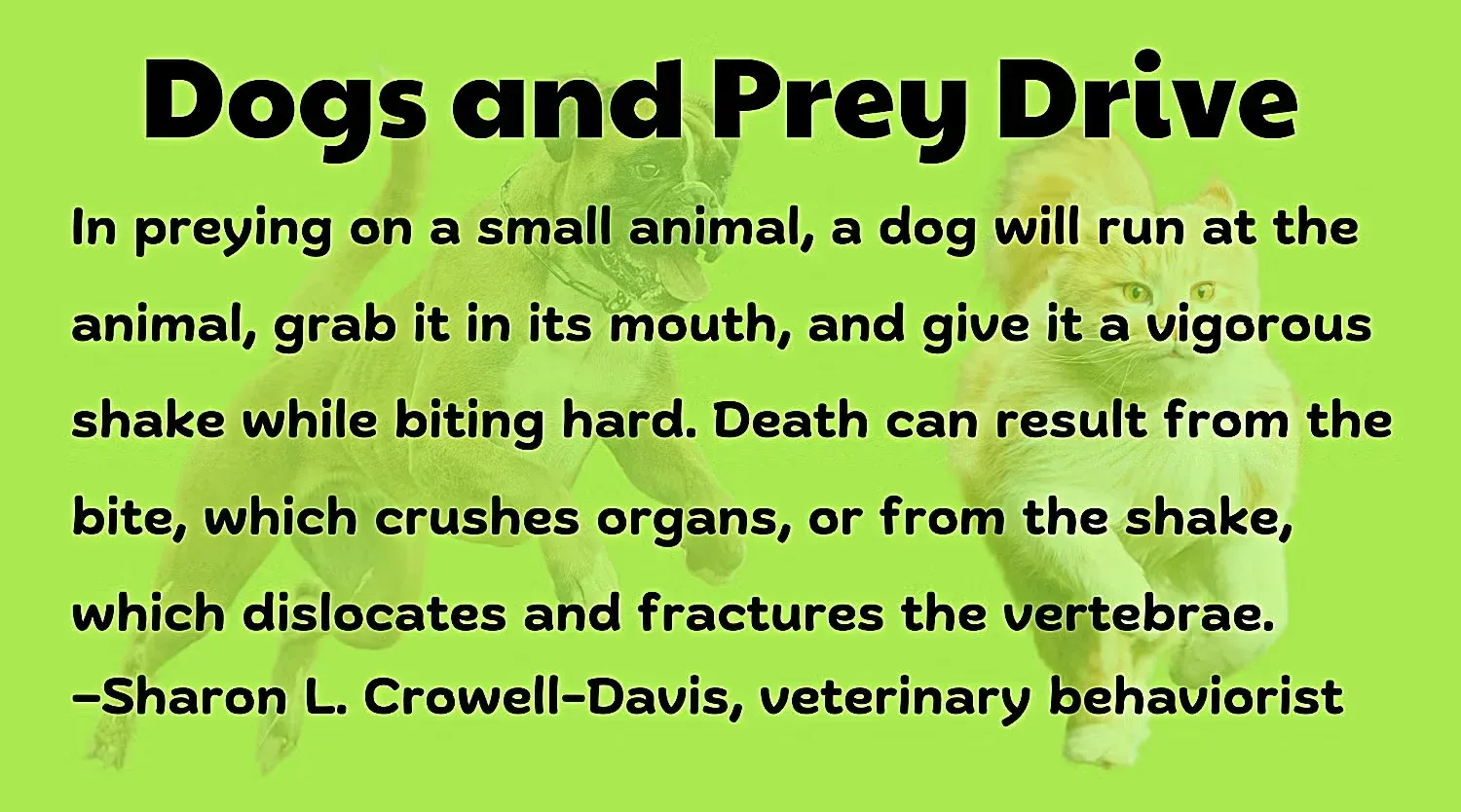
In preying on a small animal, a dog will run at the animal, grab it in its mouth, and give it a vigorous shake while biting hard. Death can result from the bite, which crushes organs, or from the shake, which dislocates and fractures the vertebrae.
The High of the Hunt
However, other than rage, there may be other feelings going on. According to dog trainer David D. Cardona, when hunting, dogs reach an emotional natural high as the neurochemical dopamine ends up sending endorphins throughout the dog's body. The hunting action itself, therefore, becomes addicting and self-reinforcing. Temple Grandin claims that animals like having their predatory circuits turned on because predatory killing means dinner.
When a dog is engaging in predatory behavior, the behavior stems from the same areas of the brain where the "seeking circuits" come from. These are circuits that elicit curiosity, intense interest, and anticipation as animals seek what they want. It's the pleasurable feeling a cat that kills a mouse must feel, or a primate peeling a ripe banana. As humans, we may feel the same way when we catch many fish or go on a shopping spree.
So when we feel like our dogs are being cruel for killing an animal, we are engaging in anthropomorphism, attributing to them moral values dogs don't have. "Predatory aggression by a dog does not reflect a psychological problem, and neither is the perpetrator vicious, malicious, or vindictive," explains veterinary behaviorist Dr. Nicholas Dodman. As Temple Grandin concludes, "Inside the brain, predatory killing and angry aggression are not the same thing. Not even close."
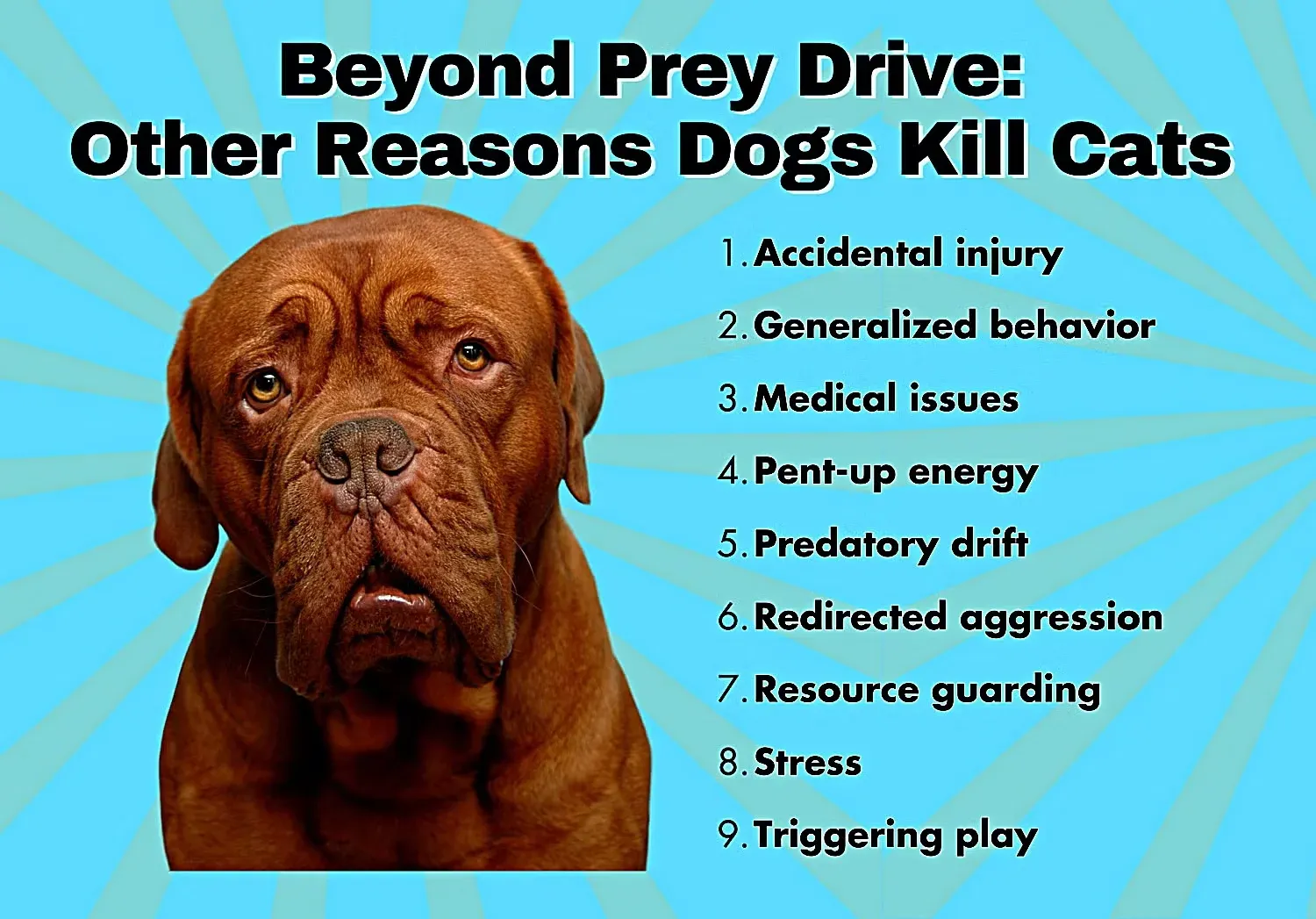
While prey drive is the most obvious reason dogs kill cats, there are several other possibilities.
Other Reasons Dogs May Kill a Cat
When a dog kills a cat, the predatory drive isn't always necessarily the main culprit, even though it may be a contributing factor. Witnessing what occurred before the incident may reveal some insights into the dynamics of the behavior.
- Accidental injury: In households where a dog and cat got along for a while, it could be that the dog and cat were playing, and the cat got accidentally injured.
- Generalized behavior: It could be that the dog has started killing other animals and decided to generalize the behavior to the cat if the cat started fleeing.
- Medical issues: It could be that the dog may have medical problems that have lowered his threshold for aggression.
- Pent-up energy: If dogs aren't exercised enough, their pent-up energy may lead to pestering the cat, which could lead to predatory drift.
- Predatory drift: At times, dogs and cats may interact, and then predatory instinct may take over. Sometimes, cats and dogs may be playing when predatory drift, a phenomenon where a dog's predatory instinct is suddenly turned on, may take effect. A dog may also be chasing a cat out of his perceived territory, and then predatory instinct may take over.
- Redirected aggression: It could be that a fight erupted among the dogs, and the cat fell victim to a redirected bite for high arousal levels in the dogs. It could be an animal may have entered a fenced yard and, frustrated from not being able to catch it, the dog reverted to its predatory instincts towards the cat.
- Resource guarding: It could be that the dog was resource-guarding an item (food, toy, sleeping place), and the cat came too close, and the dog fatally injured the cat.
- Stress: It could be that the cat got panicky or had a seizure, and the dog was stressed by the behavior. It could be that the dog wasn't feeling well, and the cat failed to read his signals to be left alone. One must consider if there were any recent changes that could have caused stress. Stressed dogs may act out of character.
- Triggering play: In households with multiple dogs, it could happen that one dog is playing and other dogs join in, and then predatory instinct may kick in in one dog. Fleeing often induces dogs to chase, and instincts may sometimes kick in.
There are several dynamics that may take place, and sometimes, a real answer is never known, as only assumptions can be made.
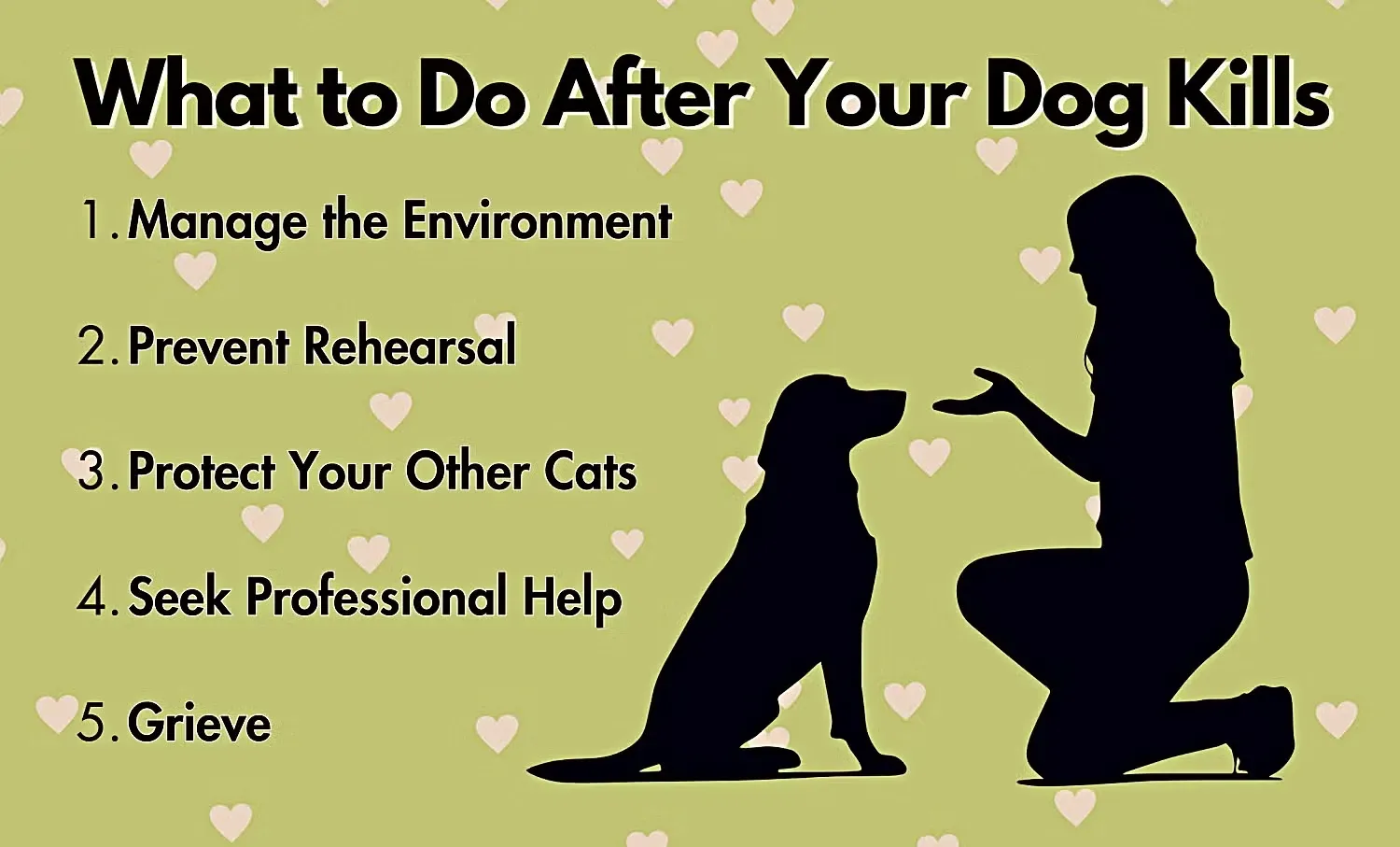
If your dog kills, here are a few things to keep in mind.
What to Do After Your Dog Kills
A dog killing a beloved cat is an owner's worst nightmare come true. As much as one was attached to the cat, blaming a dog for acting out of instinct is not helpful. Instinct is hardwired behavior that can be managed and sometimes changed, but never totally removed.
Following are some tips to recover from the loss and prevent future mishaps.
1. Manage the Environment
If your dog killed a neighbor's cat, after sending condolences and perhaps offering to pay for the burial or cremation services, it's important to take care that nothing similar happens again in the future. Since we are the ones responsible for managing our dog's environment, it's our responsibility to protect the animals of others.
Sometimes though, cats are in the wrong place at the wrong time. Cat parents must also ensure their cats don't get into a property where dogs reside.
2. Prevent Rehearsal
If a dog is provided with ample environmental opportunities to act on their predatory drive through conditioning and rehearsal, the predatory behavior will be fine-tuned and get stronger and will, therefore, repeat in the future. So, when a dog chases or kills a cat, it's important to realize the dog is likely to do it again.
3. Protect Your Other Cats
If you have other cats, it's imperative to prevent access to them from now on. Keep them completely separated from your dog, or consider rehoming your dog or the cat(s).
4. Seek Professional Help
Just because a behavior may be "natural" does not mean that it cannot be changed. In some cases, the implementation of force-free training and behavior modification can help.
5. Grieve
You have been through a very traumatic experience and have earned the right to grieve. There's the death of another animal to consider, the grieving of another pet parent and their family, and the emotional impact on your own family.
Will My Dog Hurt My Children?
Killing a small animal doesn't necessarily mean the dog would hurt a young child, infant, or another dog, even though this behavior may indicate the dog is at risk for such problems.
Dr. Nicholas Dodman warns, however, that some dogs may get overstimulated by fast-running children. It never hurts to always practice caution and always supervise the interactions between dogs and children, whether your dog has a history of killing small animals or not.
If you are ever uncomfortable with any situation, consult with a professional to assess your dog.

If your dog kills a cat—especially your own cat—you have to reassess your dog and the environment to ensure a repeat attack won’t happen again. Please don’t be afraid to call a behavioral professional for help.
Jamie Street via Unsplash
If your puppy or dog shows signs of potential aggression (lunging, barking, growling, snapping, biting), please consult with a dog behavior professional for direct in-person guidance. Articles, videos, and general information provided online are not meant to replace in-person training/instruction. By using this service, you are waiving any liability claims or other types of claims related to any of your dogs' behaviors against you or others.
Questions & Answers
Question: My sister insisted giving her dogs free access to my house with a dog door, but she was supposed to secure her dogs away from the rest of the house so they wouldn't get to my cat. She failed. My cat was killed by one of the dogs. I want the dog euthanized. Why is that response to a dog killing my cat drastic?
Answer: The mistake was mostly your sister's poor management. The dog shouldn't pay the price. Responsible dog ownership entails keeping dogs under control and preventing other people or other animals from being harmed and private property from being damaged. Killing small animals can be highly instinctive in some dogs. In some dogs, prey drive is very strong and some dog breeds have even been selectively bred to kill small furry animals. Others, they are rough and don't realize the impact of their teeth. Regardless, we don't put cats to sleep for killing mice (even if the mice were cherished pets) and the dynamics are similar. We are talking instincts, highly related to survival and years of selective breeding, which is different from the deliberate killing humans do.
Question: My cat was on my fence and fell and my dog killed it in front of my eyes, will he kill my other cats?
Answer: This is difficult to say, has your dog been raised with your cats from an early age? Does he have a long history of getting along with them? If so, I am thinking this was just a very freak accident.
Your cat may have fallen off the fence and your dog may have tried to catch it out of instinct.
Reminds me of my dog who has never attacked our chickens or baby chicks, but one day a bird had entered our home and in a panic flew right down the chandelier and my dog lunged up to catch it with his mouth instantaneously killing the bird. The look on his face right after the fact was "oops."
It could be your dog acted up on instinct, trying to catch the cat from the fall and not knowing it was your cat. It could be he also thought this was an animal that was invading his property and failed to recognize it was your cat.
A cat doesn't fall from a height like that often so in this context your dog may have acted too impulsively. It would have been interesting to know if your dog shook the cat with his head side-to-side which is more in compliance with instinctual prey drive.
Of course, this is just an assumption as we can never really know what was going on in a dog's mind. There is really no 100 percent way to know if your dog may ever harm your other cats.
So sorry for your loss.
Question: My puppy is almost two months old. I don't know if she killed this kitten, or if it died another way, but she was eating it! Why would she eat it? I know she's not starving.
Answer: Dogs are some of the most indiscriminate eaters. Ask many dog owners, and most likely all will have a story of their dogs finding a dead squirrel or some other animal carcass and eating it. Puppies are often curious and will mouth just about anything they find. Please do not be upset by it. It would have likely happened anyway whether it was a kitten or a dead bird or lizard.
Question: My dog grew up with three cats with no problems. We have this cat in the neighborhood that torments him and comes into our yard. Sadly the cat was in our yard again and my dog got hold of him and killed him. Will my cats be at risk now too?
Answer: This can be very difficult to predict. In general, we would assume that stranger cats are killed because the dog perceives them as invading their territory, they are not part of their social group and dogs instinctively chase and grab fleeing animals. However, we never know what may go into an animal's mind at every given moment. Chances are, he knows your cats well enough and has accepted them for a long time, that it would never come into his mind to harm them. But there are also stories of dogs and cats living together for many years and then one day, out of the blue, something goes wrong. I would feel hesitant to let your cats in the yard (if they are allowed to) for a while, just because this episode is so "fresh." Supervision is always a must when having cats and dogs. With my cats and dogs, they were always kept separated when we were not actively supervising.
Question: The dog and cat were fine, and then out of nowhere, he mauled her, what could've caused that?
Answer: It difficult to know what may have happened exactly. Did they live together with no issues for some time? Or were they new to each other? Here are just a few possibilities: your dog had pain somewhere and redirected by lashing towards the cat, the cat went close to your dog's resource, maybe your cat had some sort of seizure you weren't aware of, your cat smelled different from being at the vet or someplace else, they were playing and your dog got too rough, your dog has been stressed lately, he wasn't trustable near cats in the first place and he learned not to attack in your presence but the moment you moved away he attacked, the cat entered the dog's territory, the dog is protective of you or a family member, the cat did something that triggered the dog's prey drive. Of course, there are many more possibilities. So sorry this has happened.
Question: We have 4 dogs and 2 cats, all adopted from a local shelter. We then rescued 4 cats from another country 9 months ago. My shepherd who joined our family at a young age and with 2 cats already in the house, has killed two of the cats we rescued from another country. Do you have any advice for me?
Answer: It's unfortunate, but things can get quite challenging when we put together dogs and cats that are not perceived as part of the "family." Dogs and cats should always be supervised and never be left alone and this applies as well to animals we know to have a history of getting along. You had quite a large amount of pets (4 dogs and 6 cats total at one time) and it's not easy to monitor them all, but this is important for the sake of safety for all.
Question: My dog killed a cat that was in my garden, it was barking at the cat and the cat was defending itself but hissing and going to scratch my dog. Will my dog do it again?
Answer: It's hard to say. Perhaps yes, if he/she would meet a cat in a similar context (being in the garden and with he cat hissing and threatening to scratch). As the saying goes "an ounce of prevention is worth a pound of cure." I would, therefore, make sure your dog is always supervised when outside and that any cat owners nearby securely confine their cats or put more secure fencing to prevent future mishaps.
Question: My dog has never hurt an animal before or got into a fight but a dog bit her. The next day she was in the back garden and a cat came in and she went for it, she was chasing it up and down the garden, but the cat climbed out and didn't seem too hurt. We have 2 cats and always have kids in our house and my mother seems to think that since the dog attacked her shes now traumatized and will attack anything or anyone if she feels uncomfortable and wants the dog put down. Could this be the case?
Answer: Dogs are animals, and as animals, we can never really predict their behaviors. Does this mean he will attack kids because of the trauma of the dog bite? Not necessarily, but can we can ascertain this 100 percent? Never, because we don't know how dogs may react when they are stressed. For safety, no cats or kids should ever be around your dog unsupervised, and they should never be allowed to do things a dog might not like, regardless of whether there was a recent attack or not, regardless of breed, regardless of how long the dog has been owned, regardless of size. I am sorry but unfortunately I cannot predict how your dog may react to cats or kids and the cat chasing behavior may or may not be related to the recent dog bite. Many dogs will chase unknown cats if they are in their yards. Every dog is an individual and therefore responds differently to stress. I would definitely have a dog behavior professional asses the dog if you there are any concerns to play it safe.