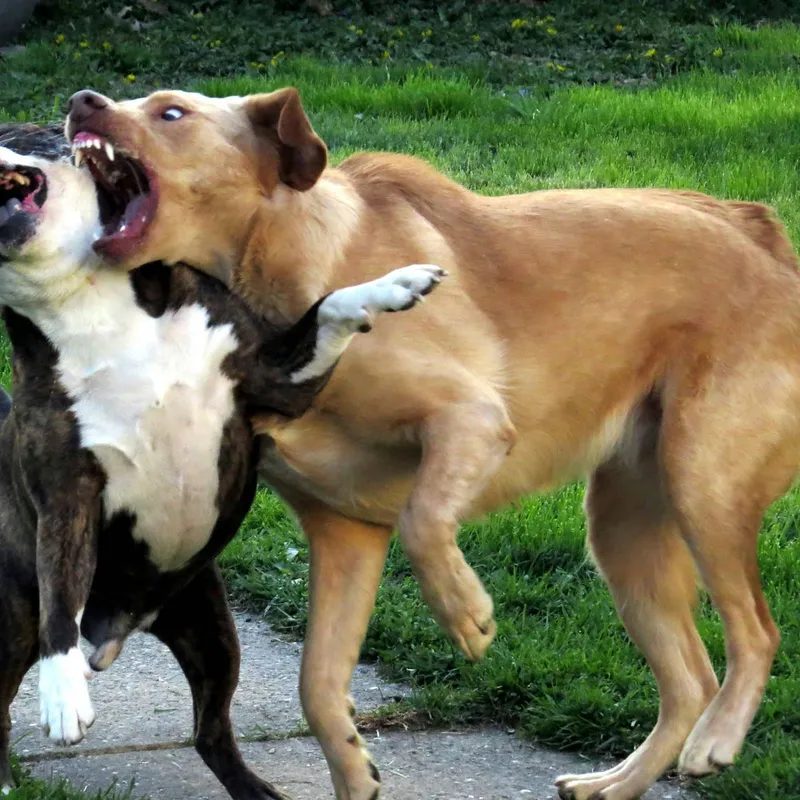
When Household Dogs Turn on Each Other: Causes and Solutions
Elliot Watson
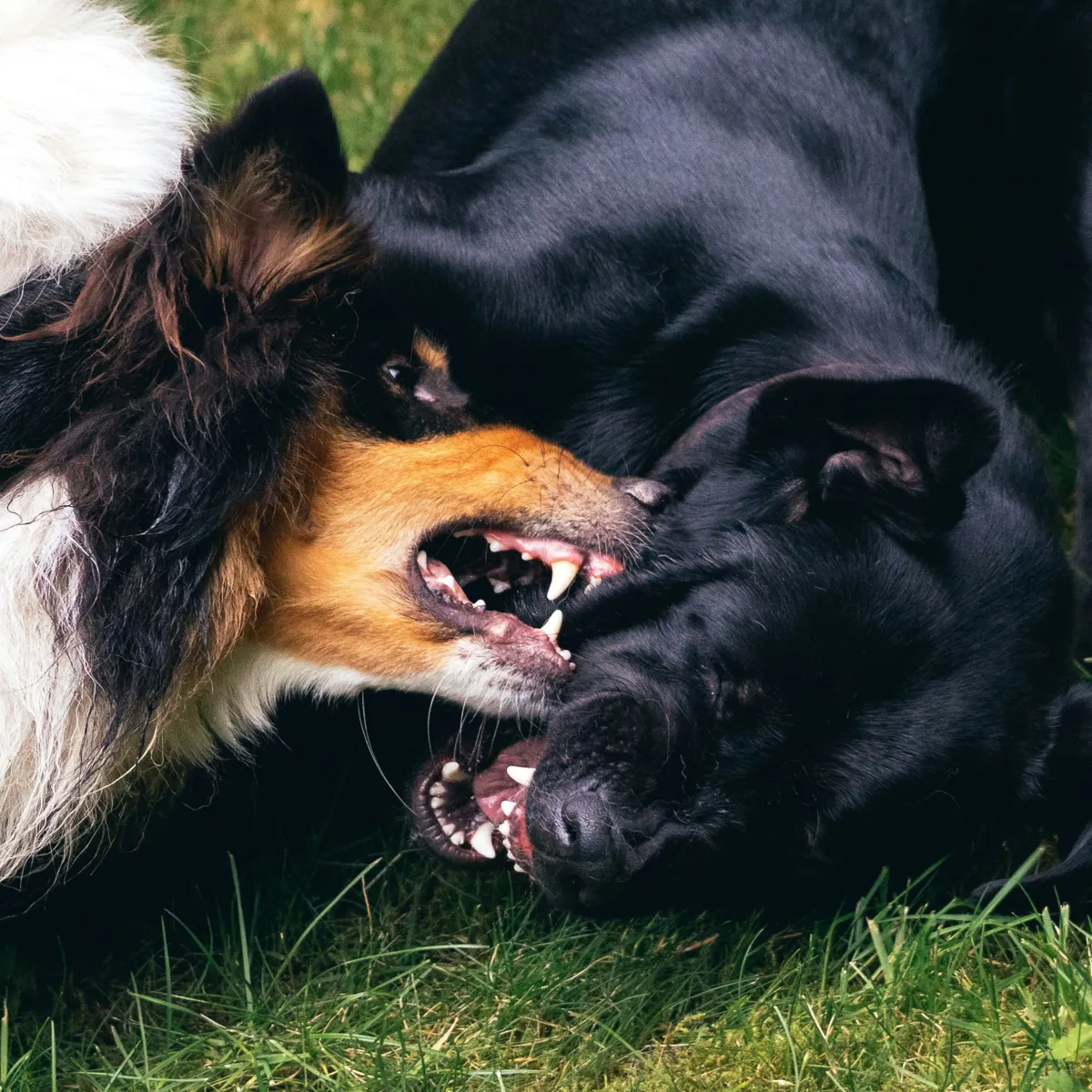
Investigating Sudden Aggression Between Dogs in the Same Home
For owners of multiple dogs, few issues are as distressing as when their pets begin fighting. Although dogs are widely considered social creatures, conflicts and even violent altercations can happen.
These situations arise from a variety of circumstances and can involve complex dynamics. Two dogs that were friendly as puppies might start serious fights once they mature. A younger dog may unexpectedly go after an older one despite years of peaceful coexistence. Bringing a new dog into a home where two dogs have long gotten along can also set off fighting.
Such scenarios are not rare, and many owners face them regularly, sometimes daily. Why does this happen? What leads dogs to fight? Inter-dog aggression within a household has many potential causes, so pinpointing the specific triggers is crucial.
At times, just as with people, two dogs simply may not be compatible. This shouldn't come as a shock. Below are some of the most frequent reasons behind dog fights.
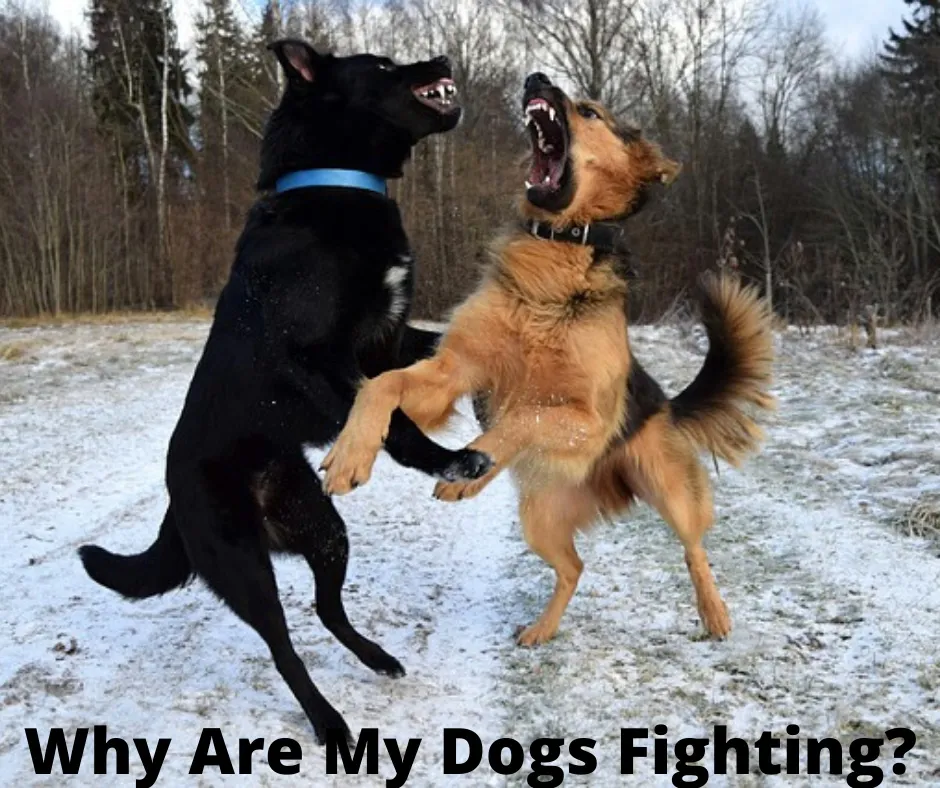
Are your dogs suddenly fighting?
Aggression Between Dogs of the Same Sex
If you have two female or two male dogs, fighting is quite common. Certain breeds are more inclined toward same-sex aggression. For example, Alaskan Malamutes, American Pit Bulls, and Boxers are known for this tendency.
In a Petplace article, Nicholas Dodman and Alice Moon Fanelli note that terriers may be more likely to fight because they were historically bred to work independently.
However, any dog, under the right conditions and with a genetic predisposition, can develop inter-dog aggression. Typically, these dogs get along fine as puppies, but when they reach social maturity—usually between 12 and 36 months—the situation changes dramatically. Fortunately, there is a reason for this shift.
Dogs Prefer Their Own Social Groups
In the wild, it would be highly unusual for two female or two male dogs of similar age to live in the same social group. Once they mature, they typically leave to form their own groups.
If they stay, they must respect the breeding rights of the other same-sex dog. According to Gail Fisher, a dog trainer and breeder with over 40 years of experience, "A pack with several adult males and females of the same age would rarely, if ever, be found in the wild."
The Merck Veterinary Manual supports this:
"At social maturity, in free-ranging packs, dogs that challenge the established social hierarchy may leave and form their own groups if they do not succeed in altering the extant social order. This situation may be analogous to one form of inter-dog aggression that occurs in multiple-dog households. Social maturity is also the time during which problem aggressions and anxieties develop. In multi-dog groups, the highest-ranking animals may be the only ones to breed."
Hormonal Influences
If dogs are not spayed or neutered, hormones can sometimes play a role in fights. In female dogs, hormonal shifts during the estrus cycle and pregnancy can particularly trigger conflicts. However, even when not in heat or pregnant, fights may continue due to hierarchy and breeding rights. For more, see "Why Are My Female Dogs Fighting?"
In male dogs, testosterone may contribute to inter-dog aggression. After spaying/neutering, dogs prone to such aggression might no longer fight due to hormones, but they may still fight viciously for other reasons discussed below.
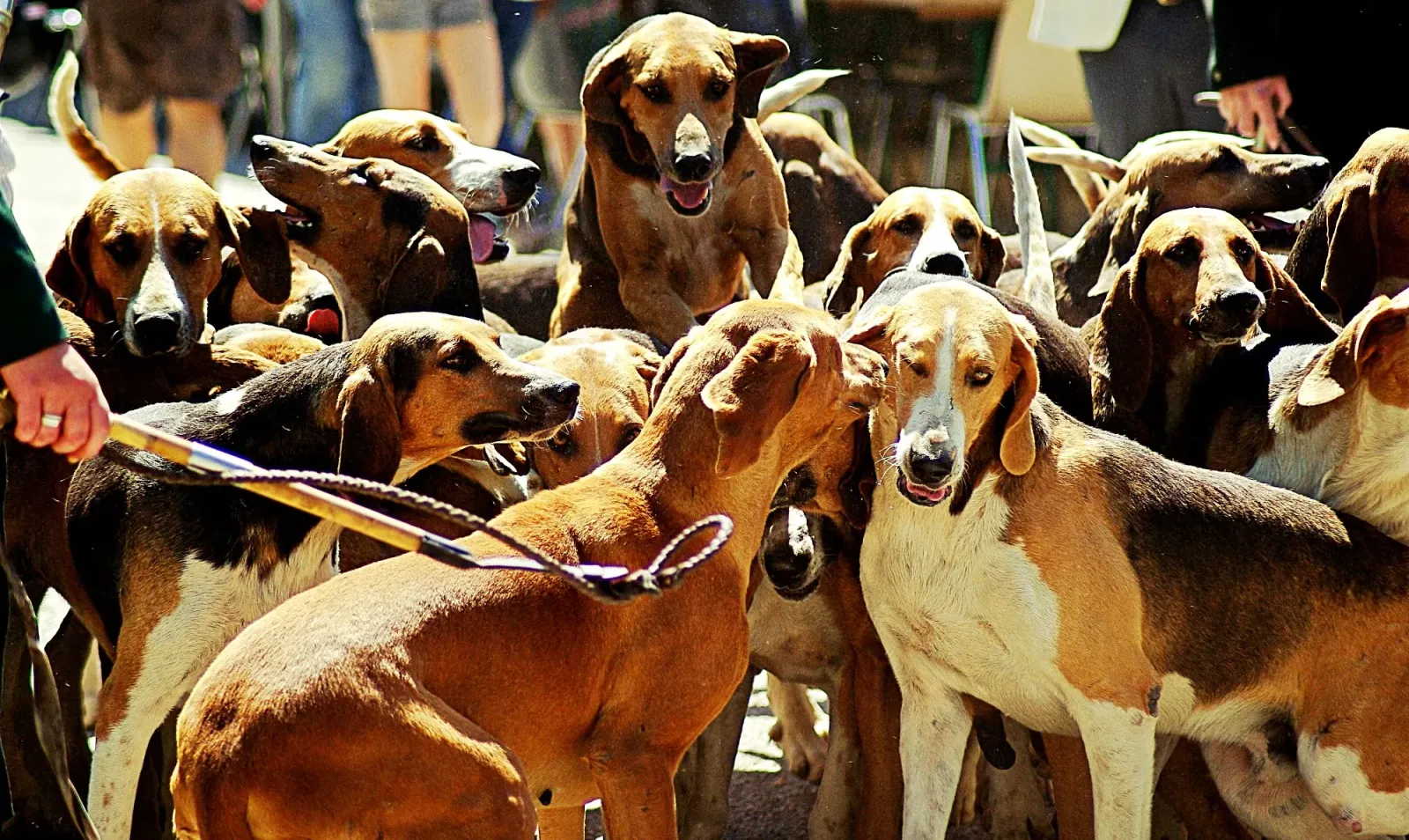
A pack of hounds looks like utter chaos, but dogs are actually masters of ritualized aggression and hierarchy.
Social Hierarchy Among Dogs
Social hierarchy is a major cause of inter-dog aggression in homes with multiple dogs. Pat Miller, a dog trainer and owner of Peaceable Paw, says, "Social hierarchies do exist in groups of domesticated dogs and hierarchy can be fluid." Dogs are naturally skilled at resolving conflicts and are masters of ritualized aggression.
Ritualized aggression involves resolving disputes without biting. Growling, raising hackles, and baring teeth, though dramatic, help avoid actual confrontations. In nature, expending energy on minor issues is counterproductive; animals need to conserve energy for survival tasks like hunting.
So why do actual fights occur in multi-dog households? Why do dogs bite and break skin if they are good at conflict resolution? Let's examine the hierarchy in dogs more closely.
Rank Is Contextual
According to Karen Overall, rank is relative to context. A genuinely high-ranking animal would typically be tolerant of lower-ranking members. The behavior of lower-ranking dogs toward higher-ranking ones determines the social hierarchy. In other words, lower-ranking dogs make the hierarchy clear by "withdrawing."
Higher-ranking dogs regulate and maintain access to certain resources, but this access is context-dependent. A resource might be highly guarded at certain times and not others, or some resources may not be guarded at all. Resources, therefore, can be both contextual and subjective.
Resource Guarding
What are common resources from a dog's perspective? Here are some:
- Attention from the owner or guests (greeting the owner, interacting with the owner)
- Food (respect space when feeding dogs, or better, crate them individually for safety)
- Toys (especially new ones or those not seen for a while)
- Sleeping areas (a favorite bed, a higher spot, or a preferred place)
- Bones (seen as high value even among dogs that get along, so exercise caution)
- Space (many dogs have a space threshold, an invisible barrier that, if crossed, may lead to a dispute)
Generally, a high-ranking dog will maintain access to resources through ritualized displays; problems arise when these displays are ineffective. This is why fights often occur between dogs of similar or equal rank when ritualized signals are ignored.
Sometimes, ignoring a display is not voluntary. Lower-ranking dogs may ignore a signal because it is overridden by an event that temporarily blurs the hierarchical status. We'll explore such circumstances below.
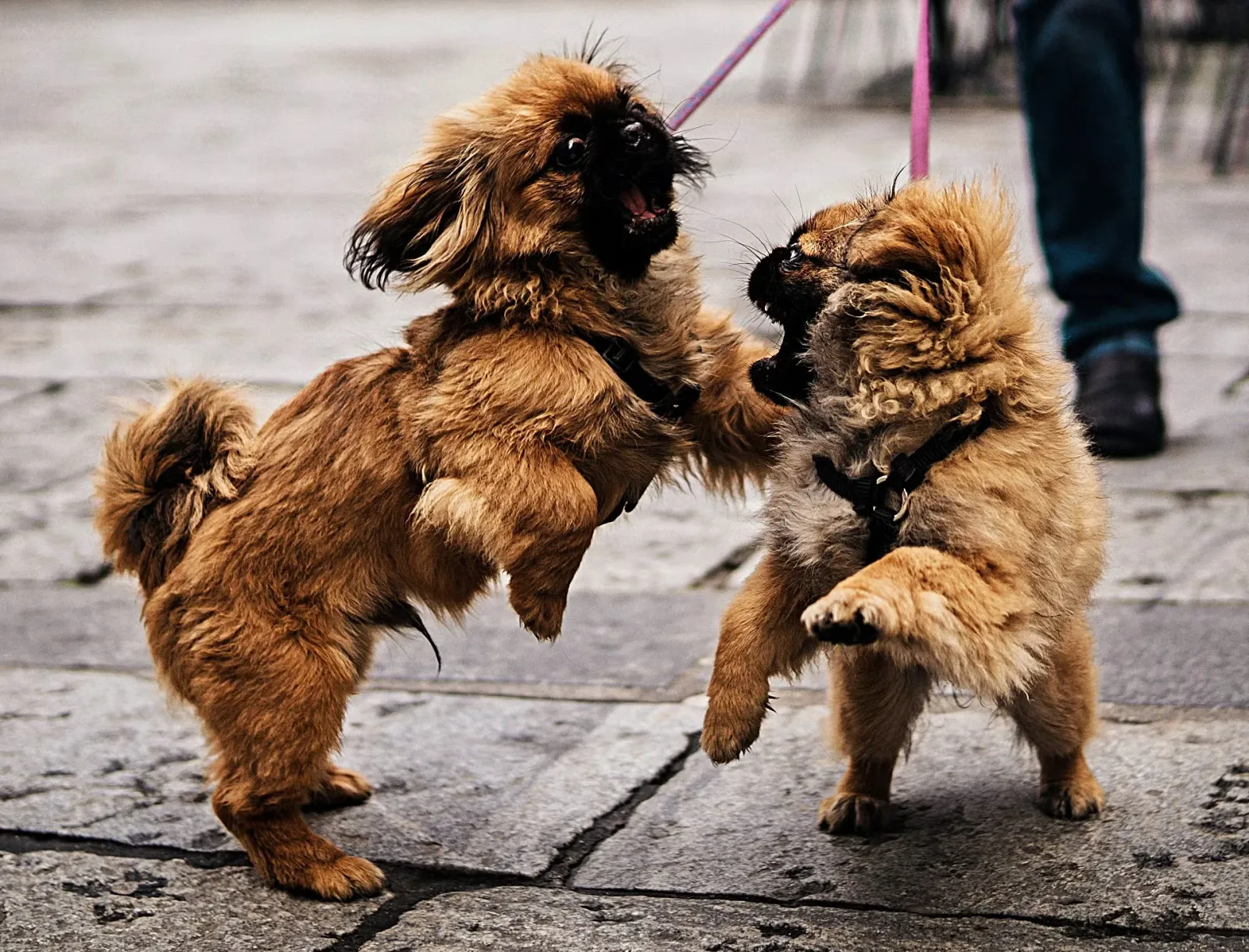
Even a brother/sister combo like these two can go from play-fighting to actual fighting in high arousal situations like going on a walk.
Photo by Collins Lesulie on Unsplash/PhotoScape
High Arousal Levels
As mentioned, social boundaries can sometimes be blurred by events. For instance, if both dogs haven't seen the owner for a long time, the lower-ranking dog may not defer to the higher-ranking dog's wish to greet the owner first because it is too excited, or it might feel safe knowing the owner will protect it.
When over-excitement occurs, it often triggers major fights in multi-dog households. Excitement can easily blur social rules and etiquette, sparking a fight. Sometimes, during play, high arousal levels can also lead to a fight.
Territorial Barking
Another example is territorial barking. When two dogs are highly aroused by a trigger seen or heard behind a fence, it can lead to a fight. The fight may be due to redirected aggression from high arousal.
In redirected aggression, highly aroused dogs enter a hyper-vigilant state that triggers reactive responses not seen when they are calm. Because of this, owners of dogs prone to fighting should never physically get between two fighting dogs to separate them.
With high arousal, dogs are in fight mode, and anything between them could trigger a bite, which is not delivered voluntarily.
Changes in the Social Group
A typical scenario affecting social hierarchy occurs when a higher-ranking dog becomes weak or old. A younger dog that has reached social maturity may then ignore the older dog's ritualized displays, leading to a serious fight.
Sometimes, the senior dog may want to give up the top position but cannot defer effectively due to loss of sensory or motor abilities, which can cause severe fights. Because a dog's social group in nature cannot be led by a weak member, fights may sometimes be bloody and even fatal.
Introduce a new dog to your “pack” slowly, and don’t show the newbie an undue amount of attention because it may trigger your dogs.
Introducing a New Dog
Another situation involving social group changes is when a new dog is added. In such cases, adjustments are needed. Fights may occur but can be temporary until an agreement is reached.
How the owner handles the situation can sometimes worsen it. Giving too much attention to the new dog may create more conflicts. If a dog has been away and is reintroduced, problems may arise as the social order needs to be re-established.
At other times, owners may exacerbate dynamics by intervening. Often, owners don't realize they are creating problems by defending a lower-ranking dog. By protecting a lower-ranking dog and correcting a higher-ranking one, the owner escalates the problem.
Alliance Aggression
Dog behavior expert and obedience trainer Stan Rawlinson, known as the "Dog Listener," advises owners not to fuel the fire by feeling bad and "rushing to protect the would-be subordinate from being 'bullied.'"
This can cause problems and potential fights. Nicholas Dodman calls this "alliance aggression" and states it typically occurs when the owner interferes with the establishment of a stable hierarchy.
The "Dominance" Myth
While social hierarchy is seen in multi-dog households, it's important to note that humans are not dogs, so assuming the "alpha role" to earn respect is pointless.
The dominance myth has been debunked, and recent studies suggest that dogs are mostly not status-seeking entities trying to rule the home but opportunists who repeat behaviors that are reinforced.
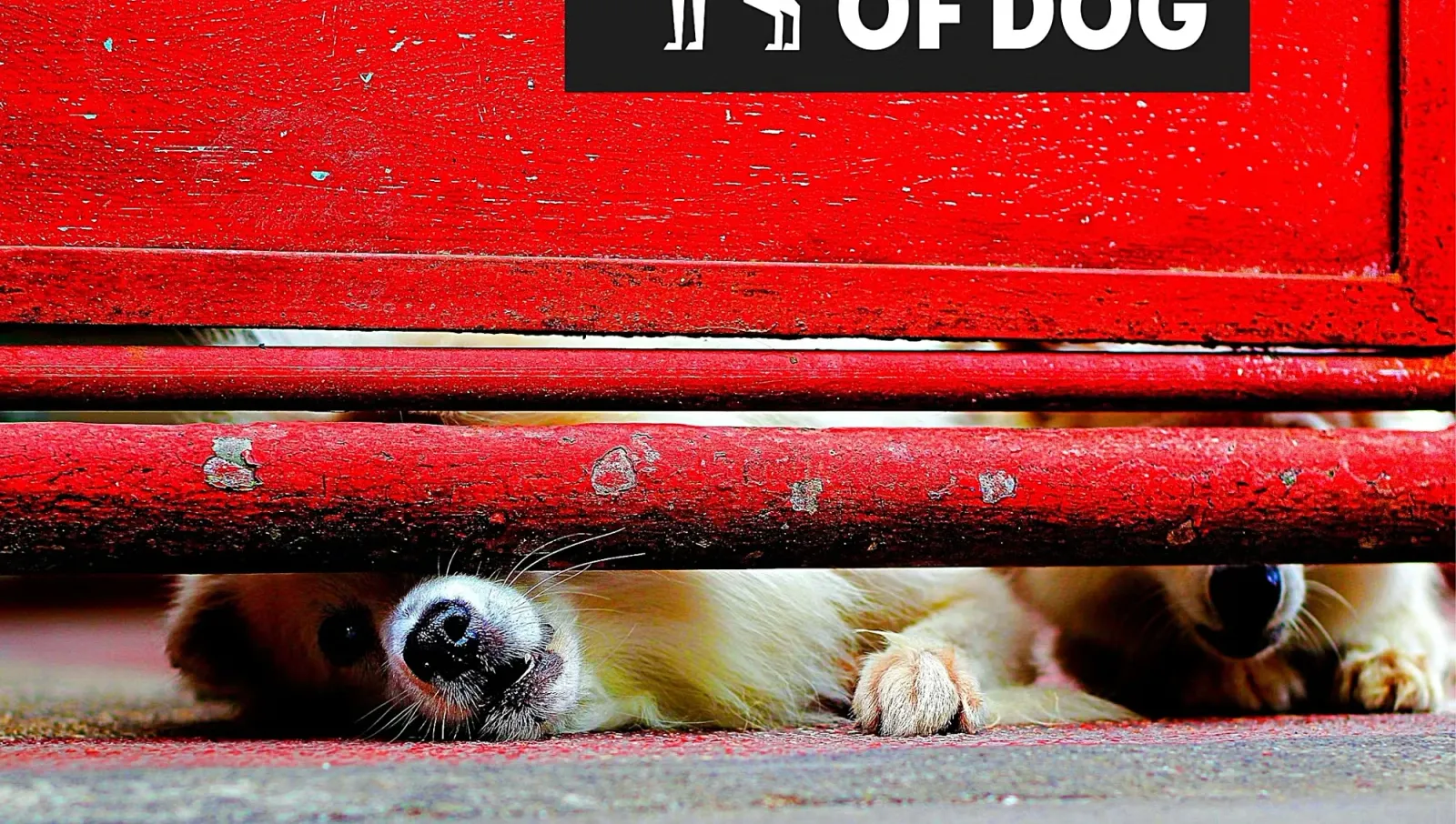
Some dogs fight because they have poor social skills. In fact, some dogs—like the untrained guard dogs here—are rewarded for their poor social skills. You have to decide what you want your dog to be and train them toward that goal.
Photo by Kent Tupas on Unsplash/PhotoScape
Poor Social Skills
Not all dogs have great social skills. A dog that has been poorly socialized may not recognize normal social behaviors. These dogs may feel compelled to attack others for simple things like panting, tail wagging, or sniffing under tails. They are socially illiterate and must learn the basics of normal social language.
While some dogs were socialized as puppies, they often forget the language if inter-dog socialization stops. Some breeds are not naturally social butterflies, and this must be respected. They may never enjoy dog parks, but they should at least tolerate other dogs passing by without acting aggressively.
Trigger Stacking
Sometimes, aggression between two dogs results from a phenomenon called trigger stacking. Essentially, small triggers a dog experiences accumulate over time, causing the dog to sometimes appear as if it "attacked the other dog out of the blue."
For example, imagine Bloom is easily stressed by noises and routine changes, while Maggie is not. On Monday, Bloom endures a thunderstorm, a very scary event, leading to hiding in a closet and trembling. Maggie visits out of curiosity, and Bloom "greets" her with a snarl, showing her teeth.
The next day is little Bob's birthday party (the owner's child), who invited a dozen friends. Bloom spends the day hiding under the couch while Maggie socializes with the kids. The next day, a construction worker stops by to fix a leaky sink. Bloom barks at the worker and hides under the table.
When he leaves, Maggie heads under the table, inviting Bloom to play with a play bow. Bothered, Maggie comes out, and as soon as Maggie rushes up to her hoping to play, she is attacked. Fortunately, the bite was inhibited, causing just a little tooth scrape, but their squabble was loud and scary for the owner to witness.
"Sometimes, inter-pack aggression is the result of a phenomenon called 'trigger stacking,' in which small, sub-threshold triggers add up over time and finally the dog is out of patience for the day … Each trigger causes a reduction in the dog's patience level for the day, and when they all stack up in a short amount of time, the dog has the equivalent of road rage." —Michele Godlevski, ACDBC, CBCC-KA, CC, CPDT-KA
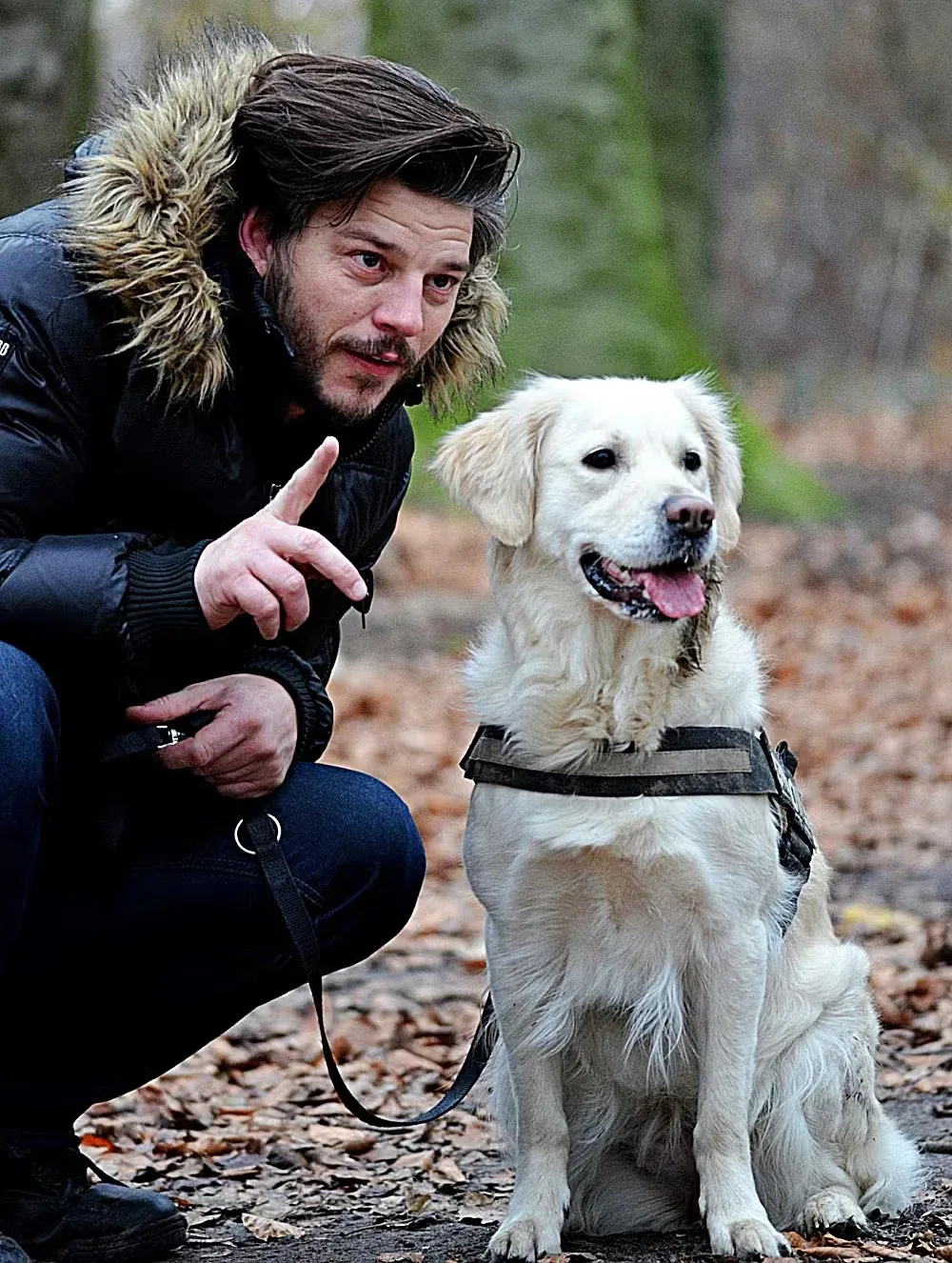
If your dogs are fighting, call a professional who is a reputable dog trainer well-versed in dealing with dog behavioral problems, a veterinary behaviorist, or a certified applied animal behaviorist.
Photo by Pixabay on Pexels/PhotoScape
Why Professional Help Is Needed
As seen, dog fights are serious issues that can worsen if the owner doesn't intervene correctly. Trying to make dogs "sort things out" is not recommended. Many owners attempt to "step aside" only to report weeks later that their dogs got into a dangerous fight costing hundreds in vet bills for stitches.
If your dogs are fighting, call a professional: a reputable dog trainer experienced with behavioral problems, a veterinary behaviorist, or a certified applied animal behaviorist.
A Strong Recommendation
If your dogs are not getting along, make management your top priority and consult a reputable professional. This article is not a substitute for professional advice, as only a professional can advise after assessing your dogs in person. By reading this article, you automatically accept this disclaimer.
Questions & Answers
Question: My dogs get along 95% of the time, and then all of a sudden out of the blue, they start fighting and don't get along. It seems to last a week or so then they will go back to getting along. I have no idea what causes it. What can I do to get them to get along again?
Answer: It would be important finding out what triggers the behavior Although it might not seem like there is a trigger, most likely there is one and work needs to be done based on that. You would need the intervention of a behavior professional for an evaluation and behavior modification.
Question: Two of my dogs have been best friends for five years. In the last four months they have had a few fights which are the likes I have never seen. They have literally tried killing each other. And a bit like you said above on the last two occasions the smaller dog has been to the vets twice where my other dog has cut her badly. I have phoned a couple of professionals but am yet to see one as they are busy at the moment. Is there anything I can do in the meantime that would help?
Answer: Yes, management is your best friend as you wait to see a professional. Basically, keep the dog separated. This may mean in crates or in separate areas of the home where they can't reach each other. Baby gates may be another option. You may need some sturdy ones and put some mesh wire between the gaps to prevent access to each other.
Question: My dogs fight and we stop them, but then one or the other starts it up again. It is getting too hard for me. What can I do?
Answer: You have several options: You can keep them separated all of the time, rehoming one or consulting with a behavior professional. It would be important providing the professional with details on what seems to trigger the fights, in what context they occur and whether there is any history of injuries. The professional can then assess the situations and provide suggestions on what course of action is needed. This is important at a safety level as well considering that, when stopping dogs who are fighting, there are always risks for a redirected bite.
Question: I have a male and a female dog. They are just two-years-old and are also brother and sister. They have suddenly started fighting. What can I do to rectify the situation?
Answer: Dogs can fight for many reasons. Often, they are erupted by some form of resource guarding or access to a resource. It is important determining if these are actual fights or just noisy "discussions" or if they are actually real fights. At this age, both dogs have reached social maturity and disputes are not uncommon. You may need to consult with a dog professional on this one, especially if the fights are real and not just ritualized aggression and there is a risk for tension among the dogs and potential injury.
Question: After a recent loss, which resulted in leaving behind a lonely 6-year- old greyhound, we decided to introduce her to another dog. For the past couple of weeks, they have been playing and have been fine with each other. However, there were two instances when they didn't get along. Why could have caused this?
Answer: There can be many possibilities. It is important to analyze in what context this happened. Was it around toys, food, bones, or a sleeping area? Was one dog resource guarding you? Was it through a doorway or a small space? Did one dog insist on playing while the other wasn't willing? Most of all, was it just a noisy squabble that ended there and nobody got injured? Many dogs living together have small "discussions" which are just part of communication, but you need to keep an eye on these interactions in case they escalate to something more. If both dogs were engaged and there seemed to be a real intent to harm each other, in such a case, it would be best to have a professional evaluate the situation.
Question: My dogs, who used to get along okay, have been breaking out in fights when I am gone. It used to be the females that fought so they are now separated but recently, two of my males have been fighting viciously when I am gone and the weather is bad. Everyone is spayed/neutered. Why are they getting aggressive now after six years of living together?
Answer: This is hard to say as there can be various dynamics going on. Often, dog-to-dog aggression starts becoming apparent as dogs mature, and therefore we see a lot of changes once dogs reach social maturity around the age of 2 to 3 years. However, since you mention these fights take place when the weather is bad, there may be chances that they may be anxious about thunder and this lowers their aggression threshold.
Question: I have a 3-year-old male French bulldog neutered & a 2-year-old bitch, but she's not yet been spayed. They have always gotten along fine, indeed, they often play fight but nothing serious. However, in the past week, the male has attacked my female twice over treats. Why has my dog suddenly started getting aggressive over treats? They get 3 treats a day and they both get exactly the same. I don't understand why he's started to become vicious over it. What can I do to stop my dog's aggressive behavior?
Answer: We may never know exactly why dogs sometimes act this way. All we can do is make some assumptions. Things that come to mind are that in many households, once dogs reach social maturity (anywhere between 12 to 36 months of age) there is a tendency for relationships to shift and for aggressive behavior to raise their ugly head. Other things that come to mind are that maybe there may be something medical going on that may cause increased hunger in your male or perhaps he is not feeling too well which can lower the aggression threshold. Maybe one day when you fed the treats, the dogs were too close to each other and your male felt threatened by your female.
While dogs may get along fine, not many dogs will accept another dog too near to food and valuable treats. Distance is important to ensure everybody is comfortable and relaxed. I suggest giving them more distance when you feed treats so that they don't have to be worried. Even better, give the treats in separate rooms or in crates. Careful, as these episodes tend to repeat and may sometimes happen over toys or other valuables.