What Separates a Show-Grade Siberian Husky from a Pet One?
Parker Lee
Understanding Quality in Siberian Huskies
When people talk about a "quality" Siberian Husky, they mean one that meets the AKC breed standard. That doesn't mean the dog must be a champion or come from champion bloodlines. Many breeders produce excellent Siberians but lack the resources to show them.
Showing dogs is a costly activity that not everyone can manage. So, the absence of a championship title doesn't automatically mean a dog is low quality. To judge your Siberian's quality, you can compare it against the breed standard.
Below are a few examples that highlight how show-quality and pet-quality Siberians can differ.
What are the differences between a Siberian and a quality Siberian?
Joe007 from Pixabay via Canva.com
Siberian Eye Color
At dog shows, I've often overheard spectators ask, "Why doesn't my husky look like that?" The explanation is straightforward: quality.
Many individuals don't research their chosen breed before getting a puppy and instead learn as they go. Also, some people aren't willing to pay the price a responsible, quality breeder charges. They opt for the least expensive dog instead.
Another factor—which I believe is misguided—is eye color. A lot of people insist on a blue-eyed Siberian. In reality, a significant number of quality Siberians have brown eyes or are bi-eyed. Based on my experience and conversations with other handlers, judges tend to favor brown or bi-eyed dogs over blue-eyed ones. Similarly, a quality breeder focuses on temperament, health, and conformation when breeding. Eye color is a low priority.
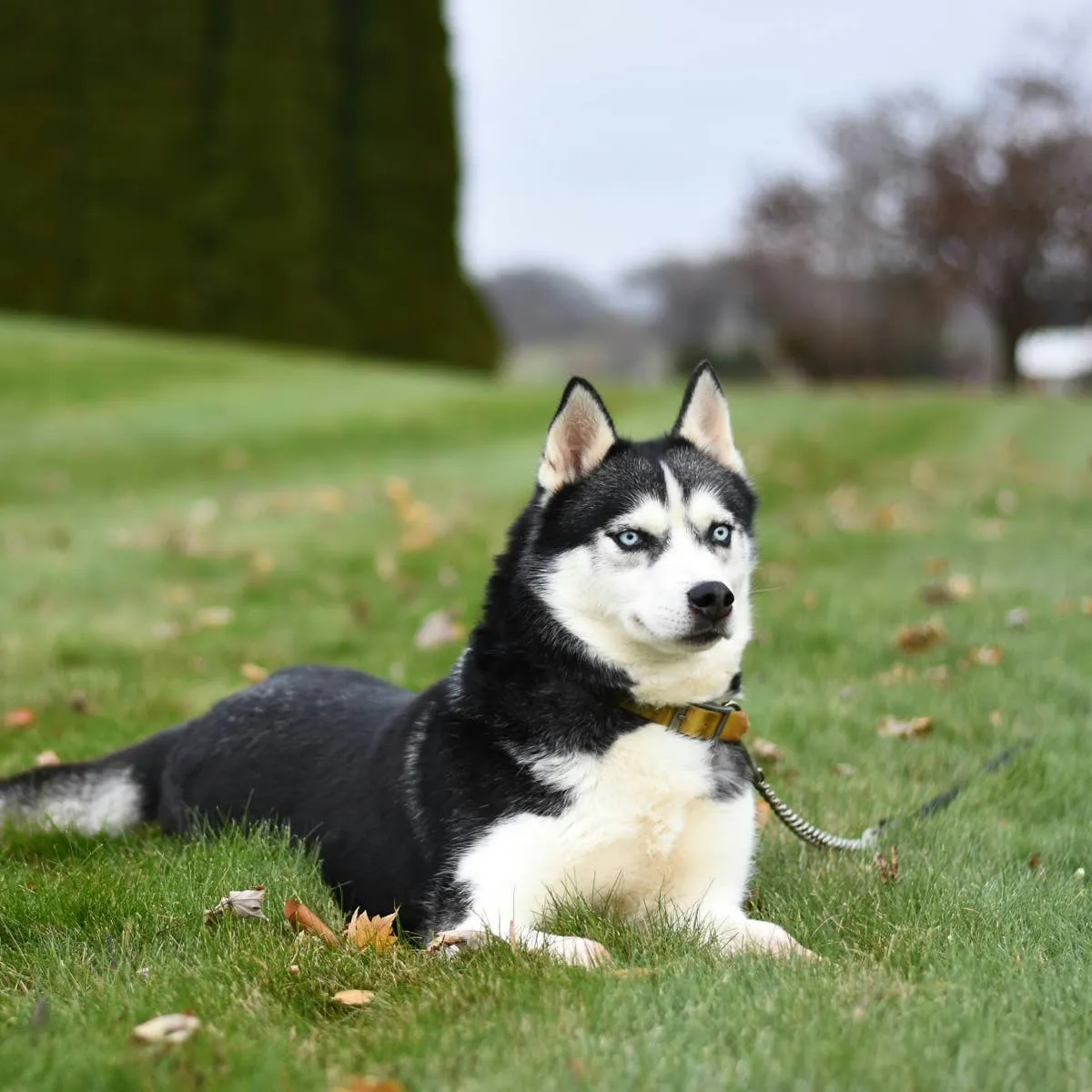
This is Tux, my Siberian, at seven months old, exhibiting correct head, tail, and coat.
General Appearance
Note: The following paragraph, along with every part of the breed standard, is quoted directly from "The Complete Dog Book 20th Edition," an official AKC publication, Siberian Husky, pages 330–334.
The Siberian Husky is a medium-sized working dog, quick and light on his feet and free and graceful in action. His moderately compact and well furred body, erect ears and brush tail suggest his Northern heritage. His characteristic gait is smooth and seemingly effortless. He performs his original function in harness most capably, carrying a light load at a moderate speed over great distances. His body proportions and form reflect this basic balance of power, speed and endurance. The males of the Siberian Husky breed are masculine but never coarse; the bitches are feminine but without weakness of structure. In proper condition, with muscle firm and well developed, the Siberian Husky does not carry excess weight.
Size Really Does Matter!
Size, Proportion, Substance.
- Height: Dogs, 21 to 23½ inches at the withers. Bitches, 20 to 22 inches at the withers.
- Weight: Dogs, 45 to 60 pounds. Bitches, 35 to 50 pounds. Weight is in proportion to height. The measurements mentioned above represent the extreme height and weight limits with no preference given to either extreme. Any appearance of excessive bone or weight should be penalized. In profile, the length of the body from the point of the shoulder to the rear point of the croup is slightly longer than the height of the body from the ground to the top of the withers.
- Disqualification: Dogs over 23½ inches and bitches over 22 inches.
If your Siberian exceeds these height limits, it is not show quality. I've heard people say they want a large Siberian. When I hear that, I often recommend they look for a reputable Malamute breeder, because a responsible Siberian breeder won't breed for oversized dogs.
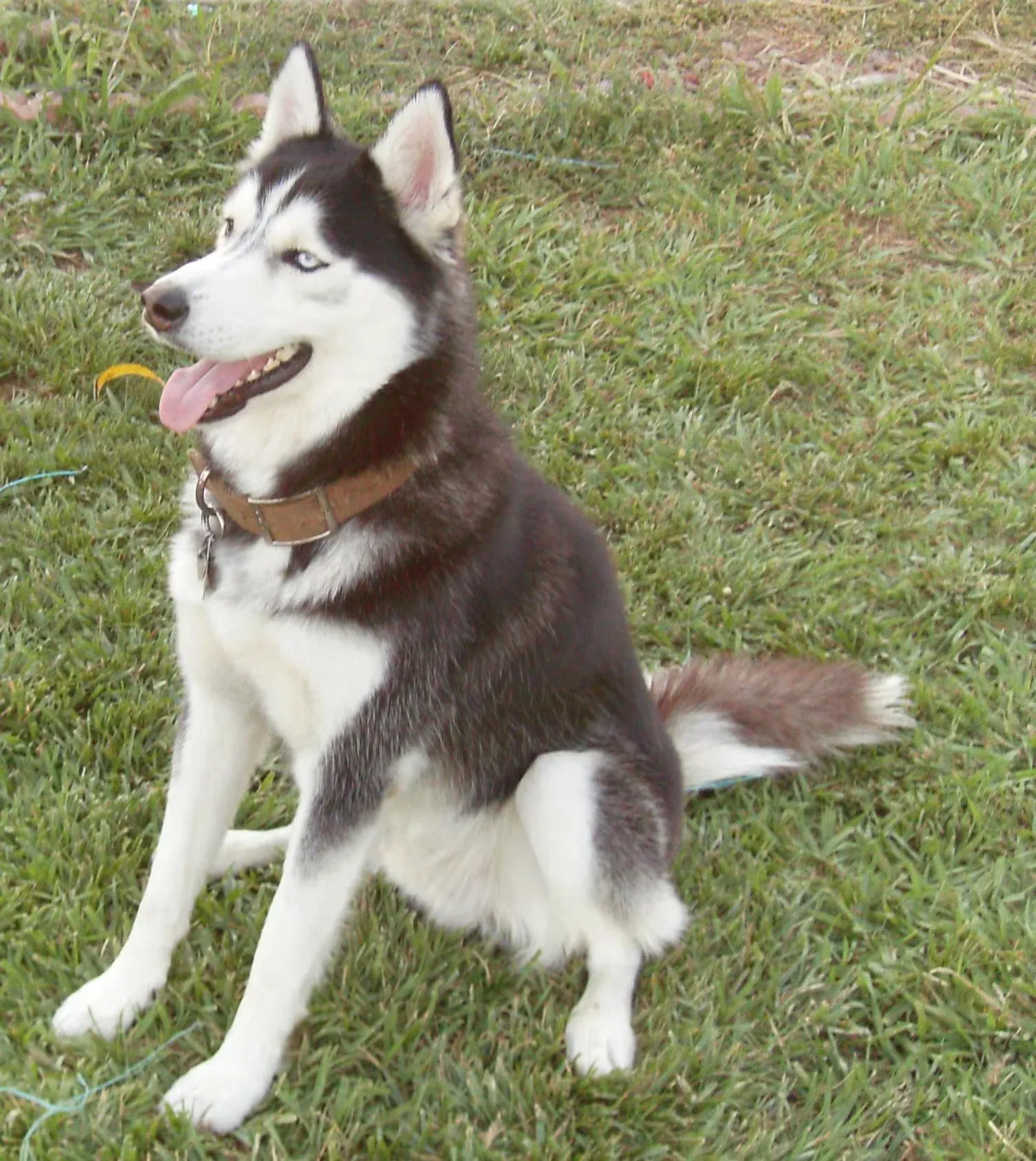
This is a Siberian showing excellent headset.
By Huskyfellaboy, CC, via Wikipedia
The Head
- Expression is keen, but friendly, interested, and even mischievous.
- Eyes are almond shaped, moderately spaced, and set a trifle obliquely. Eyes may be brown or blue in color, one of each, or parti-colored. Faults: Eyes set too obliquely or too close together.
- Ears are of medium size, triangular in shape, close-fitting, and set high on the head. They are thick, well-furred, slightly arched at the back, and strongly erect with slightly rounded tips pointing straight up. Faults: Ears too large in proportion to the head, too wide set, or not strongly erect.
- Skull is of medium size and in proportion to the body, slightly rounded on top, and tapering from the widest point to the eyes. Faults: Head clumsy or heavy or too finely chiseled.
- Stop is well-defined, and the bridge of the nose is straight from the stop to the tip. Fault: Insufficient stop.
- Muzzle is of medium length, that is, the distance from the tip of the nose to the stop is equal to the distance from the stop to the occiput. The muzzle is of medium width, tapering gradually to the nose, with the tip neither pointed nor square. Faults: Muzzle either too snipy or too coarse, too short, or too long.
- Nose is black in gray, tan, or black dogs and liver in copper dogs. May be flesh-colored in pure white dogs. The pink-streaked "snow nose" is acceptable.
- Lips are well pigmented and close-fitting.
- Teeth close in a scissors bite. Fault: Any bite other than scissors.
Some of the most noticeable of these are the ears, stop, muzzle, and teeth.
Featured Gallery
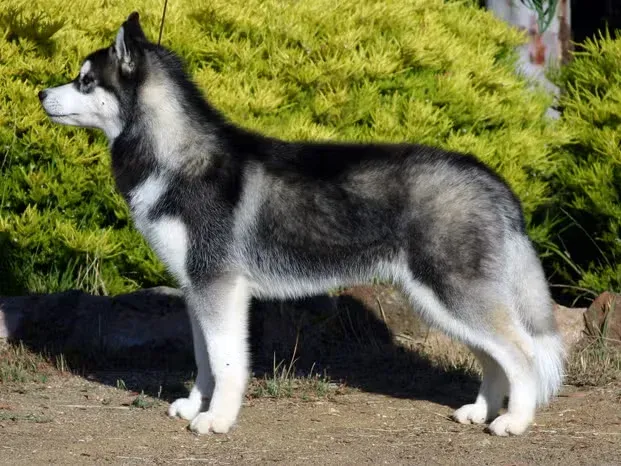
_The “plush” coat of this Siberian adheres to the breed standard.
By Utopialand, CC, via Wikipedia_
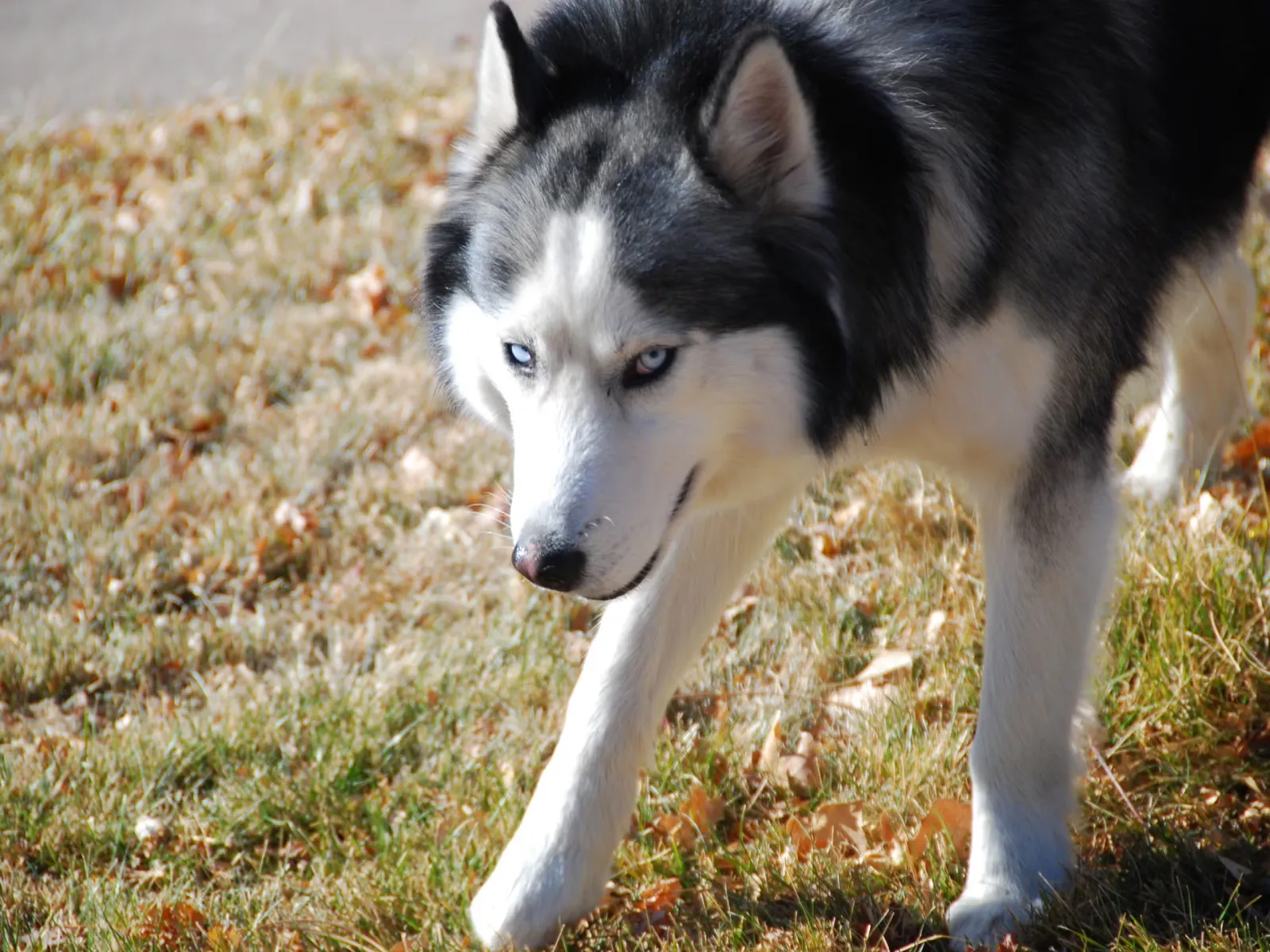
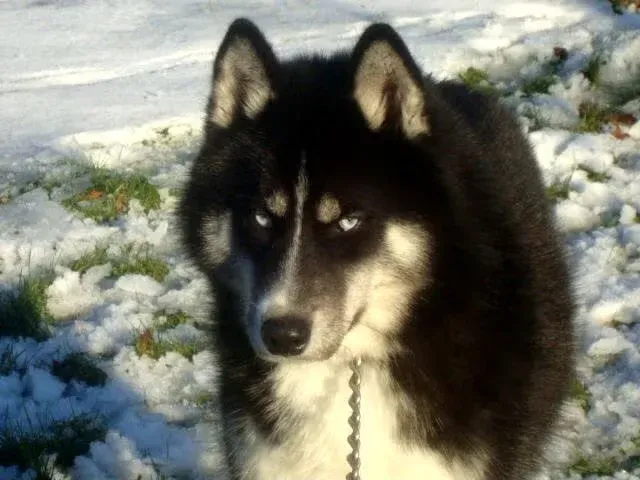
_This is a “wooly” Siberian with a coat length disqualified by the breed standard.
By Jasen Millier, CC, via Flickr_
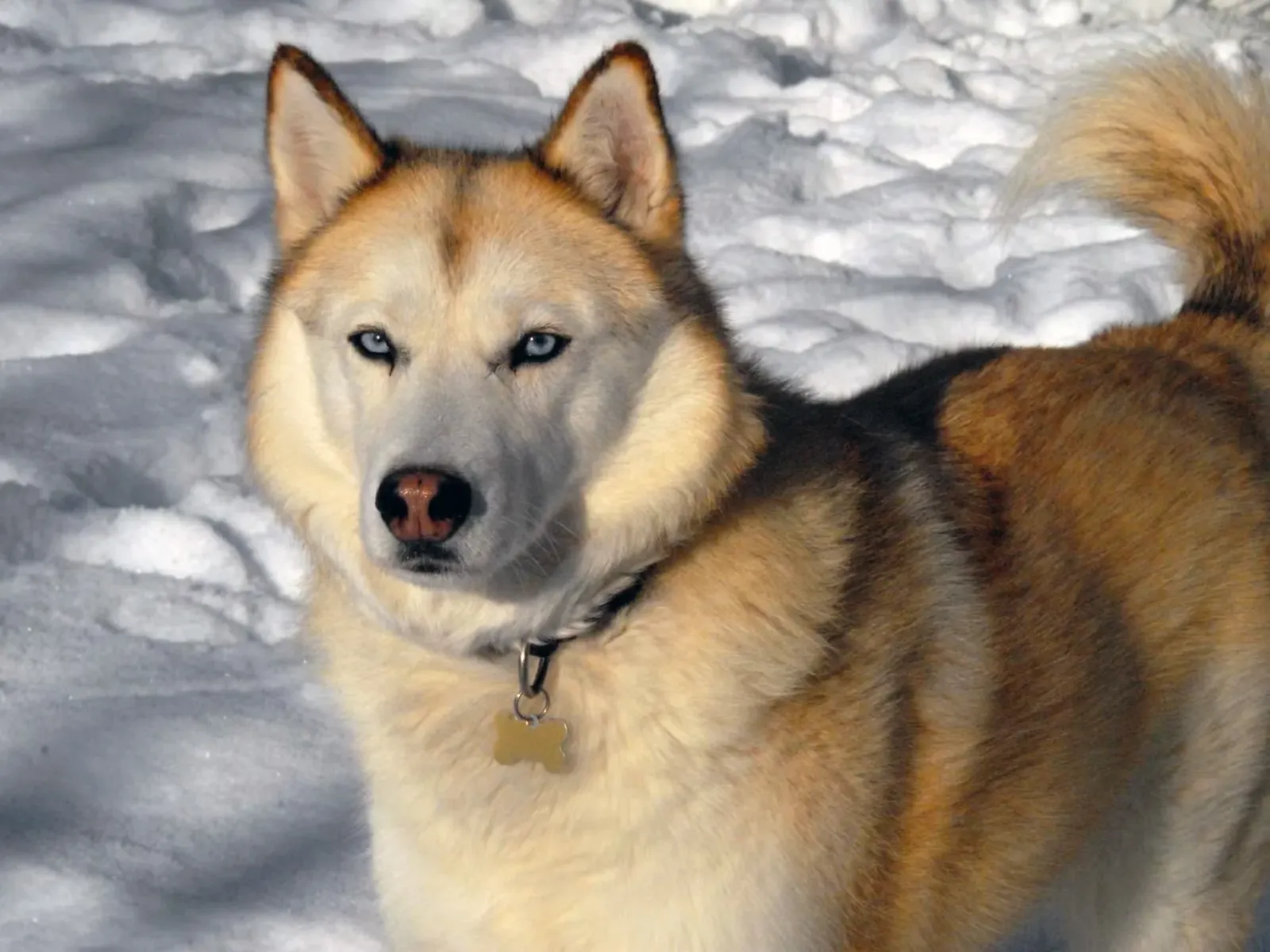
_This is a sable-colored Siberian Husky.
By Sue and Marty, CC, via Wikipedia_
Coat Variations
- Neck is medium in length, arched, and carried proudly erect when the dog is standing. When moving at a trot, the neck is extended so that the head is carried slightly forward. Faults: Neck too short and thick or too long.
- Chest is deep and strong but not too broad, with the deepest point being just behind and level with the elbows. The ribs are well-sprung from the spine but flattened on the sides to allow for freedom of action. Faults: Chest too broad, "barrel ribs," ribs too flat or weak.
- Back is straight and strong, with a level topline from withers to croup. It is of medium length, neither cobby nor slack from excessive length. The loin is taut and lean, narrower than the rib cage, and with a slight tuck-up. The croup slopes away from the spine at an angle but never so steeply as to restrict the rearward thrust of the hind legs. Faults: Weak or slack back, roached back, or sloping topline.
- Tail is well-furred of fox-brush shape is set just below the level of the topline. It is usually carried over the back in a graceful sickle curve when the dog is at attention. When carried up, the tail does not curl to either side of the body, nor does it snap flat against the back. A trailing tail is normal for the dog when in repose. Hair on the tail is of medium length and approximately the same length on top, sides, and bottom, giving the appearance of a round brush. Faults: A snapped or tightly curled tail, a highly plumed tail, or a tail set too low or too high.
- Coat is double and medium in length, giving a well-furred appearance, but is never so long as to obscure the clean-cut outline of the dog. The undercoat is soft, dense, and of sufficient length to support the outer coat. The guard hairs of the outer coat are straight and somewhat smooth lying, never harsh or standing straight off from the body. It should be noted that the absence of the undercoat during the shedding season is normal. Trimming of whiskers and fur between the toes and around the feet to present a neater appearance is permissible. Trimming the fur on any other part of the dog is not to be condoned and should be severely penalized. Faults: Long, rough, or shaggy coat, texture too harsh or too silky, or trimming of the coat, except as permitted above.
Coat Elaboration
The Siberian has three main coat lengths: short, plush, and wooly. Only the plush is breed standard, while wooly and short are not of quality. A wooly-coated Siberian has a much thicker undercoat and much longer hair. This coat type hides the shape of the dog, which is why it is a disqualification. While woolies make adorable pets, they are not quality Siberians.
Forequarters and Hindquarters
- Shoulder blades are well laid-back. The upper arm angles slightly backward from the point of the shoulder to the elbow and is never perpendicular to the ground. The muscles and ligaments holding the shoulder to the rib cage are firm and well-developed. Faults: Straight or loose.
- Forelegs are moderately spaced, parallel, and straight when the dog is standing and viewed from the front, with the elbows close to the body and turned neither in nor out. Viewed from the side, pasterns are slightly slanted, with the pastern joint strong but flexible. Bone is substantial but never heavy. Length of the leg from elbow to ground is slightly more than the distance from the elbow to the top of withers. Dewclaws on forelegs may be removed. Faults: Weak pasterns, too-heavy bone, too narrow, or too wide in the front, or out at the elbows.
- Feet are oval in shape but not long. The paws are medium in size, compact, and well-furred between the toes and pads. The pads are tough and thickly cushioned. The paws neither turn in nor out when the dog is in natural stance. Faults: Soft or splayed toes, paws too large and clumsy, too small and delicate, or toeing in or out.
- Hindquarters are moderately spaced and parallel when the dog is standing and viewed from the rear. The upper thighs are well-muscled and powerful, the stifles well-bent, and the hock joint well-defined and set low to the ground. Dewclaws, if any, are to be removed. Faults: Straight stifles, cow-hocks, too narrow or too wide in the rear.
Gait
The Siberian Husky's characteristic gait is smooth and seemingly effortless. He is quick and light on his feet, and when in the show ring, should be gaited on a loose lead at a moderately fast trot, exhibiting good reach in the forequarters and good drive in the hindquarters.
When viewed from the front to rear while moving at a walk, the Siberian Husky does not single-track, but as the speed increases, the legs gradually angle inward until the pads are falling on a line directly under the longitudinal center of the body. As the pad marks converge, the forelegs and hind legs are carried straightforward, with neither elbows nor stifles turned in or out. Each hind leg moves in the path of the foreleg on the same side. While the dog is gaiting, the topline remains firm and level.
Faults: Short, prancing, or choppy gait; lumbering or rolling gait; crossing or crabbing.
Temperament
The characteristic temperament of the Siberian Husky is friendly and gentle but also alert and outgoing. He does not display the possessive qualities of the guard dog, nor is he overly suspicious of strangers or aggressive with other dogs. Some measure of reserve and dignity may be expected in the mature dog. His intelligence, tractability, and eager disposition make him an agreeable companion and willing worker.
Color
All colors from black to pure white are allowed. A variety of markings on the head is common, including many striking patterns not found in other breeds. There is no disqualification for color, so long as it is not that of another breed (i.e., the dog is a mix).
Featured Gallery
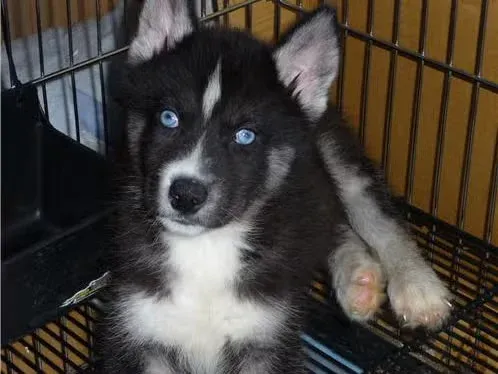
This is Tux at eight weeks of age, just before picking him up from his breeder. He is showing correct movement, headset, tail set, and build.
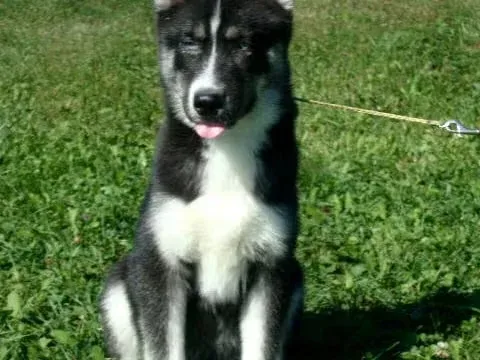
This is Tux at four months of age. His ears and legs have outgrown him, and his adult coat has not come in yet.
When Show Quality Is Evident
Another comment I hear is, "My puppy had show potential when I picked him up, and his parents are show-quality. He carries champion lines. But now he's roughly four months of age and doesn't look like he will be of breed quality. Why is this?"
Not only is this a frequently asked question, but I've gone through this myself.
Siberian puppies exhibiting show potential as a pup are likely to keep that potential as an adult. However, Siberians do go through an awkward growing stage between 3–5 months of age. Their ears out-grow their body, as do their legs. Also, they have not grown their adult coat in and have the short puppy coat with them still. They will normally appear "lanky" because they have not developed their muscles fully. Above are a few pictures of Tux, a show-quality male that I own. At the top of this article, you can see that Tux grew back into his true show-quality nature.
The Siberian Husky Is a Strong and Elegant Dog
The most important breed characteristics of the Siberian Husky are medium size, moderate bone, well-balanced proportions, ease and freedom of movement, proper coat, pleasing head and ears, correct tail, and good disposition. Any appearance of excessive bone or weight, constricted or clumsy gait, or long, rough coat should be penalized.
The Siberian Husky never appears so heavy or coarse as to suggest a freighting animal, nor is he so light and fragile as to suggest a sprint-racing animal. In both sexes, the Siberian Husky gives the appearance of being capable of great endurance. In addition to the faults already noted, the obvious structural faults common to all breeds are as undesirable in the Siberian Husky as in any other breed, even though they are not specifically mentioned herein.
© 2009 Cowgirl0216